Reactive Strength Index Calculator
Estimate drop-jump RSI, RSI-mod, flight time, contact quality, asymmetry flags, and plyometric readiness from simple jump testing inputs.
📌Presets
Presets load realistic field-test profiles for drop jumps, repeated hops, and countermovement jump RSI-mod checks.
⚙Calculator
Reactive strength profile
Enter jump height and timing data to estimate RSI and readiness.
📊Reactive Metrics
📑Reference Tables
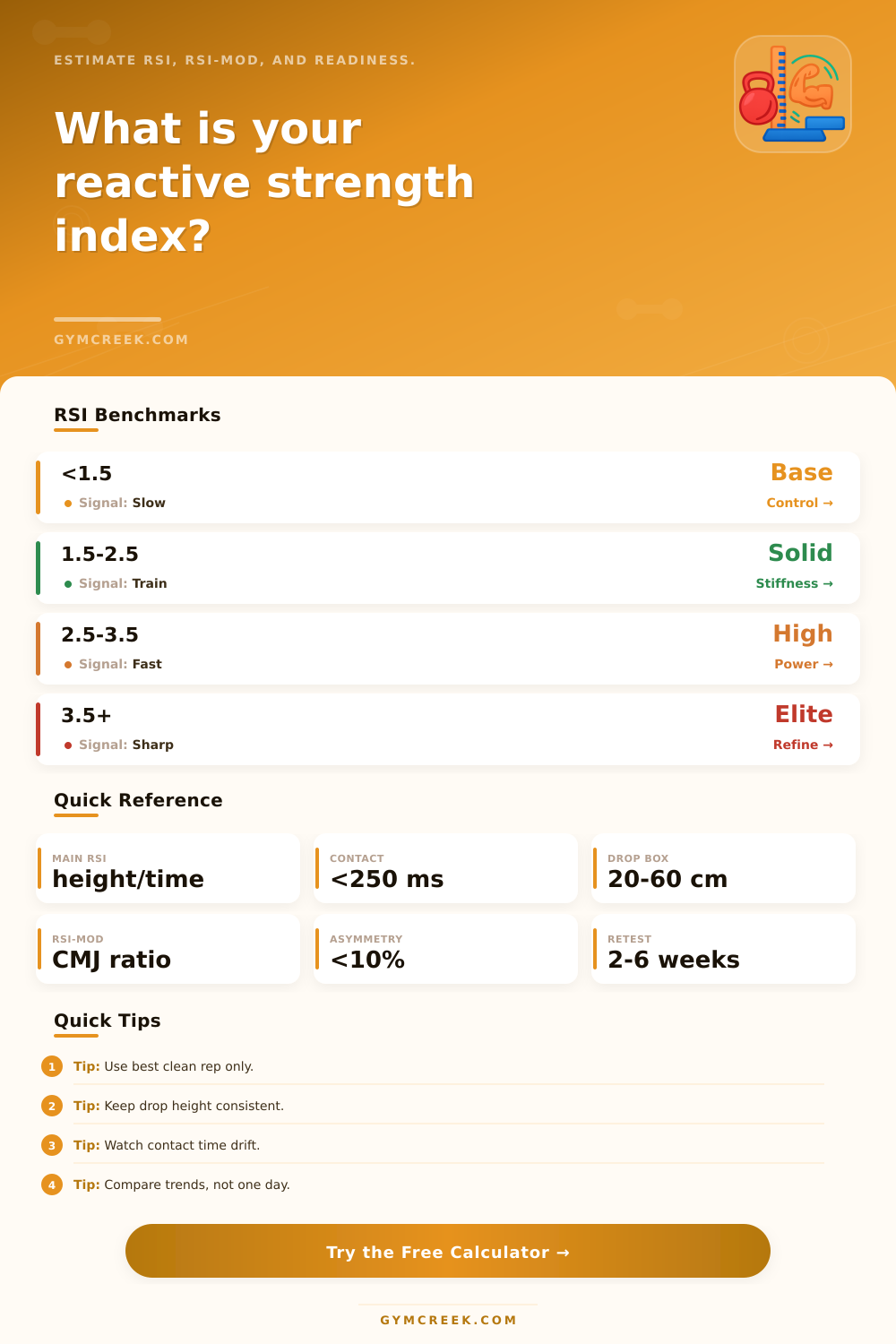
| RSI | Band | Typical Signal | Training Focus |
|---|---|---|---|
| <1.50 | Base | Slow contact | Landing control |
| 1.50-2.49 | Solid | Trainable | Stiffness |
| 2.50-3.49 | High | Fast rebound | Elastic power |
| 3.50+ | Elite | Very reactive | Maintain speed |
| Test | Key Time | Useful Range | Best Use |
|---|---|---|---|
| Drop jump | Contact | 120-300 ms | RSI |
| Depth jump | Contact | 150-350 ms | Power |
| Repeated hop | Contact | 100-250 ms | Elasticity |
| CMJ | Takeoff | 350-900 ms | RSI-mod |
| Flag | Green | Caution | Action |
|---|---|---|---|
| Asymmetry | <10% | 10-15% | Retest |
| Fatigue loss | <10% | 10-20% | Reduce |
| Contact time | <250 ms | 250-350 ms | Monitor |
| Drop height | 20-60 cm | Too high | Lower box |
| Formula | Variables | Output | Use |
|---|---|---|---|
| RSI | height/time | m/s | Drop jump |
| RSI-mod | height/TTO | m/s | CMJ |
| Flight time | height | seconds | Estimate |
| Asymmetry | L vs R | percent | Screen |
💡Tips
The stretch shortening cycle is an process that occurs within the muscles and tendons of the body, and the stretch shortening cycle allow for the muscles and tendons to absorb energy and then release that energy. When an individual’s muscles and tendons is absorbing energy and releasing energy, the muscles and tendons are acting as a spring. If an individual has a poor spring mechanism, they will spend too much time in contact with a ground; the longer that an individual is in contact with the ground, the less momentum that they will have.
The reactive strength index (RSI) is a measurement of the spring quality that an individual has. Considering the relationship between an individual’s jump height and there contact time with the ground calculates the reactive strength index. If an individual can jump high with short contact times with the ground, there RSI will be high.
What is the Reactive Strength Index?
A high RSI indicate that the individual has an efficient nervous system and stiff tendons that can handle the load. If the individual can jump high but has a long contact time with the ground, they are not acting like a spring but rather a slow piston. One of the tests that can be used to calculate the reactive strength index is the drop jump test.
The drop jump is considered to be a gold standard in measuring the reactive strength index (RSI) of an individual. During a drop jump test, an individual must step off of a box and jump into an upward rebound. The height of the box that an individual steps off of is an important measurement during a drop jump test; if the box is too high, the individual may collapse under their body weight; the longer that an individual is in contact with the ground (due to collapsing), the lower their RSI score will be.
If the box is too low, the body will not be challenged enough for the drop jump test to be effective. A measurement known as the RSI-mod exist as an alternative to the drop jump test for those who do not have access to a box or force plate to even perform the jump test. The RSI-mod uses a countermovement jump instead of a drop jump; it measures the time for an individual to move from the bottom of a dip to takeoff.
Those who do not have access to a box or force plate can perform this alternative test. Based off the reactive strength index test, an individual’s score can be categorized into different group that indicate the physical state of that individual. If the reactive strength index fall within the base or solid categories, the individual should focus upon landings and stiffness of the tendons.
An individual should have stable ankles and knees to produce reactivity; these joint must be able to stabilize any load placed upon them. If an individual falls into the high or elite categories in relation to their reactive strength index (RSI) score, the individual should focus upon increasing there reactivity to increase their speed. For these categories, even a few millisecond in contact time with the ground can make a difference in an individual’s performance.
Additionally, any asymmetry between the left and right side of the body could indicate a potential for injury. Any asymmetry in performance between the left and right sides of the body indicates that any load placed upon one side of the body will be shifted toward the stronger side; this place excessive load upon the stronger side of the body. Fatigue can have a negative impact upon an individual’s reactive strength index, as fatigue negative impacts the central nervous system.
If an individual’s jump height or jump velocity decline significantly during an individual’s training session, this indicates that their central nervous system is fatigued. By monitoring the percentage of loss of performance of an individual’s jump training session, an individual can determine when to stop training for the day. Training a fatigued nervous system is not effective, and can lead to an individual becoming slower with time.
The equipment that is used to measure an individual’s reactive strength index will also have an impact upon the accuracy of the data. A professional force platform will provide very accurately data, but video apps and jump mats can also be used to track the performance of an individual. The goal for any of this equipment is to recognize whether or not an individual’s reactive strength index is moving in a positive direction.
Reactive strength index data indicate whether or not an individual is becoming a more efficient spring. If an individual’s contact time with the ground is decreasing while their jump height remain the same, the individual is becoming a more efficient spring. By knowing an individual’s reactive strength index, an individual can go from guessing their physical trait to measuring those traits.
Furthermore, by knowing the reactive strength index of an individual, that individual can train a measurable trait.