Reaction Time Calculator
Convert your reaction trials into a corrected score, consistency grade, sport benchmark, and start advantage estimate.
📌Presets
Each preset loads realistic trial values for a different reaction task, then recalculates the output.
⚙Calculator
Reaction snapshot
Enter trial data to score your reaction quality.
📊Metrics Comparison Grid
🎯Your Current Comparison
📑Reference Tables
| Reaction Type | Elite | Strong | Average |
|---|---|---|---|
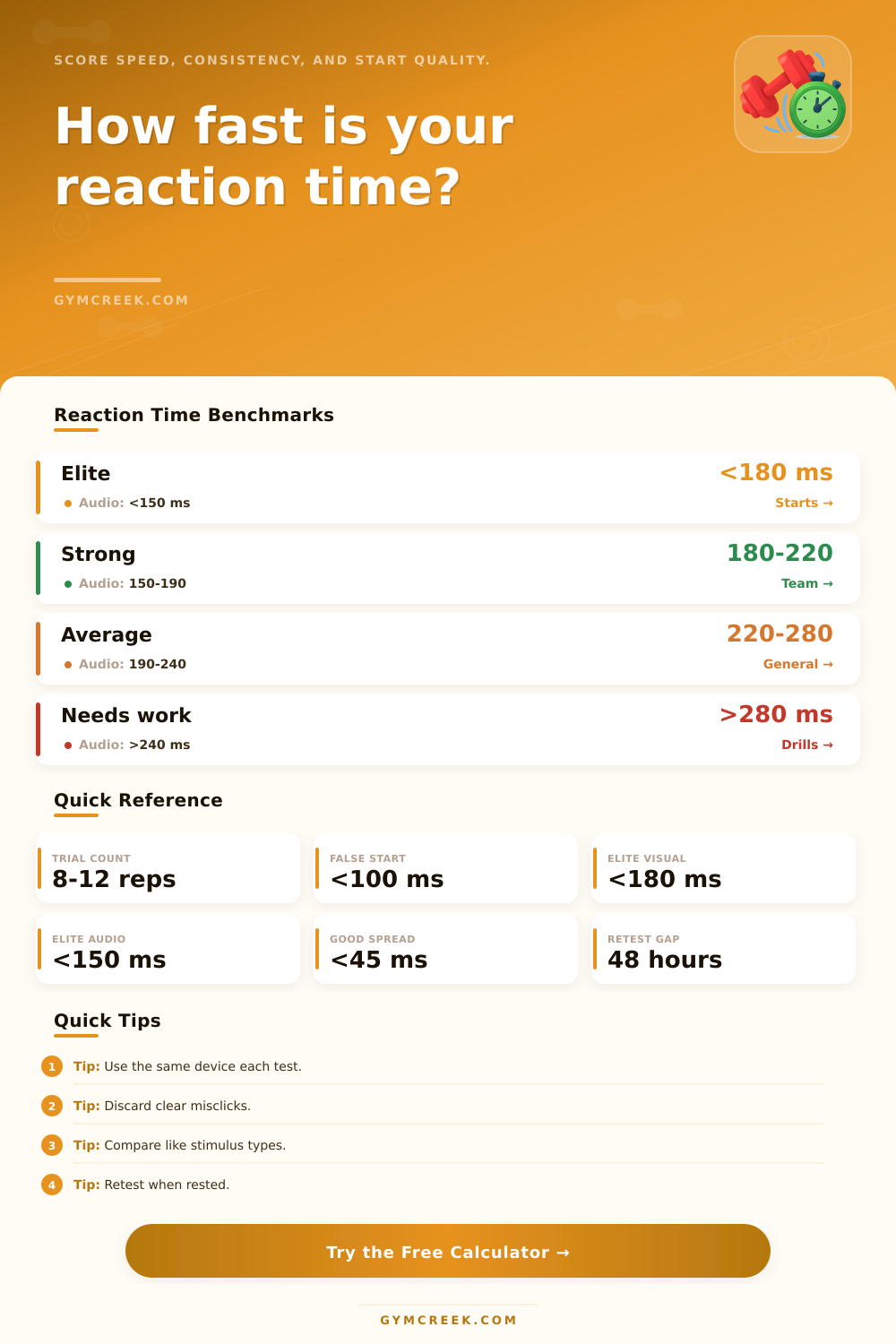
| Visual simple | <180 ms | 180-220 ms | 220-280 ms |
| Audio simple | <150 ms | 150-190 ms | 190-240 ms |
| Tactile simple | <160 ms | 160-200 ms | 200-250 ms |
| Choice reaction | <260 ms | 260-330 ms | 330-420 ms |
| Sport Context | Main Cue | Method | Key Metric |
|---|---|---|---|
| Track start | Audio | Whole body | Legal speed |
| Keeper save | Visual | Hands/body | Read delay |
| Tennis return | Visual | Feet/racket | Choice speed |
| Esports aim | Visual | Mouse click | Click latency |
| Trial Pattern | Meaning | Action | Retest |
|---|---|---|---|
| Best near avg | Stable | Progress load | Weekly |
| Wide spread | Variable | Add reps | 48 hours |
| Many false | Guessing | Slow setup | Same day |
| Slow late reps | Fatigue | Rest longer | Rested |
| Input | Formula Role | Correction | Output |
|---|---|---|---|
| Average ms | Base score | Primary | Speed tier |
| False starts | Reliability | Penalty | Valid score |
| Spread | Consistency | Stability | Grade |
| Sleep/fatigue | Readiness | Flag | Error band |
💡Tips
“I’m sitting there in the blocks with my muscles coiling. I know when they hear something, but right now they’re hearing nothing. Sometimes it makes all the difference: a fraction of a second can be gap between coming in first or fourth, so small you don’t even notice it. But it is there; you can train those milliseconds until you can notice them. You can react faster, yes, but that’s only part of it. It’s reacting under pressure, being able to process information cleanly (and that’s what reaction time are). Everybody thinks the quicker the better, but it’s not quite like that. Speed counts, sure, but consistency does too, because somebody who will react in a hundred and fifty milliseconds some times, and three hundred others, isn’t nearly as good than somebody who’s consistent at two hundred.”
So what does all of this have to do with fishing? It’s simple. Instead of just giving you your best shot, the calculator on this page will look at your whole dataset and help you find what is useful. Inputting your trial data will take into account things that frequently goes overlooked such as lack of sleep, fatigue levels etc. That may sound trivial, but if you got 7 hours of sleep instead of 9, that could make enough difference to move you up (or down) an entire performance tier in terms of reaction time.
What Is Reaction Time and Why Does It Matter?
You input your best, average and slowest valid trials; then the system calculates a “spread” score. The spread score tell you how dialed in or scattered your nervous system is. If you’ve got a tight spread, you’re consistently replicating your best effort. If you’ve got a wide spread, you’re either guessing or lacking focus.
The benchmarks change considerably based off context. Different sports require different kind of reaction. Visual cues, such as a goalkeeper in soccer reading the hips of a striker, are inherently slower then auditory ones like the sound of the start pistol in a sprint race. To account for this, the calculator lets you specify both your sport and the type of stimulus being presented. For example, a brake response in driving isn’t comparable to a return in tennis. The cognitive load involved differ. One is a simple go/no go decision whereas the other involve processing trajectory and spatial position. Having the categories separated ensures that we don’t judge ourselves against unreasonable standards. The reference tables provided with the tool break it down by category so you can see what elite looks like within each specific context.
People often get obsessed with lowering their number at the expense of accuracy. Clicking before the cue flashes? That’s not showing off quick reflexes, that’s showing off how willing you are to guess. If you anticipate in less than one hundred milliseconds, it is usualy just a false start. And since it degrades the reliablity of your score, the calculator penalizes this error. A flashier best time constructed on lucky guesses isn’t better than having an honest average (but maybe slightly slower). This correction makes you value speed as well as precision… Just like in real-life competitive sports.
Controlled conditions are necessary for patient training of reaction time. Test on the same device and in the same environment, ideally at the same time of day. Changes in screen brightness or lighting can adds variability that hides true gains. Are your scores jumpy from week to week? Check your sleep and fatigue inputs before you assume your training regimen didn’t work out. The body is sometimes just too fatigued to send clear signals. A 48-hour rest period between heavy testing day tends to produce more consistent results than pushing through fatigue.
In short, your reaction time is a reflection of your readiness. It shows your focus, sleep quality, and how primed your nervous system are. And when you begin to view these metrics as measures of health rather than just performance stats, you begin to understand yourself better. You begin to make smarter decisions because you realize that split-second difference is subtle. If you’re looking to be sharp in your vehicle or if you’re an elite athlete, this give you the ability to build a more consistent, reliable response pattern. That is where the real advantage exists.