Rate of Force Development Calculator
Estimate force-time slope, early-window output, relative RFD, impulse, and explosive strength from a simple force test.
📌Presets
Each preset loads a force-time profile and recalculates the slope, impulse, and explosive strength score.
⚙Calculator
Force-time snapshot
Enter force and timing values to estimate explosive output.
📊Explosive Metrics
📑Reference Tables
| Test | Main Output | Useful Window | Best Comparison |
|---|---|---|---|
| Isometric mid-thigh pull | Peak force and RFD | 100-250 ms | Same pull height and posture |
| Countermovement jump | Net force rise | 50-200 ms | Same jump strategy |
| Squat jump | Concentric force slope | 100-300 ms | Same starting depth |
| Sprint start | Early horizontal force | 50-150 ms | Same stance and timing gate |
| Ballistic push-up | Upper body impulse | 75-200 ms | Same hand spacing |
| RFD Zone | Average RFD | Relative RFD | Interpretation |
|---|---|---|---|
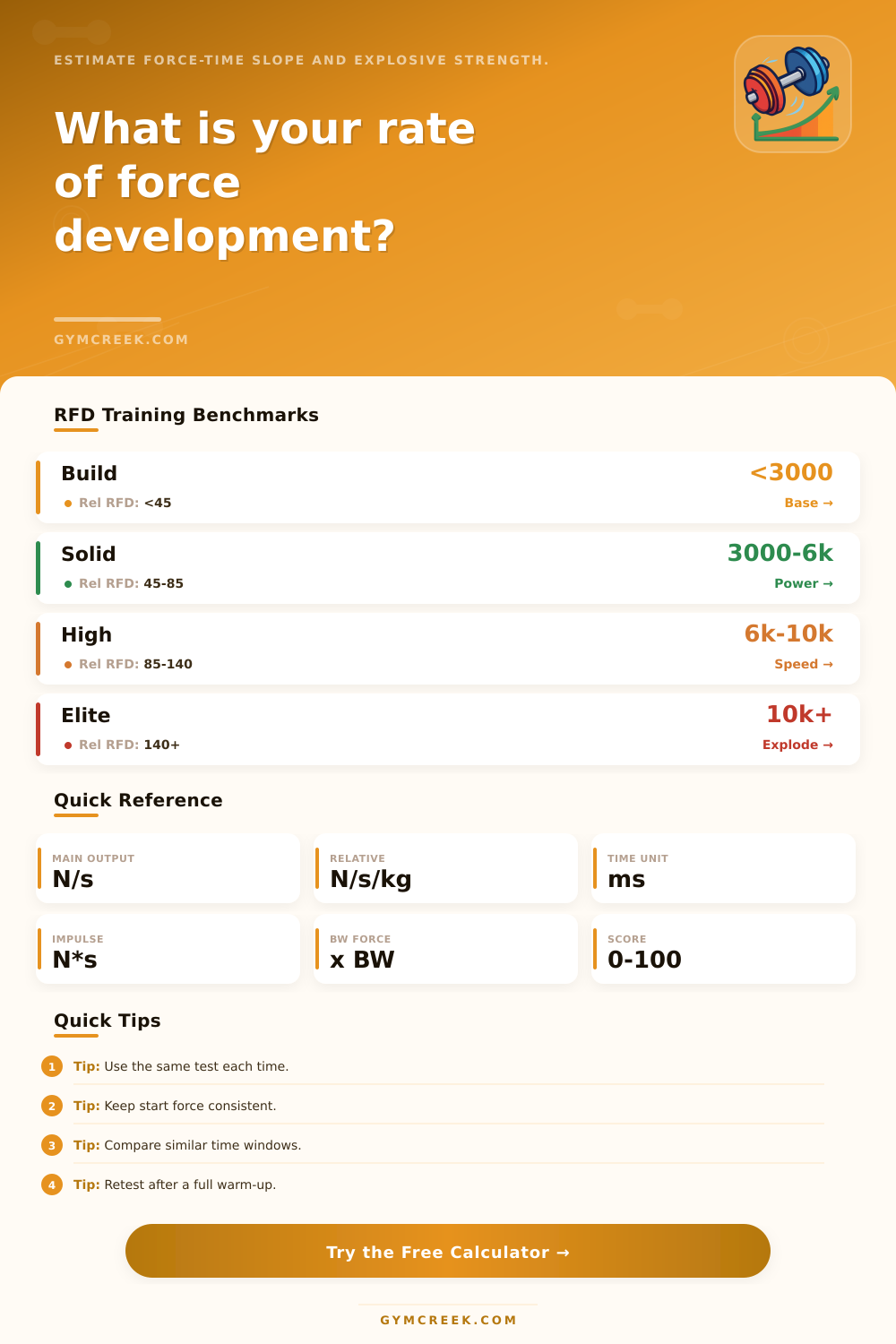
| Base | Below 3,000 N/s | Below 45 N/s/kg | Build force capacity and timing |
| Developing | 3,000-6,000 N/s | 45-85 N/s/kg | Useful for general power training |
| High | 6,000-10,000 N/s | 85-140 N/s/kg | Strong explosive profile |
| Elite | Above 10,000 N/s | Above 140 N/s/kg | Very fast force expression |
| Time Window | What It Shows | Common Use | Watch For |
|---|---|---|---|
| 0-50 ms | Very early force | Sprint starts and reflexive output | Noise and trigger error |
| 0-100 ms | Early explosive strength | Team power monitoring | Start threshold consistency |
| 0-200 ms | Practical sport force | Jumps, pulls, and contact tasks | Strategy changes |
| Peak time | Full force slope | General RFD estimate | Longer times lower slope |
| Formula | Variables | Output | Use |
|---|---|---|---|
| Average RFD | Delta force / time | N/s | Overall force-time slope |
| Relative RFD | RFD / body mass | N/s/kg | Body-size comparison |
| Impulse estimate | Mean net force x time | N*s | Action output estimate |
| Force multiple | Peak force / body weight | x BW | Force capacity context |
💡Tips
A starting block explodes with a sudden, sharp sound. And then, in that fraction-of-a-second pause before anything move, victory and defeat is determined, not by maximum strength or speed, but instead by how instantly that strength is applied to the earth. That’s what we call rate of force development, or RFD.
For athletes whose task is to go fast, not merely heave great weights around, it’s something of great importance. You may bench press like a beast, but if it takes you a half-second to do so, your competition has run ten yards downfield while you were still sitting up. The physics of that pace are straightforward enough, though not always easy to execute.
What Is Rate of Force Development?
A tool for dividing force into time spares you having to guess at your own power profile. Imagine RFD as a graph with time on one axis and force on another. As time increases, force increase. How steep is that line? That’s how explosive you are. If your RFD is bad and your maximal strength is good, you’ve got a flat line that takes awhile to curve upward. So you’re slow to react, but once you do you can be strong. Good RFD and solid strength mean someone gets near-max force numbers immediately. This is what coaches are trying to get after because sports don’t usually involve running at a steady pace for minutes on end. They consist of bursts.
The calculator above does all the math for you. It plugs in your raw timing and force information and spits out a clear picture of what your line look like and where you sit compared to everyone else. To understand what’s happening, you need to have steady inputs. That means body weight. Heavier athletes must produce more total force than lighter ones to achieve the same acceleration. Hence, there is a need for relative RFD. It normalizes the data so both a sprinter and a heavyweight lineman can be evaluated based off their explosive merits in spite of total mass.
Then you must know where your starting point is. Is this a measurement from zero force, or are we taking into consideration the tension that exists prior to starting movement? Knowing this will change size of difference significantly. Your time-to-peak may become shorter when measured from a pre-loaded state. Failure to account for this would falsely inflate your RFD.
The only way to track progress is consistency Whether it’s a countermovement jump or an isometric mid-thigh pull, repeat your testing in the exact same way every time. You can look at that on the page where I’ve categorized the performance zones and laid out the reference table for it. That will show you if your snap is at a base level or even reaches an elite level.
Another nuance are in the timing windows. Early RFD (often considered in the first hundred milliseconds) reflects your ability to recruit fast-twitch fibers and the neural drive component. Later windows reflect whether you can sustain that force under changing conditions like building momentum or fatiguing muscles. The wider the window, the more it smoothes out the noise; yet also blurs that initial spark. Narrowing the window captures the spark but makes it susceptible to small changes in the timing of the trigger. It is a choice between precision and relevance.
You need a window that aligns with what your sport requires. In sprinting, they care about the first fifty milliseconds. Maybe weightlifting cares more about the entire concentric phase. Don’t focus so much on having a big number. Focus on having a number that relates to how you perform on game day. Don’t make one measurement the sole determiner of what gets trained.
Your RFD will improve as you become able to produce more force and/or do so in less time. Those objectives aren’t always aligned. Going heavier may increase your peak force output but also slow down the movement, which decreases RFD. Lightening the load quickens the pace but maybe doesn’t give you enough total force to work with. Find the sweet spot based off where the limiting factor currently is.
Are you a beast but lack explosive abilities? Work on getting light stuff moving quicker. Are you weak but fast? Lay the foundation first. Follow the trend lines and trust the process. Explosion isn’t all about power. It’s about precision and patience in delivering that power.