Racquetball Calorie Calculator
Estimate calories burned from singles or doubles play, rally pace, court coverage, games played, serve drills, warm-up time, rest ratio, body weight, and MET logic.
📌Presets
Each preset fills a realistic racquetball session profile and recalculates the calorie estimate.
⚙Calculator
Racquetball calorie snapshot
Enter match format, rally pace, court coverage, body weight, and rest time to estimate racquetball calories.
📊Fitness Metrics
🧮Formula Cards
Calories per minute = MET x 3.5 x body weight in kg / 200. The calculator applies it separately to rally work, serve drills, warm-up, and rest.
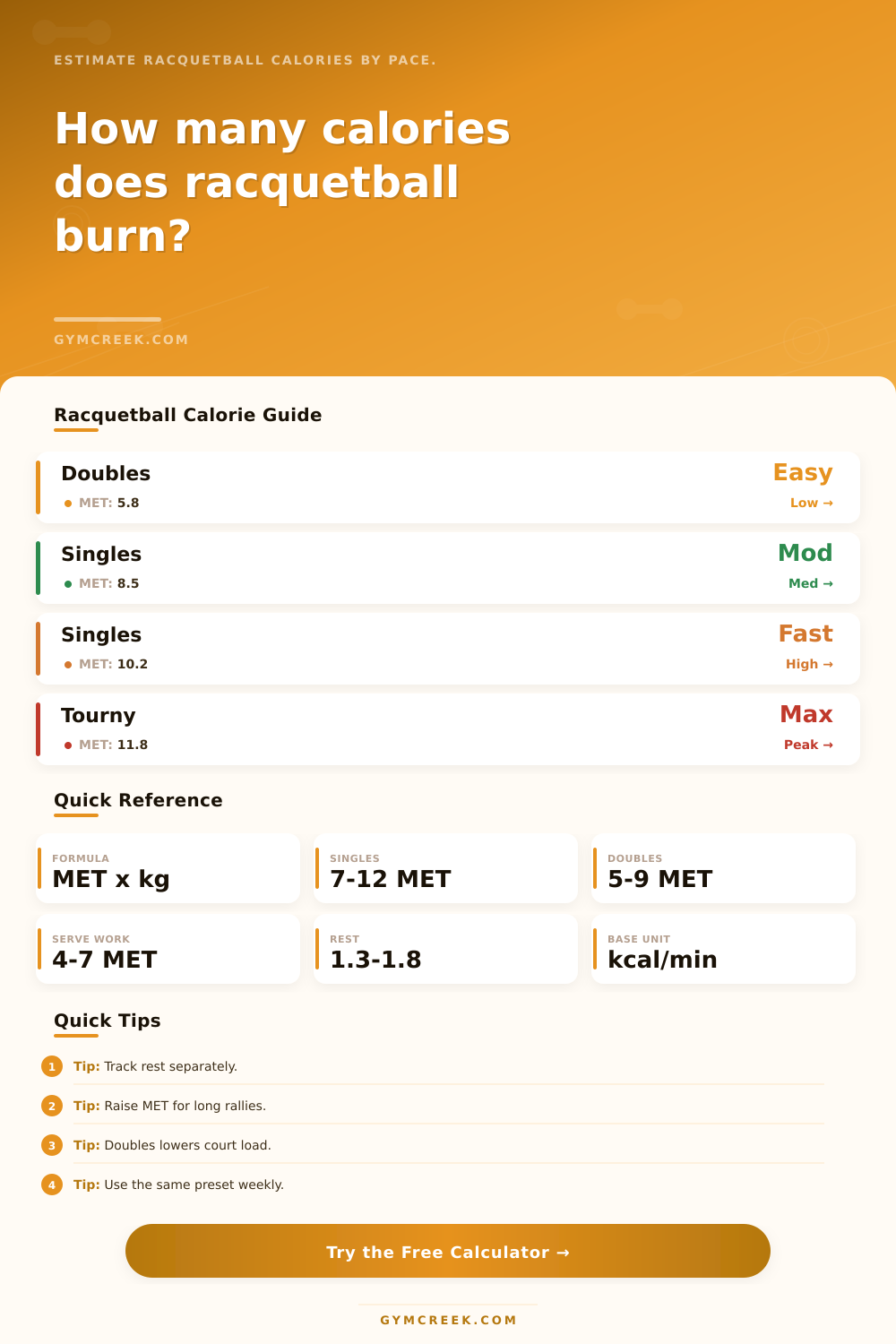
Singles starts higher because one player covers the full court. Doubles and cutthroat start lower, then rally pace and coverage can raise the estimate.
Rest ratio = rest minutes divided by match-play minutes. Rest calories are included, while long breaks lower the weighted average MET and effort density.
Mifflin-St Jeor estimates BMR from weight, height, age, and gender, then the selected activity multiplier estimates TDEE for comparison.
📑Reference Tables
| Format | Easy | Steady | Fast |
|---|---|---|---|
| Singles | 7.0 MET | 8.5 MET | 10.2 MET |
| Doubles | 5.8 MET | 7.0 MET | 8.4 MET |
| Cutthroat | 6.4 MET | 7.7 MET | 9.1 MET |
| Drills | 4.8 MET | 6.2 MET | 7.4 MET |
| Coverage | Modifier | Typical Pattern | Load |
|---|---|---|---|
| Low | 0.92x | Shared court | Lower |
| Standard | 1.00x | Club rallies | Medium |
| High | 1.08x | Many gets | High |
| All-court | 1.15x | Scramble | Peak |
| Session | Time Split | Typical MET | Use Case |
|---|---|---|---|
| Serve work | 0/30/5 | 4-7 MET | Practice |
| Doubles | 45/10/20 | 6-8 MET | Recreation |
| Singles | 60/10/15 | 8-11 MET | League |
| Tournament | 110/15/70 | 8-12 MET | Event day |
| Formula | Variables | Output | When Used |
|---|---|---|---|
| MET kcal | MET, kg, min | Calories | Main burn |
| Rally share | Game min, % | Active min | Match load |
| Rest ratio | Rest, match | Ratio | Density |
| Mifflin BMR | kg, cm, age | Baseline | Daily burn |
💡Tips
By now most racquetball players know that game will exhaust them… But they frequently think that means it’s burning lots of calories. Sure you’re worn out, but are you realy burning enough energy to drop pounds? In many cases, you’ll find that even if you feel exhausted after only half an hour on court, the true metabolic cost could be less than you imagine.
After all, if you chat during points and wait on your opponent for half of your session. You might have burned far fewer calories then you think. With this tool, you’ll learn to distinguish between sweat and math: What exactly is the thing you’re measuring when you lace up? That’s where MET values comes into play (MET stands for Metabolic Equivalent of Task).
How Many Calories Do You Really Burn Playing Racquetball?
Think of it like a multiplier against your resting energy expenditure: One MET would be sitting around doing nothing. A high-intensity burst, say sprinting across the court to make a backhand pass… Can reach 10 or higher. That’s where calories get burned: The difference between one and whatever the other is. And most folks overestimate their time spent at top of that range; we tend to underrate our time spent on the low end.
Standing by court while your partner makes a serve? Walking to water cooler? Taking a break between games? All those minute are registered at far lower intensity levels. Neglect them and your overall estimated calorie burn will reflect it. With the calculator above, enter your own session details and it’ll do the math with your weighted average. No need to guess-timate how those lulls affects the grand total.
Singles play naturaly carries a higher metabolic load than doubles because you cover entire court surface alone. You have no partner to help you with back-court retrieves or side-to-side motion. The baseline MET value will climb accordingly when you choose to plays singles. But even then, the tempo of play is also important. An easy-going doubles match, one where partners chat while playing, may not burn as many calories than an all-out singles match, every point contested at maximum speed.
Think about how much of the court you actually move through. Are you pursuing corner balls hit to back corners? Are you going after ceiling balls? Then you’re probably in the all- or high-court-coverage zone which increases intensity estimate since your body must use more effort to regain its starting location after every shot.
Interestingly, energy expenditure is impacted by skill as well. If you’re able to play at an elite pace, calories burned per point may be lower since you move more efficienty (less waste). However, because you play with such sustained intensity, there’s less time off between points. This means your overall session burn tends to still be higher.
The calculator uses a skill and shot pressure setting. This helps it account for whether you are intentionally stopping play or if you are playing recreationally and making mistakes that slow things down. Staying on a continuous rally flow elevate your heart rate for longer stretches and therefore increases total energy used.
Warm-ups and drills is also often ignored in this equation. Rally play will burn much more than a few minutes spent warming up with light mobility work. Put those two together as one time period and you’re not being accurate. Break it out and it becomes clearer how much you actualy put out. That’s what the tool does, breaks out match play from drill work and serve work so you can see where the juice goes.
That comes in handy if you want to train for endurance or weight loss. Do you really know whether you’re burning fuel or developing technique? More important than most realize: how you rest matters. If you sit on a bench, that lowers your metabolism a lot vs. This happens when you are walking from match to match or standing by the court. Over time, that little bit add up to a big difference in terms of a long tournament day. The guy who moves around when he’s resting has a higher average intensity level throughout the tournament than the guy who rests completely.
A little thing, but if you are trying to estimate total daily expenditure, you’d would of like your estimate to be based on what you actually do rather than an ideal picture of non-stop activity. It’s all about being consistent, not necessarily precise when you’re tracking calories. Nothing is going to be 100% accurate when you track calories burned.
But the point of setting some sort of base line is so you can look back and see if you are improving from week to week. As long as you have a similar format, play at a similar pace, take similar amounts of rests, the trend will show you how you are progressing. With some real data, you can either tweak your training or tweak your nutrition accordingly.
The court wants something out of you, but once you understand what that is, you can target it more effectively. When you step off the court, you’re exhausted, but this time you know exactly what it cost you.