Race Weight Calculator
Estimate an event-specific race weight from current weight, body fat, lean mass, height, training load, and target timeline.
📌Presets
Presets load realistic athlete profiles across race demands, sex, body composition, training volume, and timeline.
⚙Calculator
Race-weight snapshot
Enter your current body composition and race goal to estimate a practical target.
📊Fitness Metrics Comparison
📑Reference Tables
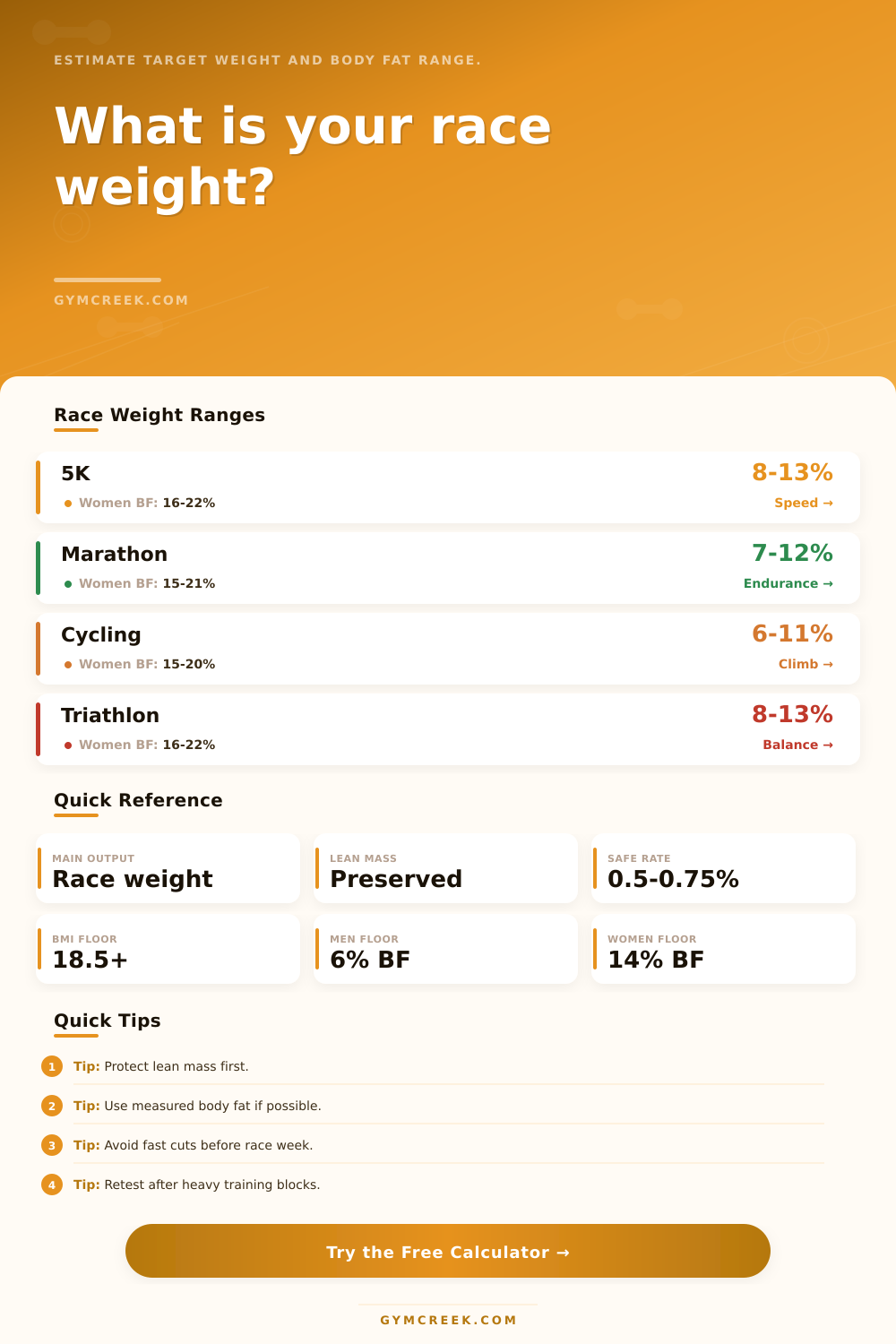
| Race Type | Men Target BF | Women Target BF | Weight Emphasis |
|---|---|---|---|
| 5K or 10K | 8-14% | 16-23% | Speed with resilience |
| Half marathon | 7-13% | 15-22% | Economy and repeatability |
| Marathon | 7-12% | 15-21% | Endurance economy |
| Cycling climb | 6-11% | 15-20% | Power-to-weight |
| Triathlon | 8-13% | 16-22% | Durability across sports |
| Obstacle race | 10-16% | 18-25% | Strength plus running |
| Weekly Change | Rate | Typical Use | Watch Point |
|---|---|---|---|
| Very slow | 0-0.25% | Race season | Small data changes |
| Moderate | 0.25-0.75% | Base or build phase | Training quality |
| Aggressive | 0.75-1.0% | Short controlled block | Recovery drop |
| Too fast | 1.0%+ | Usually avoid | Lean mass risk |
| Metric | Formula | Input Needed | Use |
|---|---|---|---|
| Lean mass | Weight x (1 - BF) | Body fat estimate | Preserve muscle |
| Race weight | Lean mass / (1 - target BF) | Target body fat | Target estimate |
| BMI | kg / m² | Height and weight | Safety context |
| P/W shift | Current / target - 1 | Weight change | Climb economy |
| Profile | Current BF | Target BF | Typical Change |
|---|---|---|---|
| Marathon build | 14-18% | 9-13% | Gradual cut |
| Triathlon base | 16-22% | 13-18% | Small cut |
| Cycling climb | 12-17% | 8-12% | Power checked |
| Obstacle race | 15-24% | 12-20% | Strength held |
| Masters runner | 18-25% | 15-22% | Recovery first |
💡Tips
Most runners treats race weight like a finish line time. They have a number in mind and they chase it with the same intensity as running a marathon in under four hours.
Your body composition isn’t your speed; it’s your structural integrity. If you stopped eating tomorrow you could of lost five pounds this week, but will those five be from your waistline or your legs? That’s where the calculator above saves you some of the guess work, the math part: you plunk in your numbers and it do all the conversion and coefficient calculations. It moves the emphasis away from one number on the scale (which really doesn’t matter) to a range of body fat percentage that actualy supports your performance for your specific event.
Why Race Weight Is Not Just About Losing Pounds
Your starting body fat percentage are the first input to consider. Everyone skips over it, or assumes they know where they sit based off whether their jeans fit or not. That’s a recipe for error. Based on that number, the tool compute what portion of you is lean mass, i.e. This includes organs, bones, and muscle tissue. You’d like to retain all that lean mass but get rid of extra energy stores.
If you plug in an estimated body fat number (versus having it measured with something like a DEXA scan or calipers), the output will have been built on nothing solid. The result won’t be trustworthy. It’s like tweaking the dials on a broken radio.
This all shifts when you consider the kind of event. Speed and power to weight ratio is rewarded in a five kilometer race, so you would target lower end of your body fat range. Ultra marathons require endurance and durability. This means you would have more body fat to use as fuel for longer efforts, along with greater storage of glycogen too. This is laid out neatly in the reference table on the page for various sport. Obstacle racers requires strength to haul their body up over walls, while cyclists who excel at climbing mountains needs to be light. Context matters and determines the type of physiology. You can’t apply the same target across disciplines.
Most people let themselves down by their timeline. How far out are you from your event? That’s when the calculator improve its recommendation for the week. Do you have 12 weeks? Great. You can start cutting gradually. Do you have only two weeks? It’ll probably tell you to do little (or nothing) and maintain your body fat level now. Dropping too fast right before a race deplete your glycogen reserves, not to mention raises your injury risk. Sure, you may drop pounds in your running shorts, but you won’t feel it as much out there.
Your muscles needs time to recover. A small rate of change is safe. Otherwise you tend to break things down quicker then you build them back up. The metric here is something they don’t mention: power to weight ratio. Being light isn’t everything. It’s about how much force you can produce relative to what you are carrying. Runners who weigh less but lack power might run slower than runners who are heavier but have drive.
The calculator provide some context for this changeover. If you’re aiming at an aggressive target weight, see if your mileage allow for such leanness. High mileage requires high fuel intake. Big miles require big fuel. Cutting back on calories while keeping up the hammer is a split the body doesn’t handle well. You’ll either break down or slow down.
If you don’t know where to begin, use the presets. They’ll load realistic physiological ranges for triathletes, cyclists, runners, and so on. This way you get an idea of what the data actualy looks like when it is based on reality, rather than fantasy. Then you can adjust your numbers accordingly.
It’s not about being the lightest on the podium. It’s about being the strongest version of yourself AT that weight. Race weight isn’t just one specific number; it is a range. And the best part… Treat it as such and I think you’ll enjoy the process more.
First protect your lean mass so that by the time race day comes around, you’ve got the engine to run the distance. That’s how you finish strong.