Race Pace From 5K Calculator
Convert a recent 5K into realistic 10K, 15K, half marathon, marathon, or custom race targets with endurance profile, course conditions, split bands, and pacing strategy.
🏁Race Pace Presets
Presets use realistic 5K performances, endurance profiles, and race contexts. Adjust the fields to match your current fitness rather than an old personal best.
⚙5K Race Inputs
5K conversion snapshot
Enter a recent 5K and target race to project finish time, pace, splits, and readiness context.
📊Fitness Metrics Grid
📑Race Pace Tables
| Distance | Prediction | Pace | Use |
|---|---|---|---|
| --- | --- | --- | --- |
| Segment | Distance | Split Target | Cumulative |
|---|---|---|---|
| --- | --- | --- | --- |
| Factor | Selection | Adjustment | Meaning |
|---|---|---|---|
| --- | --- | --- | --- |
| Zone | Estimated Pace | Effort | Common Use |
|---|---|---|---|
| Easy | --- | Conversational | Daily running |
💡Race Pace Tips
For me, 5K distance always seem easy because of its shortness, and it’s a hard push when you get out there. It’s over before you know what happened. But that outcome tell you something about what your body can handle at a longer distance. And the trick is translating an effort here to an effort there…without having either optimism or exhaustion do the math for you.
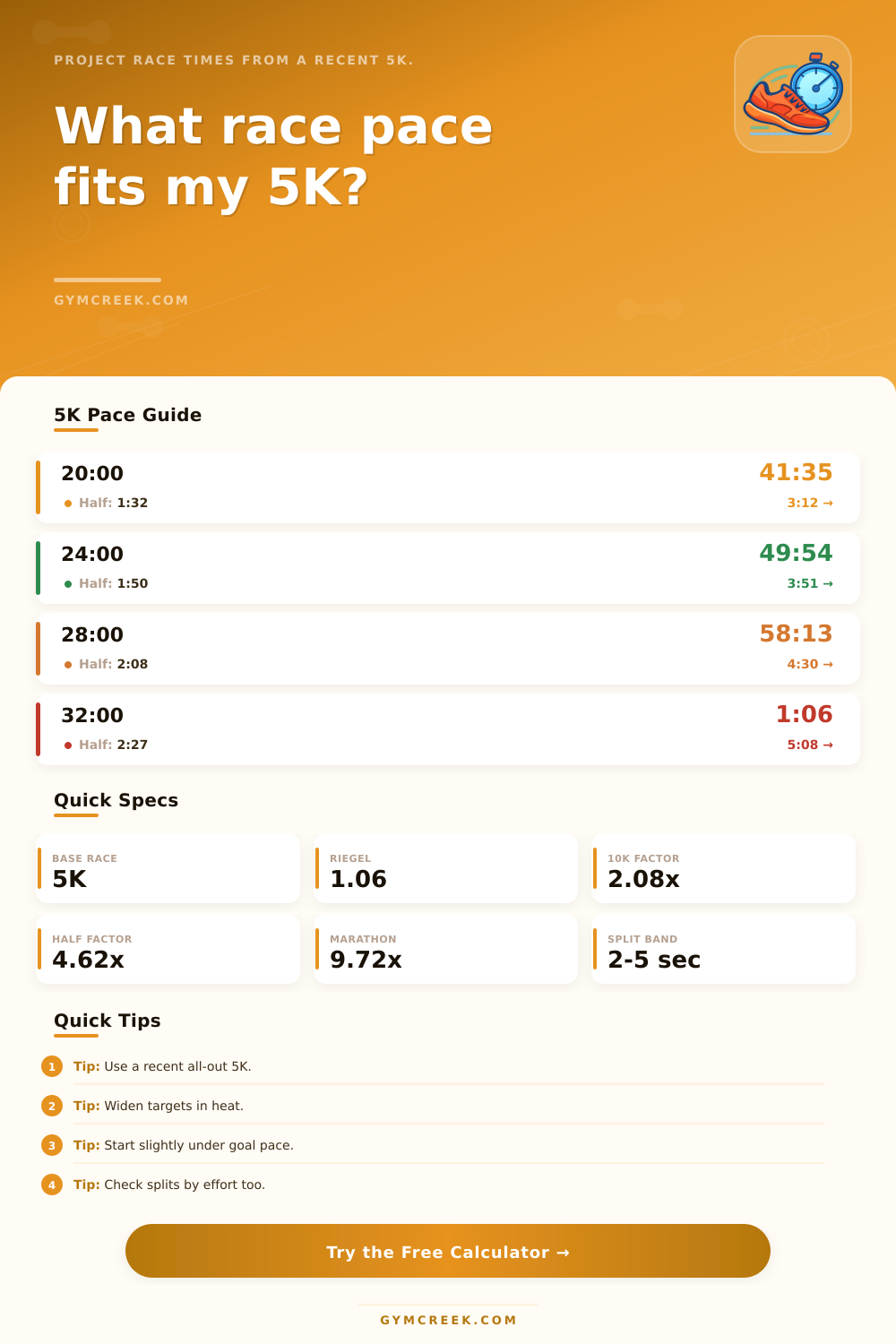
To use it, just plug in your last 5K time into calculator up top and choose what kind of race you’d like to run. It will calculate results for you based off Riegel model. This moddern model uses an exponential formula to predict times by stretching or shrinking them for greater distances. Not all runners has the same exponent. Someone who is more naturaly speedy may see their performance slow down more after a 10K. Someone else with a deeper aerobic base will lose less speed at half-marathon or full-marathon distance. You can tweak that with the endurance profile selector, and make the projection match how fit you actualy are.
How to Use the 5K Time Calculator
In real races, there aren’t perfect days. What we’re talking about here is how same fitness level produces different results due to heat, hills, travel, or an old 5K result. Altitude, weather, course profile. Those inputs widen or tighten the target range in quiet ways. You may be as fast on a hot day as you were on an ideal one, but that doesn’t just mean you’ll be slower. It means the split-to-split tolerance are larger, since it is harder to judge your effort when your body is fighting the temperature. Those allowances gets folded into final window, and you’re not staring at a single number that seems recklessly aggressive or too safe.
The inputs, weekly volume and longest recent run… Is indicators of readiness, not just raw speed. If someone has been running 60 kilometers per week with a 25-kilometer long run, he or she should of be able to handle the half-marathon demands. If their long run is only 12 kilometers, maybe yes, but they’ll experience a steeper slowdown at end of race different than the model predicts. The readiness score in the results are nothing more than a comparison between those two training marker and target distance. It’s an instant read on whether it seems like projection is optimistic or realistic.
After setting the time goal, pacing strategy comes into play. Even splits rein in early effort. Controlled negative splits requires patience in the initial half, followed by a measured push later. Each option adjust the pace of the opening kilometer while keeping total target unchanged. This distinction help you determine whether to plan for protection from early enthusiasm or from late fade.
Those post-calculation reference tables is designed to inform decision-making during training, not as something to stare at on race day. The “equivalent” times shows what a 5K time say about your potential in a 10K or a half marathon. And the training pace rows: How do I translate that 5K speed into an easy, steady, threshold range that’s something you can apply out there on the road during tempo sessions and on recovery days? There is no substitute for a watch or a coach with live feedback, but this is a consistent place to start if you’re mapping out a block.
And that’s why so many people gets it wrong… They assume any given conversion is forever. The weather has changed; your fitness has evolved; you ran that last 5K six weeks ago and now it’s slowly dissapears into memory. Every time you run the numbers, when something shifts in your running (or perhaps your training volume), you remind yourself what the targets should be. And doing that over and over turn the calculator from a novelty into a way to check yourself against both too much caution and unearned confidence.