Race Day Fuel Calculator
Estimate total carbohydrates, gels and drink count, sodium and fluid targets, fueling interval, and gut-risk score from your race duration, sport, body weight, tolerance, aid spacing, and hourly fuel plan.
🏁Race Fuel Presets
Presets load realistic race-day scenarios. Edit any value to match your tested products, course aid, weather, and gut training.
⚙Calculator Inputs
Race fuel snapshot
Your carb, sodium, fluid, interval, and gut-risk plan update as inputs change.
📊Metrics Grid
📑Fuel Rules and Reference Tables
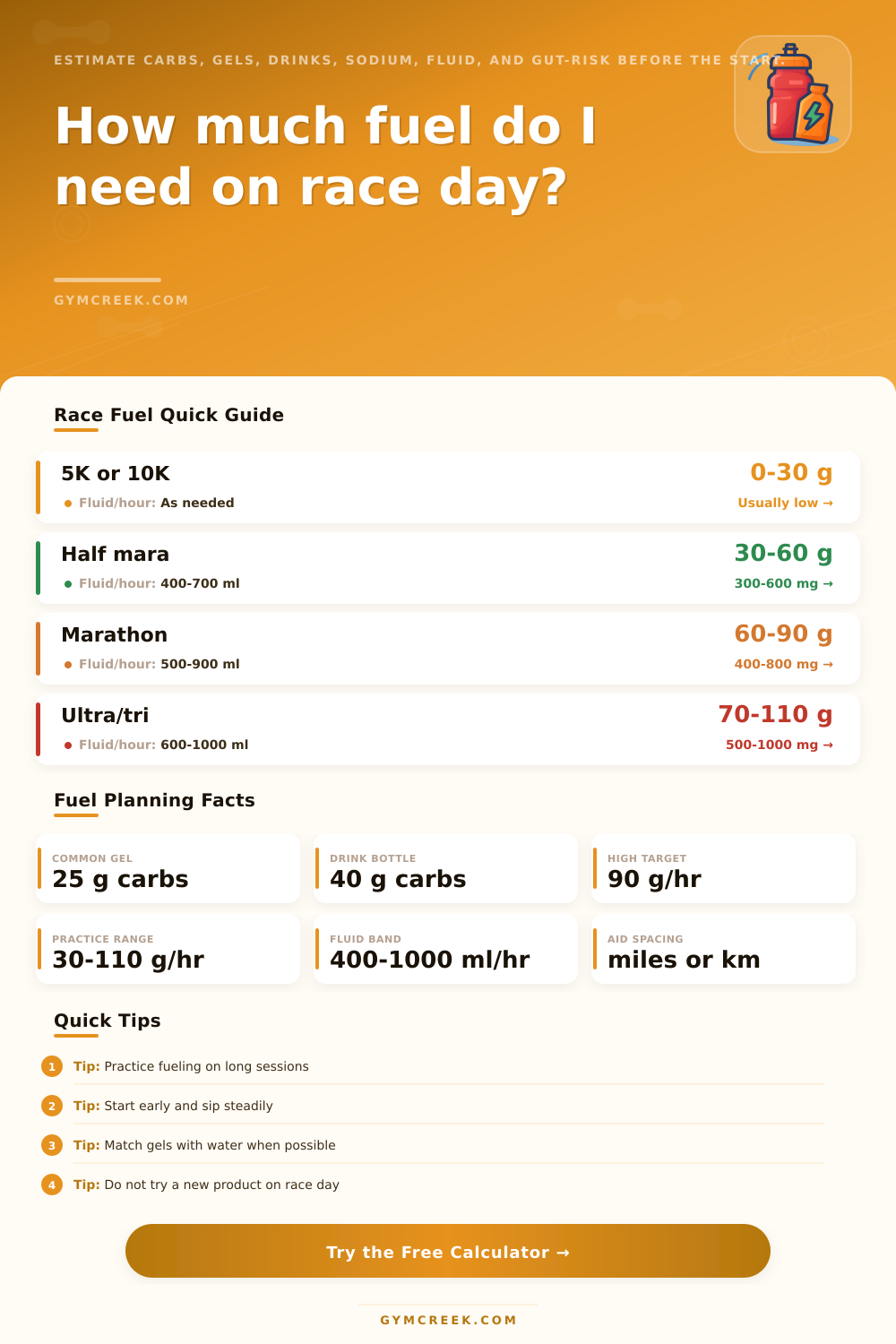
| Duration | Typical carbs/hour | Best fit | Practice note |
|---|---|---|---|
| Under 60 minutes | 0-30 g | 5K, 10K, short events | Breakfast may be enough. |
| 1 to 2.5 hours | 30-60 g | Half marathon, short triathlon | Start with simple, familiar products. |
| 2.5 to 5 hours | 60-90 g | Marathon, century, long gravel | Practice intake at race intensity. |
| 5+ hours | 70-110 g | Ultra, long triathlon, endurance rides | Mix gels, drinks, and real food as tolerated. |
| Score | Label | Main triggers | Action |
|---|---|---|---|
| 0-29 | Low | Moderate carbs, familiar timing, practical fluids | Keep the plan steady. |
| 30-49 | Low-moderate | Slightly high carbs or close breakfast | Test once more in training. |
| 50-69 | Moderate | High carb density, sodium, or fluid load | Simplify sources and rehearse. |
| 70-100 | High | Aggressive carbs for tolerance, very close meal, heavy fluid | Reduce targets or use a trained plan only. |
| Item | Calculator assumption | Useful for | Watch point |
|---|---|---|---|
| Gel | 25 g carbs each | Portable, easy counting | Take with water when concentrated. |
| Drink bottle | User-entered carbs per bottle | Combines carbs, sodium, and fluid | Strong bottles can raise gut-risk. |
| Sodium | Sodium/hour x race hours | Heat, salty sweaters, long events | Do not force sodium without testing. |
| Fluid | Fluid/hour x race hours | Hydration logistics and bottle count | Use thirst and conditions; avoid overdrinking. |
| Step | Rule | Inputs used | Output |
|---|---|---|---|
| Total carbs | Race duration x carbs/hour | Duration, carbs/hour | Grams of carbohydrate |
| Gels count | Total carbs divided by 25 g, rounded up | Total carbs | Equivalent gels |
| Drink count | Total carbs divided by drink carbs/bottle, rounded up | Total carbs, drink carbs | Equivalent bottles for carbs |
| Sodium and fluid | Hourly target x race duration | Sodium/hour, fluid/hour, duration | Total mg sodium and liters fluid |
| Fueling interval | 25 g gel divided by carbs/hour x 60 minutes | Carbs/hour | Minutes between gel-equivalent hits |
| Gut-risk score | Starts at 12, then adds points for high carb density, tolerance mismatch, close breakfast, high fluid, high sodium, long duration, and sparse aid | All inputs | 0-100 score and label |
💡Tips
Race day fueling require you to manage your carbohydrates, fluids, and sodium intake. Managing your carbohydrates, fluids, and sodium is necessary for your body to perform at a best possible level during the race. You need to consume enough carbohydrates to provide your muscle with the energy they need.
You need to consume enough fluids to replace the fluids that you lose through sweat during the race. You need to consume enough sodium to continue to maintain proper bodily function. However, you have to be careful not to consume too much or too little sodium with your fueling plan because this can cause new problem for your body during the race.
How to Fuel on Race Day
Due to the fact that each person has a different rate at which they sweat and each person have a different capacity for there bodies to digest the contents of their gut, there is no fueling plan that will work for each individual. Carbohydrate intake is one of the most important aspect of your fueling plan for race day. This is due to the fact that your body can only store a limited amount of glycogen.
If your glycogen stores drop too low during the race, your pace will drop. To avoid this, you must consume carbohydrates throughout the race to ensure that your glycogen stores remains high. The amount of carbohydrates that you need to consume each hour will depend upon the length of the race and the strength of your digestive systems training to process fuel while you are performing.
Some athletes can process 90 grams of carbohydrates each hour while others can only process 45 grams of carbohydrates each hour. Therefore, it is essential that you determine how many grams of carbohydrates your body can take in each hour of the race rather than selecting a number that may seem impressively but is too high for your body. Fluid and sodium requirement are also essential components of your fueling plan but will change based off the environment in which you will be racing.
If the conditions are hot, you will lose more fluid through sweating. However, if you drink too much fluid, it will dilute the sodium in your blood and cause medical problem. Cold and dry air can make it hard for individual to recognize when they are losing fluids.
Therefore, even in an environment that is not hot, you must manage your fluid intake. Additionally, the distance between aid station will impact how much fluid you will have to carry and your sodium intake. If aid stations are close together, you can carry less fluid.
If the aid stations are further apart from the start of the race, you have to change how you carry and consume your fluids and sodium. Another essential aspect of setting up your fueling plan is determining when to have breakfast. This is due to the fact that the timing of your breakfast will impact the amount of space that your gut has for the fueling plan for the race.
If you eat too close to the race start, your gut will be filled with food and will compete with the fueling for your body. However, if you eat too early, you may find yourself underfueled for the race start. A calculator can help you determine how many gels and how many fluids you will need to consume based on the length of the race and the spacing of the aid stations but cannot take into account how your bodys gut may feel on race day.
Instead of using the calculator to set up your fueling plan for race day, you should use this tool to discover your limits during your long training runs or long training ride. This is when you can test your body to see if a specific amount of gel spacing work for you, if a particular drink mix does not upset your stomach, and if your sodium intake does not cause stomach trouble after long hours of racing. While the calculator can help to provide a map of where to start your fueling plan for the race day, it is your training that will show whether or not your fueling plan is accuratey for your body.
The gut-risk score that the calculator presents to you with the fueling plan created is not the indication of your success during race day but does provide information to you regarding where your fueling plan is located on a spectrum. A low gut-risk score indicate that your fueling plan aligns with what you have trained in your races. A high gut-risk score indicates that your fueling plan could lead to gastrointestinal issue for other athletes who follow this fueling plan.
Therefore, a high gut-risk score can inform you of the need to train your body to be able to handle the amount of carbohydrates, fluids, and sodium that you have planned for your race day fueling plan. One of the main value of a fueling plan is that it will remove the guesswork that an athlete has to perform during the race. If you know how many gels or how many bottle of fluid you need to consume during the race, your mind can focus on the physical demand of the race rather than the math that would otherwise take up that mental energy.
This type of fueling plan is only made possible after you have tested the fueling plan that you have created for your race against your body during your training. Although the calculator will assist you in creating your fueling plan, it is the long races and long rides that will allow you to complete the creation of an effective fueling plan for race day.