Qigong Calorie Calculator
Estimate qigong calories from practice style, movement versus standing share, breath cadence, stance depth, set duration, repetition rounds, rest pauses, and rest-adjusted MET logic.
📌Presets
Presets load realistic qigong sessions and recalculate from style MET, posture split, breath pace, stance depth, rounds, and session density.
⚙Calculator
Your session snapshot
Calories are estimated from weighted MET minutes for movement, standing practice, rest pauses, breath cadence, stance depth, rounds, and body mass.
📊Session Metrics
🧮Formula Cards
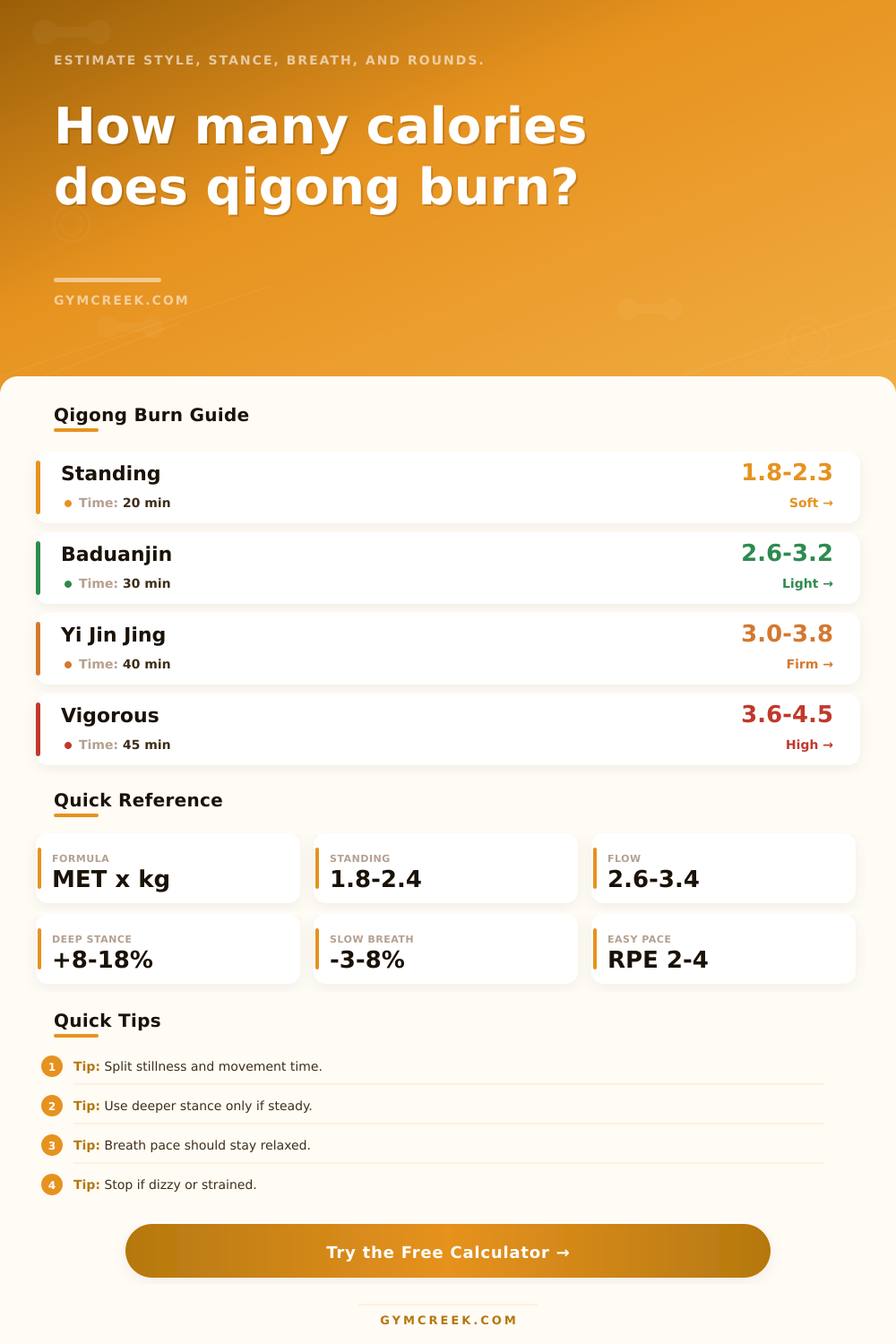
Calories per minute = MET x 3.5 x body weight in kg / 200. The calculator applies separate MET values to movement, standing practice, and rest pauses.
Total minutes are allocated by your movement share, standing share, and pause share. If the shares exceed 100 percent, they are scaled proportionally before calories are calculated.
Breath cadence, stance depth, arm range, balance demand, and movement tempo adjust the base style MET so quiet and vigorous sessions are not treated the same.
Set duration multiplied by repetition rounds estimates density. Mifflin-St Jeor estimates BMR, then the activity multiplier estimates TDEE for daily calorie share.
📑Reference Tables
| Practice Style | Move MET | Stand MET | Best Use |
|---|---|---|---|
| Standing meditation | 2.0 | 1.9 | Stillness |
| Baduanjin | 2.9 | 2.1 | General flow |
| Shibashi | 2.7 | 2.0 | Soft forms |
| Five Animal Frolics | 3.3 | 2.2 | Playful range |
| Yi Jin Jing | 3.4 | 2.3 | Tendon work |
| Vigorous warm-up | 4.1 | 2.5 | Martial prep |
| Stance Depth | MET Mod | Leg Demand | Note |
|---|---|---|---|
| High stance | 0.96x | Low | Easy knees |
| Medium stance | 1.00x | Light | Balanced |
| Low stance | 1.12x | Firm | Use care |
| Variable depth | 1.06x | Mixed | Changes |
| Breath Cadence | Modifier | Feel | Use |
|---|---|---|---|
| 3-5 breaths/min | 0.94x | Very calm | Meditative |
| 5-8 breaths/min | 1.00x | Relaxed | Typical |
| 8-12 breaths/min | 1.04x | Active | Flowing |
| 12-18 breaths/min | 1.08x | Lively | Warm-up |
| Formula | Variables | Output | Use |
|---|---|---|---|
| MET kcal | MET, kg, min | Calories | Main burn |
| Weighted MET | Split, MET | Avg MET | Session load |
| Round density | Set, rounds | Percent | Volume check |
| TDEE share | Kcal, TDEE | Percent | Context |
💡Tips
Qigong conjures up an image for most of us: standing still somewhere, perhaps in a park (moving with slowness), taking deep breaths. How much could that possibly cost me metabolically? Especially when I’m lifting weight, running around?
The answer is that most of the time, we’re wrong, as we’ve neglected to account for internal load from breath control and posture.
How Qigong Burns Calories
Plug in your stance depth and your qigong style, and let the calculator do the math. This saves you from having to convert units or try to figure out coefficients. It views your session as not just one single unit of effort but instead a combination of various physical demands.
It comes down to how much your body move versus how much it doesn’t. Even if you’re doing something for 30 minutes, that doesn’t mean it’s 30 minutes of straight motion. You pause to reset; you hold a posture; you stop to listen to instructions. These are different. To the tool, they’re different enough that you should break them apart.
Some movements burns more calories per minute (like flowing forms such as Baduanjin), while others burn less (like standing meditation, also known as Zhan Zhuang). But none is free. There’s always muscle tension involved in holding an alignment with spine engaged and the knees soft. The calculator gives each phase a MET value and weighs it based on how long you’re really doing it. So yes, if you spend ten minutes in a deep squat, that will register as more intense activity than walking around.
The rhythm of your breath also has a real but subtle part to play in the last number. For example, slower breathing (typically between 6-8 breaths per minute when relaxed) will tend to decrease metabolic demand as well as heart rate. However, rhythmic, faster breathing during a vigorous flow will increase metabolic demand. This is where that detail comes in through the input fields.
A beginner’s typical base is a relaxed 6-8 breaths per minute, roughly equivalent to the standard baseline. However, if they’re practicing vigorous martial arts or warming up, then their breath may speed up and increase estimated burn. The page includes a nice reference table that lays all this out clearly: the base intensity plus how breath pace modulates it.
Of all the physical variables, stance depth probably matters most. Stance that’s higher (with knees relaxed) is gentler on joints yet burns fewer calories. Going lower, which lowers your center of gravity, exponentially loads the glutes and quadriceps. Lowering your center of gravity increases the load on your quadriceps and glutes, so the calculator applies a multiplier for deeper stances to reflect that extra muscular effort. That’s why a shorter stint in low stance may expend more calories than a long stint in high stance. It’s a matter of conditioning vs. Comfort. Are you there to build structural strength or are you there to relax?
It breaks down how much of that time was spent moving around as opposed to standing still, and then provides an overall calories burned number. It compares that with your total body energy requirement for the day. This helps keep things in perspective, because one workout alone won’t do a lot for you (Qigong isn’t normaly a major weight loss tool). Consistency is key, and so is ease on your joints. You could of doing it every day, unlike hard exercise where you need some time to recover. The calories are just icing on the cake.
The tool also assists in setting realistic expectations. It prevents you from making an apple-to-oranges comparison. A half-hour session of HIIT won’t be equivalent to a half-hour session of qigong. It could compare well with a half-hour of light yoga or walking slowly. Depending on how fast you move through the forms, and what kind of stance you assume, it may compare more favorably than doing a slow walk.
The point is knowing how much you’re putting your body through with this practice. When you know the numbers, you’ll know whether to adjust your other exercises or change something about your diet.
One beauty of qigong is that it can fit into even a busy life. No special equipment required; no gym membership necessary. You only need a patch of floor and a desire to stand still for a few minutes. What it takes is quiet energy, but it takes energy.