Q Angle Calculator
Estimate knee alignment from ASIS, patella center, and tibial tubercle geometry, then compare the result with side-to-side and risk-context signals.
📌Presets
Each preset loads landmark distances for a standing frontal-plane estimate and recalculates the alignment context.
⚙Calculator
Q angle snapshot
Enter landmark geometry to estimate knee alignment.
📊Metrics Grid
🧭Risk Context Logic
📑Reference Tables
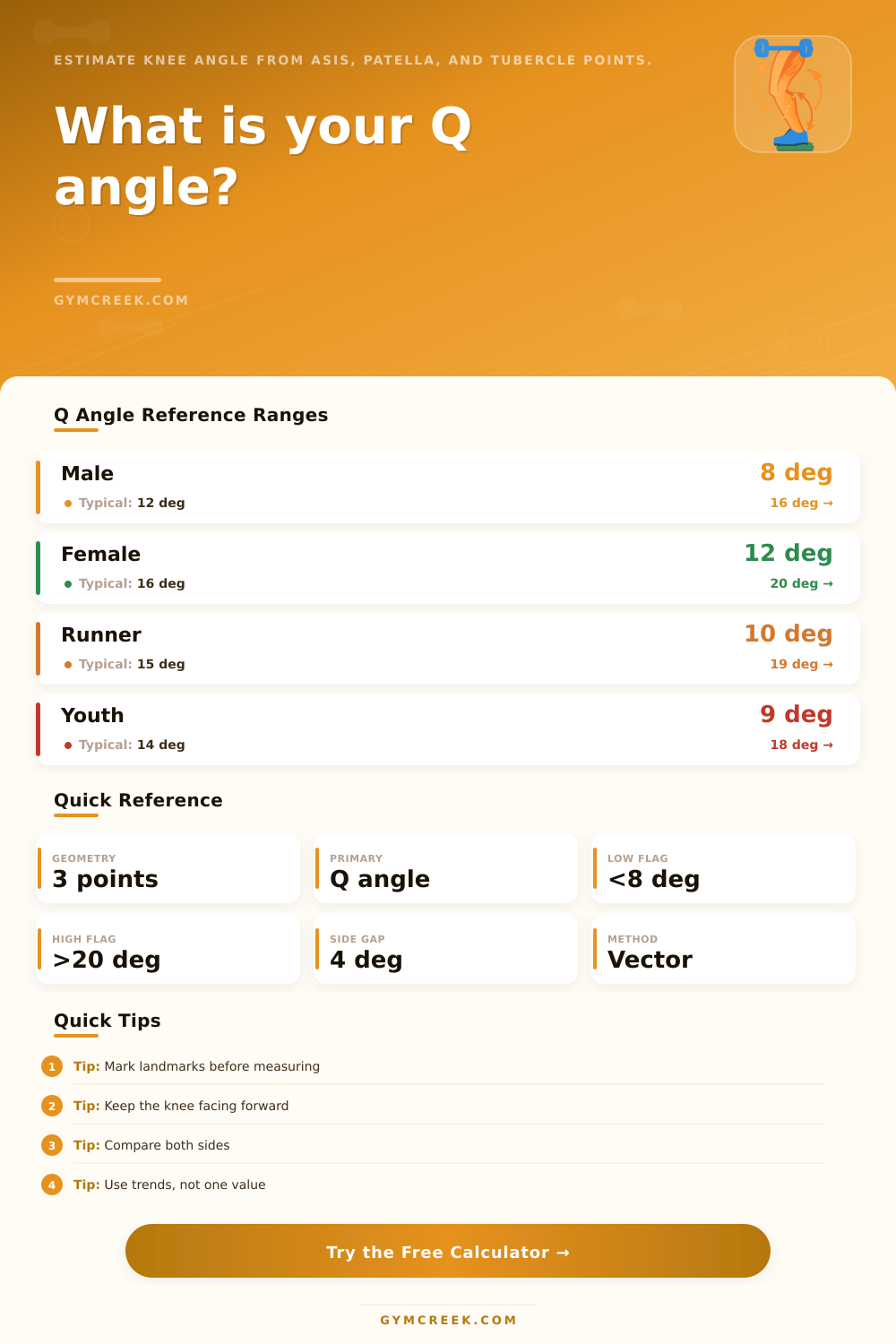
| Profile | Low | Typical | High flag |
|---|---|---|---|
| Male reference | <8° | 10-15° | >17° |
| Female reference | <10° | 13-18° | >20° |
| Youth reference | <8° | 10-17° | >19° |
| Runner context | <9° | 11-17° | >19° |
| Geometry | Formula | Meaning | Common issue |
|---|---|---|---|
| Upper vector | atan(offset/drop) | ASIS to patella line | Wide pelvis |
| Lower vector | atan(tub/drop) | Patella to tubercle line | Lateral tubercle |
| Q angle | Upper + lower | Quadriceps pull angle | Tracking load |
| Side gap | Measured - other | Asymmetry cue | Single-side stress |
| Scenario | Angle cue | Context cue | Review |
|---|---|---|---|
| Neutral screen | In range | Low symptoms | Retest 8 wk |
| Patella pain | High angle | Pain present | Coach or PT |
| Return to run | Side gap | Drift check | Retest 2 wk |
| Growth phase | Changing | Youth profile | Trend only |
| Risk input | Low | Moderate | Higher |
|---|---|---|---|
| Q angle | In range | Near edge | Outside |
| Side gap | <3° | 3-5° | >5° |
| Knee drift | <4° | 4-8° | >8° |
| Symptoms | None | Training | Daily |
💡Tips
Unless something’s wrong, you likely don’t give much thought to your quadriceps angle. But if you’ve had a bout of squats or an extra-long run and find yourself feeling like your legs aren’t tracking correct, it typically begins as a nagging ache behind the kneecap. This isn’t typically random; more often than not, it’s a mechanical cue telling you that there’s some misalignment between how your patella is being pulled versus axis of your joint.
Known as your Q angle, its measurement take into account geometry from your hip to your knee then to your shin. Knowing what it is turns a mysterious knee pain into a solvable structural puzzle. It’s simple trigonometry, but I don’t think you can do it in your head standing on one foot. Here are three points: Your hip has a pointy bone sticking out on the front that’s called the anterior superior iliac spine. Then there’s center of your kneecap. Then there is the bump right underneath your kneecap where the patellar tendon connect to your shinbone, called the tibial tubercle.
Understanding Your Q Angle
So the distance from your hip to your knee is the vector of the pull of the vastus lateralis muscle. Then there’s the other direction, going back from your knee to your tubercle, and angle between those two directions is your Q angle. Basically it gives you an idea of how much lateral stress are being applied to your kneecap when you’re moving around.
We’re taught that our knees should be nice and straight, but nature doesn’t deal in perfects very often. Due to biological differences between men and women (a wide pelvis for the same height), there’s typically a bigger angle at the hip for females. Understandably, this lead to an increased risk of ACL injuries and other anterior knee pain in female athlete. This isn’t a design flaw; it is just a matter of anatomy with a slightly different starting shape.
Knowing this helps avoid panicked thinking when you see that your number is above some male comparison. The number itself is less important than what it represents. You’ll need to take a few exact measurements of these distances (and use a pen to mark each landmark so it doesn’t get away from you). Then stand with your feet comfortabley hip width apart and be relaxed.
Remember, however: All that matters is how you move dynamically. If you observe caving-in at the knee when you land after jumping or squat down, then that’s functional stress added by dynamic valgus. This won’t show up in a static standing measurement. You can use this tool on this page to give you an estimated static baseline, which is valuable in terms of seeing if there are any differences between leg that may result in uneven wearing over time.
If left is significantly different than right, there’s probably something worth looking into. You don’t have to get the decimal exactly right. You’ll see that slightly changing where you think center of the patella is will change this measure by a couple of degrees. Instead, seek patterns. As you put on some weight or new shoes and find yourself with an upward sloping angle, you’ve got something there. In other words, high arches will push off and compensate further down the body and can throw things out of wack regarding tibial rotation and effective knee alignment. Flat feet create too much pronation, and everything is related.
It isn’t about getting to perfect zero degrees, which is physically impossible for most people anyway; it is instead about reducing abnormal shear forces. Many times rehabilitation for this involve working the glutes and hip to control the rotation of femur. And if you have a large Q angle, meaning lots of lateral pull, then building up those outer hip stabilizers may prevents the knee from collapsing inwards so much. Remember, it’s not stiffness we want but balance: the body require some amount of rotation and flexion in order to move effectively in space.
The goal here is directing the forces created by your muscles into the joint and not having them grind against the cartilage. After getting a baseline, go ahead and record it on occasion instead of all-the-time. It will serve as an anchor for diagnostics if you experience a new pain or aren’t feeling like yourself; it can help distinguish between structural alignment problems versus it might just be muscular fatigue.
You should of checked this earlier. When you know your own geometry, you can alter footwear or training load before you’re chronically injured. You are the one writing the territory, while the math is the map.