Push Up to Bench Press Calculator
Estimate your bench press 1RM, working set weight, and strength ratio from strict push-up reps, bodyweight, added load, and variation difficulty.
📌Presets
Each preset loads a realistic push-up profile and calculates the estimate instantly.
⚙Calculator
Bench estimate snapshot
Enter your strict push-up set to estimate a bench press range.
📊Strength Snapshot
📑Reference Tables
| Variation | Typical Load | Rep Range | Transfer |
|---|---|---|---|
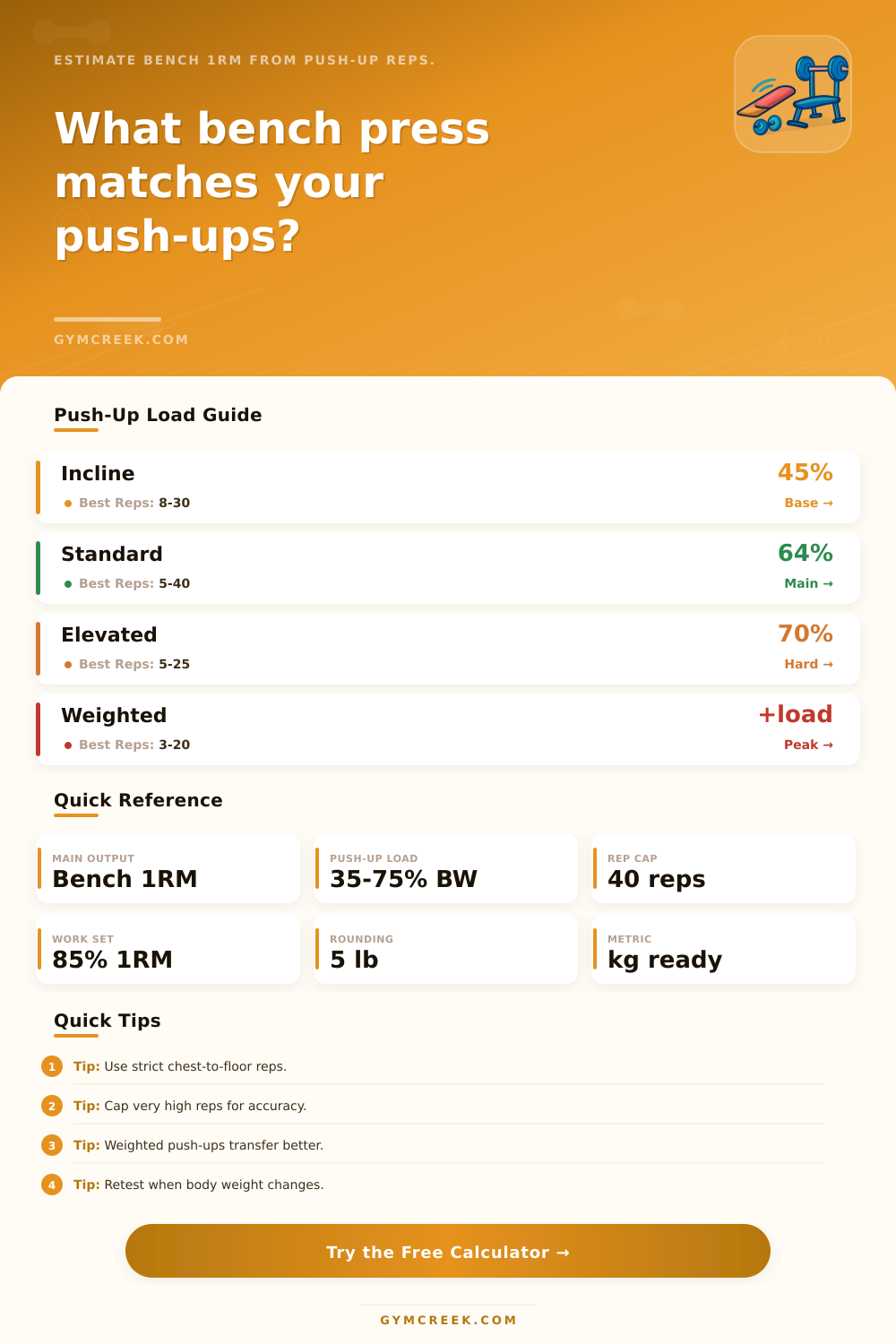
| Incline | 35-50% BW | 8-40 | Low |
| Standard | 59-64% BW | 5-40 | Good |
| Hand-release | 61-66% BW | 5-30 | Good |
| Feet elevated | 65-72% BW | 5-25 | High |
| Weighted | BW% + load | 3-20 | High |
| Bench Ratio | Men | Women | Signal |
|---|---|---|---|
| Starter | 0.50-0.75x | 0.35-0.55x | Build base |
| Recreational | 0.75-1.00x | 0.55-0.75x | Solid |
| Intermediate | 1.00-1.25x | 0.75-0.95x | Strong |
| Advanced | 1.25x+ | 0.95x+ | Very strong |
| Formula Step | Method | Variable | Purpose |
|---|---|---|---|
| Load share | BW fraction | Variation | Push-up load |
| Rep max | Epley blend | Reps | Strength curve |
| Transfer | Bench factor | Level | Pattern match |
| Range | Plus/minus | Quality | Estimate band |
| Scenario | Profile | Input | Expected Result |
|---|---|---|---|
| General fitness | Standard reps | 15-30 reps | Useful range |
| Strength focus | Weighted reps | 3-15 reps | Best transfer |
| Testing | Timed cadence | 20-60 reps | Wider range |
| Rebuild | Incline reps | 8-25 reps | Conservative |
💡Tips
Load specificity plays a role in this. If you can do 30 pushups without a problem but find it hard to bench press, remember one thing. Pushups help develop relative strength and endurance, but that doesn’t necessarily translate to absolute force production with heavy barbells. After all, what amount of weight do you actualy move during a pushup? How far up or down you bend your arms depend on your technique and body composition.
The calculator closes this gap by taking your strict reps and estimating your one-rep max on the bench press. It first calculates roughly how much of your bodyweight you’re pushing, and then uses some strength curve formulas to estimate where along the barbell range that exertion fall. Why is this necessary? This is because there is variance between people (age and body weight). Even if two lifters does exactly the same number of reps, heavier person will be moving more absolute mass. The calculator adjusts for this difference so you don’t have to just go off a generic chart.
How to Use the Calculator Correctly
The variation setting is where most folks screw up. For example, when doing inclined push-ups, your center of gravity move forward. This reduces the weight on your shoulders and chest by almost half compared to a normal set-up. This makes them easier. Conversely, elevating your feet puts more weight on your upper body, making these harder than normal push-ups. So if you say you just did inclines, yet used your feet to raise yourself off the ground, then your bench estimation will be lower then it should of been.
Similarly, you want to be truthful regarding how hard it was. Did you do standard variations? Do knee push-ups? Are you wearing a vest/backpack while performing weighted variations? Those different types affect tool’s internal load coefficients.
Rep quality matters a lot The accuracy depends on rep quality. A set of twenty sloppy half-range push-ups mean very little for your strength profile. Remember: we assume strict reps. Go into full extension at the top and reach full depth to the floor. Don’t cut reps short just to increase number. It’ll blow up your potential bench press and make it look like something that doesn’t exist in real life. That’s why the input asks for your rep standard, because controlled and deliberate work works much better for barbell pressing than fast momentum-driven reps. Strength is what you’re after, not just speed.
Take the five-rep load as your working weight once you run it through the numbers. That’s your practical limit for building muscle and gaining strength. It also helps you avoid injury from maximal lifts. Unless you’re doing something competitive or testing yourself for PRs in the gym regularly, chances are you’ll never reach your one-rep max. Use the five-rep load as a practical goal to work towards increasing strength and size.
On page, they also have some reference tables that put these numbers in context compared to average person. This way, you will know whether you are an advanced or average bench presser relative to your bodyweight. That’s why retesting is important, body weight ratios shift as you gain muscle mass. Even though you might maintain a certain number of push-ups over time, that push-up will get heavier as you put on more muscle. Someone who performs twenty reps while weighing one fifty pounds are pushing much less force than someone else performing twenty reps at two hundred pounds.
The calculator calculates all of this for you, it saves us from having to memorize complicated physics equations. Just make sure you input what your body looks like today, not what it looked like six months ago. The output shouldn’t be taken as gospel. Take it as a starting point for that month’s training cycle. If it sounds too conservative, increase by five pounds. If it sounds like its on the heavy side, start at the low-end of the range.
The tool offers a framework; your body supplies the feedback loop. You don’t build strength by calculating alone. You build strength by continually progressing. Estimate the weight, hit it hard and adjust accordingly as you grow stronger. This is how you transform push-up endurance into some serious bench press power.