Push-Up Calorie Calculator
Estimate push-up calories from body weight, total reps, set pace, rest time, push-up style, and MET intensity.
📌Presets
Each preset loads a real session structure and recalculates calories, MET load, per-rep burn, and weekly volume.
⚙Calculator
Push-up calorie snapshot
Enter your session details to estimate calorie burn.
📊Fitness Metrics
📑Reference Tables
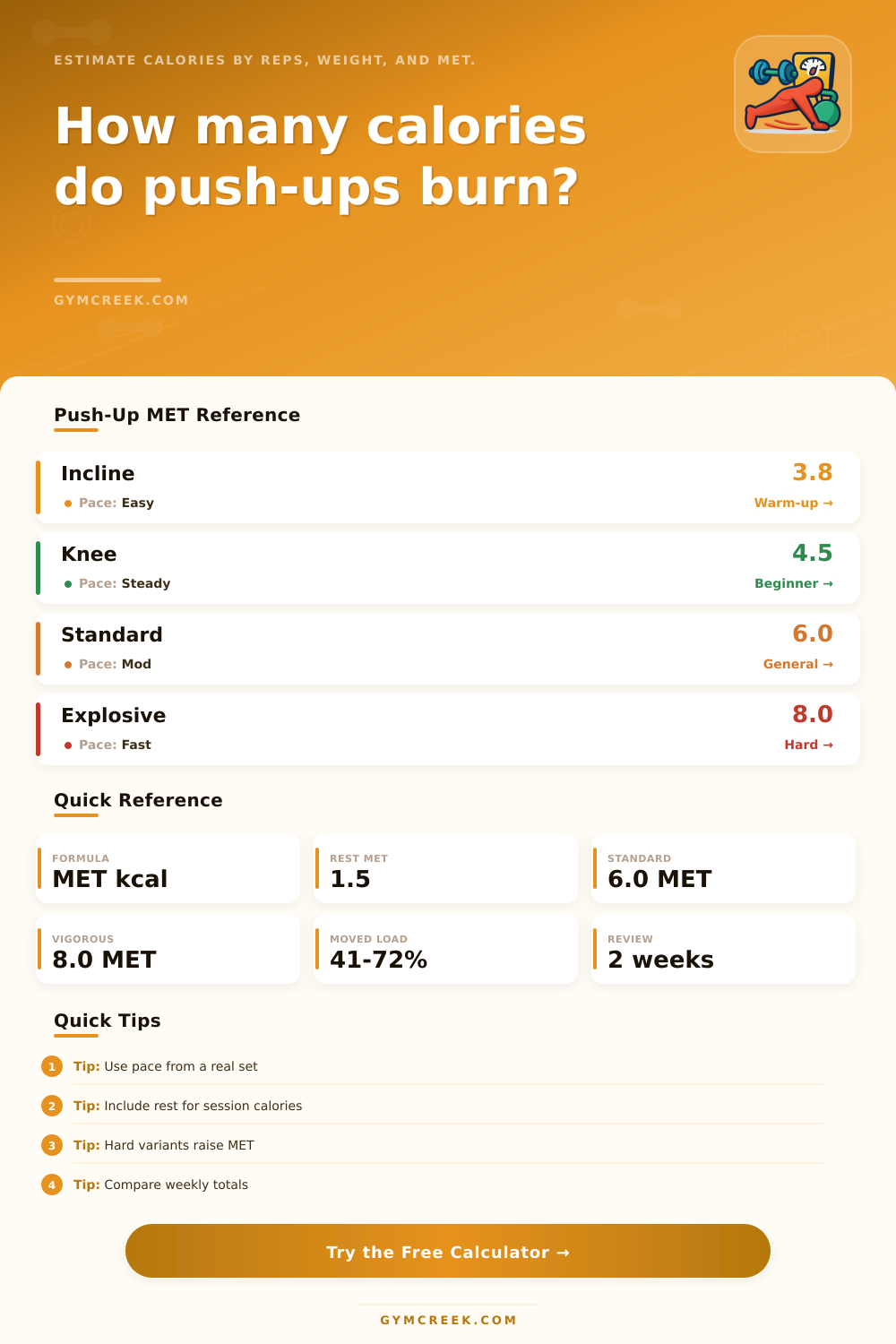
| Push-up style | Base MET | Load share | Best use |
|---|---|---|---|
| Incline | 3.8 | 41% | Technique |
| Knee | 4.5 | 49% | Entry sets |
| Standard | 6.0 | 64% | General work |
| Wide grip | 6.5 | 64% | Chest focus |
| Decline | 7.0 | 72% | Harder sets |
| Weighted | 7.5 | 64%+ | Strength work |
| Explosive | 8.0 | 68% | Power work |
| Intensity | MET adjust | Pace cue | Session feel |
|---|---|---|---|
| Easy | -12% | Slow | Technique |
| Moderate | 0% | Steady | Repeatable |
| Vigorous | +18% | Fast | Hard sets |
| Near-max | +32% | Very hard | Test effort |
| Body weight | 50 reps | 100 reps | 150 reps |
|---|---|---|---|
| 130 lb | 12-22 | 25-43 | 37-65 |
| 160 lb | 15-27 | 30-53 | 46-80 |
| 190 lb | 18-32 | 36-63 | 54-95 |
| 220 lb | 21-37 | 42-73 | 63-110 |
| Formula piece | Variable | Meaning | Used for |
|---|---|---|---|
| MET kcal | MET | Intensity | Calories |
| Weight | kg | Body mass | Burn rate |
| Active time | min | Work reps | Push-up burn |
| Rest time | min | Between sets | Total burn |
💡Tips
Everyone believes push-ups develop chest muscles alone. But each time you lift your weight off the ground and lower it again, you’re battling gravity…with yourself, and that takes energy. Because the pace and form of each rep vary, it’s hard to say precisely how many calories you burn. Is it more or less than if I go faster or slower? What if I do fewer reps but move quick through them? One rep count as one. However, a controlled slow motion rep is different then an explosive quick rep.
This calculator converts all these variables into something tangible. You no longer have to guess at the calorie content. You can simply measure your progress without needing lab-grade watch on your wrist.
How This Push-Up Calculator Works
How many reps per set? How long for each rest period? The input fields is what make this calculator tick… Literally. Body weight: Self-explanatory. It takes longer to move two-hundred pounds than it do one-hundred and fifty.
Pace and rest time are where most estimate fall short. If you only account for the active seconds and disregard the sixty-second break spent resting between sets, you’ll underreport total burn. In reality, your body still working hard as you recover. To get a realistic picture of how much energy you’re using in any given session, the tool assign a lower metabolic equivalent value to rest periods. Define the structure of your routine and let the calculator do math for you.
That’s where the variations come in. Some are easier (and burn fewer calories) than others. Incline pushups place less stress on your upper body, so they’re easier but lower caloric output. Explosive or decline versions reverse the situation by requiring quicker muscle activation and increasing shoulder/core load. The metabolism variations is clearly laid out in the reference tables within the tool itself.
Notice how simply swapping from knee push-ups to normal ones will increase your output? It’s not just about doing more reps; you are also changing the mechanical demand per rep. Many people remain stuck to one style for no reason other than habit, unaware that even a small variation might increase the intensity without increasing the volume.
But there’s also a larger picture: Frequency matter as well. A single monthly session of 100 push-ups doesn’t do much for your calories burned or fitness level compared to splitting up those same reps into three workouts per week. Building aerobic and anaerobic capacity requires consistency, it takes a while to maintain high intensity levels. That’s why the calculator factors in frequency of training (weekly burn) so you can establish reasonable expectations.
Does doing 50 push-ups makes any difference toward losing weight? Or is it more of a symbolic gesture? The numbers clear that up. Can’t measure form quality on a spreadsheet, though it impacts everything else. Flaring your elbows or dropping your hips alters muscle usage, changing both the burn rate and efficiency. Strain caused by poor form can make the set feel harder, but failing to engage major muscles well enough could actualy reduce metabolic output.
Set the pace according to reality, not aspiration. If you’re aiming for a strong effort and slow to a gasp midway through, your actual calorie burn is going to be closer to moderate intensity. Accurate output come from honesty in input.
Longer sessions and tracking your progress week by week will show trends that individual session obscure. Sometimes you’ll discover that shorter rest periods increase caloric burn more than adding reps. Short bursts of intense work keep your heart rate up and increase metabolic cost… All while avoiding heavy weights. For at-home exercises when you can’t add any weight plates, this is valuable.
By adjusting these settings with the tool, you can experiment and determine what works best for you. Whether you’re training for an event or just need to fit in some exercise while working at a desk, you can learn to manage your time. This would of helped you get the most out of your workout.
In the end, this just reiterates why push-ups are such an effective bodyweight exercise: They’re incredibly scalable to your current strength level and don’t need any equipment at all. Adding in calorie-burning information is just further icing on the cake. It’s yet another reason that you should add them to your routine, and it’s a way to make a number-based rep scheme meaningful for fitness improvement and caloric expenditure. You’ll know what works, what doesn’t work, and you’ll be able to adjust variables to match.
Then you go do the damn thing. Every rep matters, and the math will back up the sweat.