Push Up Calculator
Score a timed push-up test, adjust for range and tempo, compare age benchmarks, and set training targets for your next block.
📌Presets
Each preset loads a realistic test profile and immediately recalculates the score, benchmark, and training targets.
⚙Test Inputs
Push-up test snapshot
Enter a test result to calculate capacity, benchmark rank, and training targets.
📊Fitness Metrics Grid
📑Reference Tables
| Male Age | Needs Work | Solid | Strong |
|---|---|---|---|
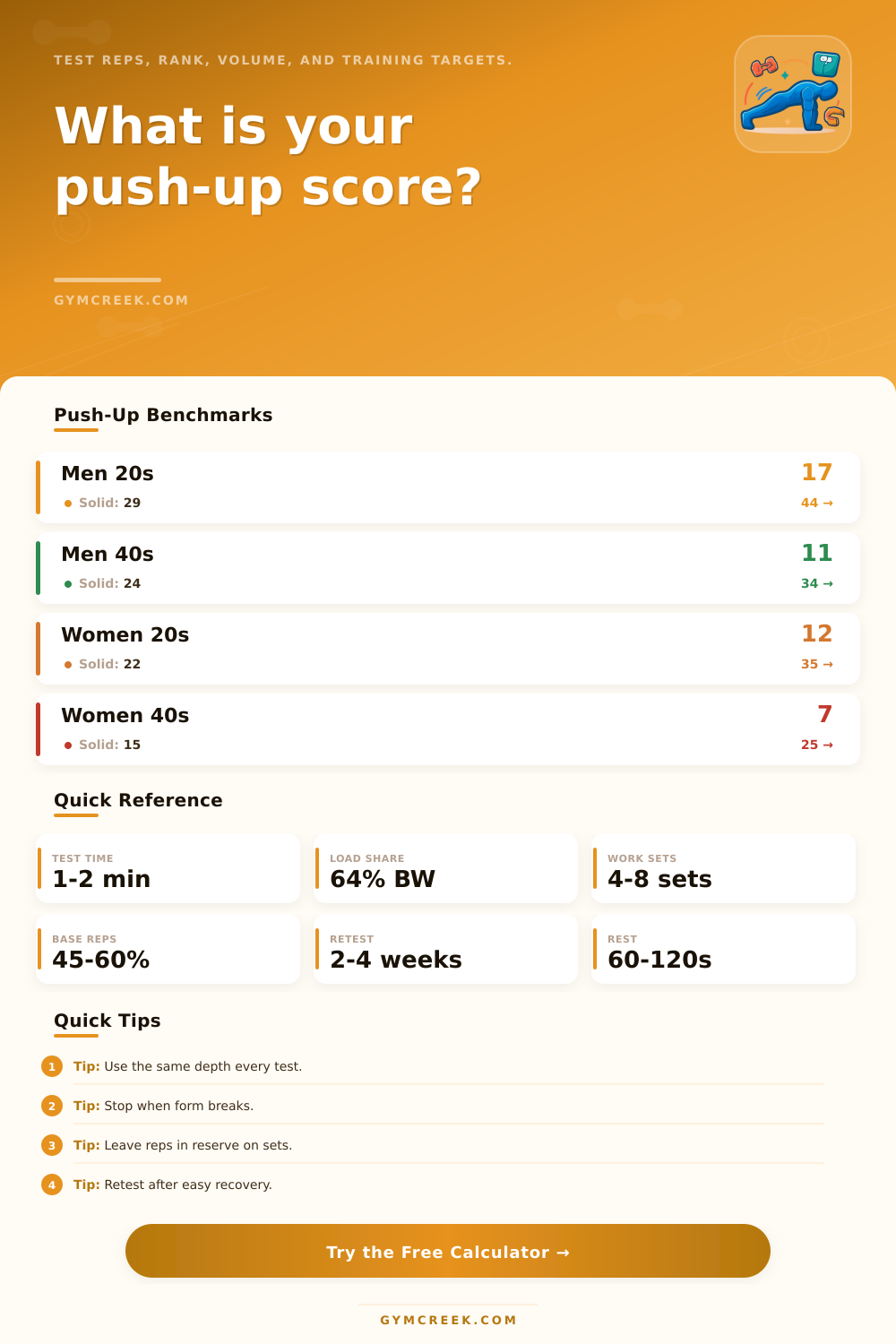
| 20-29 | 17 reps | 29 reps | 44 reps |
| 30-39 | 13 reps | 24 reps | 35 reps |
| 40-49 | 11 reps | 18 reps | 34 reps |
| 50-59 | 9 reps | 15 reps | 28 reps |
| 60+ | 6 reps | 11 reps | 24 reps |
| Female Age | Needs Work | Solid | Strong |
|---|---|---|---|
| 20-29 | 12 reps | 22 reps | 35 reps |
| 30-39 | 9 reps | 19 reps | 30 reps |
| 40-49 | 7 reps | 15 reps | 25 reps |
| 50-59 | 5 reps | 12 reps | 20 reps |
| 60+ | 3 reps | 8 reps | 16 reps |
| Style | Load Share | Best Use | Notes |
|---|---|---|---|
| Standard | 64% BW | Testing | Most norms use this |
| Knee | 49% BW | Return work | Keep torso straight |
| Incline | 42% BW | Volume base | Higher box is easier |
| Decline | 72% BW | Strength base | Harder on shoulders |
| Weighted | 64% BW+ | Strength work | Add load carefully |
| Goal | Weekly Volume | Set Zone | Retest |
|---|---|---|---|
| Test score | 5-7x max | 45-60% | 2-3 weeks |
| Endurance | 7-9x max | 35-55% | 3-4 weeks |
| Strength | 4-6x max | 55-75% | 3-5 weeks |
| Maintenance | 3-5x max | 40-60% | 4-6 weeks |
| Return | 2-4x max | 30-45% | 2-4 weeks |
💡Tips
They have a reputation problem. It’s brutal because it is brutally honest about your current physical condition. There’s no way to hide behind complicated barbell set-ups or heavy dumbbells; when you’re balancing on your toes and hands, what you’ve got shows up all at once; every weakness in your muscular endurance, core rigidity and shoulder stability.
It’s also the most accessible test of strength available to just about everyone. It’s a perfect baseline metric to use as a way to track your progression over time. But then comes the problem: treating it as if it were simply a matter of repetition counts, without understanding the actualy factors driving the performance.
Why Your Push-Up Score Matters
The typical gym-goer flops his body down on the floor and hopes that bigger means better, pumping out as many reps as possible before giving up. This method only works if you’re benchmarking against previous performances in exactly the same conditions; otherwise, your score becomes meaningless because you might just be cheating the weight by rushing through the tempo, changing the depth, or adjusting grip of hands.
In order to check your progress, you require some standardization that will allow you to tell if you are in fact becoming stronger or simply more efficient at cheating. You can skip the guesswork about how much easier or harder your chosen variation is, after plugging in your test conditions into the calculator above, it does all the math for you. It uses raw reps and adjusts accordingly for things like body weight, range of motion and tempo to provide an accurate estimate of your strength.
Why? Because bouncing on your elbows require a lot less force than lowering your chest to touch the ground in a slow, strict push-up. To account for this, the tool weighs the quality of each rep so that grinding away at poor form won’t rank you unfair below someone who has fewer but cleaner reps.
The second critical component is understanding how it distribute loads. This is a question that most folks miss. Based off both biomechanical and physics calculations, not guess work, performing regular push-ups moves about 64% of your body weight. Adding weight to your back with a plate or vest simply increases that value proportionally. Performing decline push ups shifts additional weight onto your shoulders and upper chest making it more difficult even though you’re doing the same number of reps. The chart below shows it very well so you can select the version to fit your goal.
In fact, another major factor in any type of strength or endurance test is age, primarily due to natural changes in recovery rate and muscle density with aging. If you’re pushing fifty it’s usually not worth it to benchmark yourself against somebody in their twenties; add in other lifestyle variables such as stress and sleep, and it can be a meaningless comparison. What you really want to know is how your latest result stacks up against those in your same age bracket. Using common standards, the tool ranks your performance against that of your peers, providing a realistic sense for where you fall compared to the general population.
Instead of giving it everything you’ve got each workout, use a combination of planned volume and patience to train for higher numbers. That means most folks trains as if they’re always trying to test their limits, resulting in plateaus and burnout. By setting weekly goals according to your maximum capacity, the calculator suggest rep ranges that’ll increase endurance but not break down your form. It’s about exposing yourself consistently to movement pattern so your connective tissues can adapt while staying ahead of fatigue.
Building true strength is about form over quantity. When your elbows starts flaring out and your hips begin to sag, stop counting because those reps aren’t helping; they’re hurting. Clean, controlled movements that work the whole front of your body (abs to shoulders) are what you desire. Train with several rep in reserve so you can stick the landing all workout long.
The discipline should of paid off at test time. Your push-up score isn’t necessarily a measure of your arm size; it’s a test of your ability to move efficient and with control when loaded. Take all the equipment out of the equation and let gravity be your only friend, you’ll find out exactly how much (and how little) your body can do for itself. Let the numbers serve as guidelines, but pay more attention to the sensation of solid form than to the final tally. Because a push-up requires total-body coordination, it’s still one of the most trustworthy tests of functional upper-body strength. Master that, and master the foundation.