Push Press to Overhead Press Calculator
Estimate your strict overhead press from a push press set, blend in any recent strict test, and set realistic training maxes.
📌Presets
Presets load realistic press profiles, including different leg-drive styles, test confidence levels, and plate rounding choices.
⚙Calculator
Press carryover snapshot
Enter your push press set and calculate a strict overhead press estimate.
📊Press Metrics
📑Reference Tables
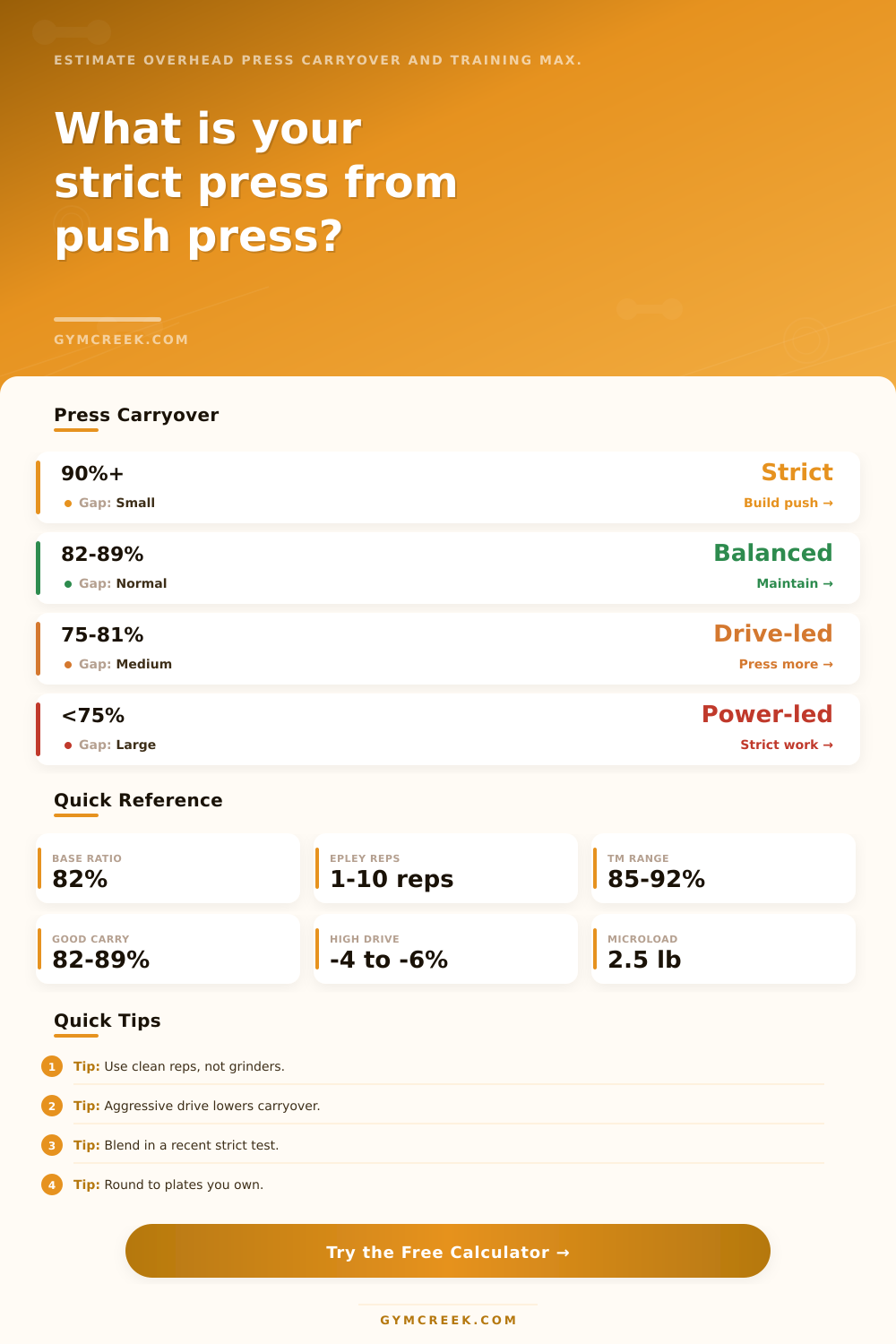
| Strict / Push Ratio | Interpretation | Common Cause | Training Signal |
|---|---|---|---|
| 90% or higher | Strict-dominant press | Small leg drive benefit | Add overload practice |
| 82-89% | Balanced carryover | Normal dip and drive | Keep both lifts trained |
| 75-81% | Push press ahead | Strong leg contribution | Bring up strict strength |
| Below 75% | Power-dominant result | Large drive advantage | Use conservative estimates |
| Leg Drive Style | Ratio Adjustment | What It Means | Estimate Bias |
|---|---|---|---|
| Minimal dip | +3% | Press does more work | Higher strict estimate |
| Solid dip | 0% | Typical push press | Neutral estimate |
| Aggressive drive | -4% | Legs add more speed | Lower strict estimate |
| Jerk-like dip | -6% | Very power dependent | Most conservative |
| Rep Range | Epley Formula Use | Confidence | Note |
|---|---|---|---|
| 1 rep | Load x 1.03 | High | Near max strength |
| 2-5 reps | Load x (1+reps/30) | Good | Best calculator range |
| 6-10 reps | Same formula | Moderate | Fatigue matters more |
| 11+ reps | Use caution | Lower | Endurance skews result |
| Training Goal | Strict TM | Push Press Load | Best Use |
|---|---|---|---|
| Strict strength | 85-90% | 95-105% strict | Build press base |
| Balanced | 85-90% | 105-115% strict | Maintain carryover |
| Overload power | 80-88% | 110-125% strict | Heavy lockout work |
| Return phase | 75-85% | 90-105% strict | Conservative loading |
💡Tips
With the push press, you can move a lot of weight because you generate force from your legs. You dip into your knees, explode up, and bar goes over your head without much arm-shaking whatsoever. But if you attempt to press that weight strictly, it falls short again.
Strictly pressing it show what your triceps and shoulders is actualy capable of doing. It’s the difference between jumping and building muscle. The gap between the two determine whether you are building muscle or just teaching yourself to jump.
Push Press vs Strict Press: The Difference
Strict: While the push press can be used to develop lockout endurance, it’s no substitute for the strict overhead press. You’ll use some of the initial velocity from your legs which your upper body will need to stop. Use too much leg drive and you’re training your glutes and quads, not your deltoids.
So, even though the calculator factors in how well you performed during your last round of strict tests, as well as your push presses, it’ll give an approximate view into your true pressing strength. Why does this matter? Because when we ego lift, our weakness remain hidden. The strict press reveals the truth about your shoulder stability and triceps strength.
To understand these numbers, consider the carryover ratio. How close is your strict press to your push press? Are your shoulders strong compared to your legs? That’s something very few lifter possess. Most are in the mid-range; there’s a visible separation. Wider still indicate greater reliance on momentum vs. Muscle tension.
As you’ll see from the reference table, varying your drive style affects your estimated strict max. An exaggerated dip will decrease the carryover percentage (the lower body takes up more of the workload). Not a bad thing, necessarily, but this indicate conservativeness when estimating your strict press. You can’t turn all that leg drive into a static lockout.
How should you apply those numbers? How will you use this information to help you get stronger? Use them to train for strict strength. Use the push press as a way of overloading your stabilizers. Set a weight heavy enough on the push press until they is fatigued and back off to sets of strict presses. This makes your shoulders do all the work.
The calculator will set training maxes according to what you can already do. And, it considers how confident you are in your most recent strict test. So if you haven’t performed a strict test in months, the tool will place greater importance on your push press numbers. But if you’ve just recently tested, it’ll lean on that number more, that way you don’t risk using any stale data.
One little thing people tend to overlook is rounding of their plates. For instance, maybe your training max equates to 133 pounds. However, the smallest plates you own are two and a half pounds. What do you do? Well, it means you’ll either have to round up or down to accommodate what’s in your gym. It doesn’t sound like much but these differences add up over the span of a twelve week block.
You should of considered this earlier. Entering your plate increments ensures the results reflect your gym environment. After all, you can’t train something off a piece of paper. You’ve gotta train with the iron you’ve got.
Balance is everything: You need enough leg drive for moving difficult loads while avoiding passive-shoulder positions. The push press teaches you to catch weight overhead. The strict press teach you to control that weight.
Once you know the distinction between the two, you cease guessing at how much weight to use. Instead, you plan how much weight you can control. This change turns a murky strength discrepancy into a crystal-clear roadmap. Press to develop the muscle; dip to move the weight. Maintain those distinctions in mind and the digits will fall into place.