Punch Force Calculator
Estimate punching force, impulse, and kinetic energy for sports biomechanics practice on focus mitts, shields, and heavy bags.
📌Presets
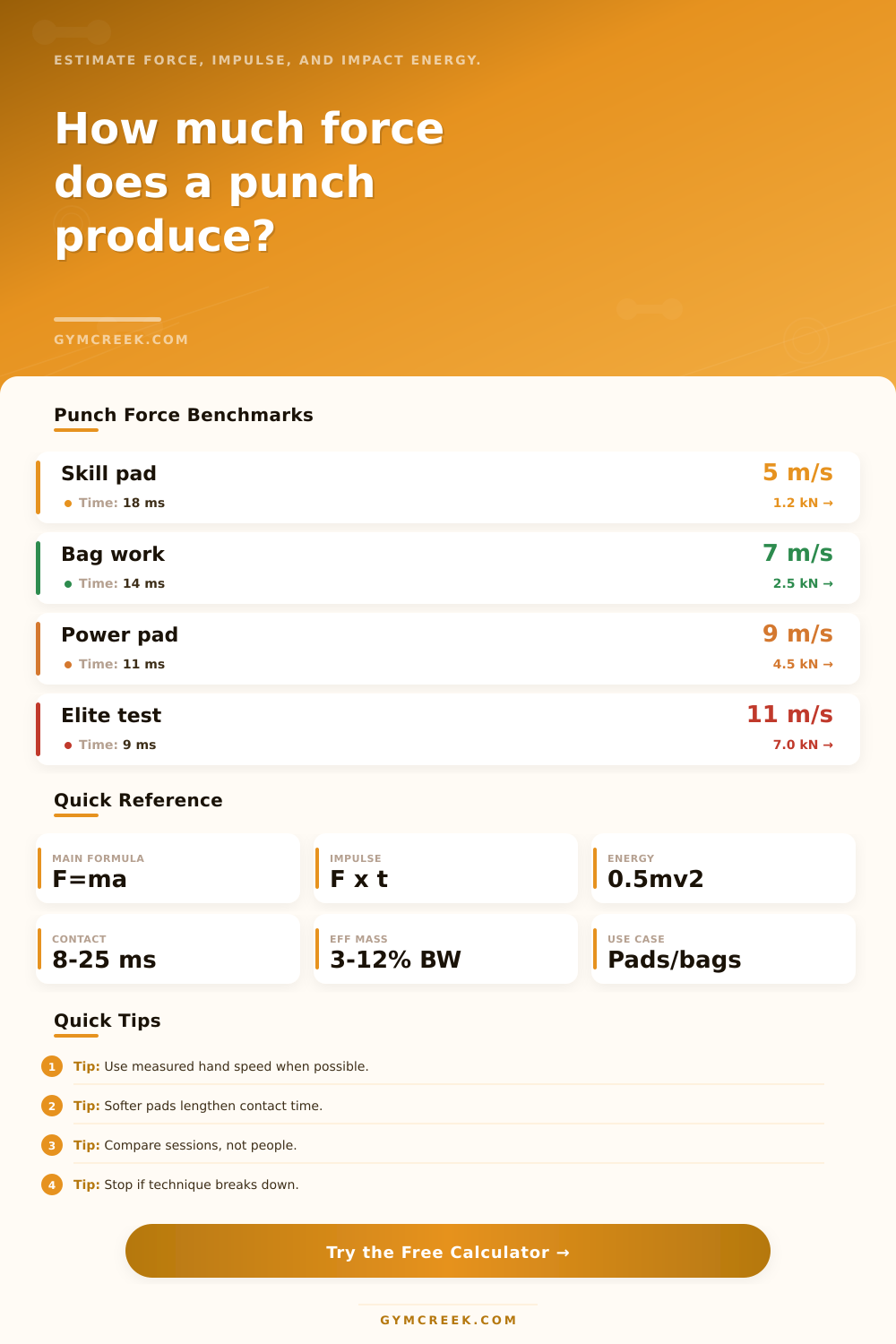
Presets model controlled pad or bag sessions and are for biomechanics estimates, not comparison outside a training environment.
⚙Calculator
Punch biomechanics snapshot
Enter speed, effective mass, and contact time to estimate training impact metrics.
📊Fitness Metrics
📑Reference Tables
| Training Scenario | Hand Speed | Contact Time | Typical Goal |
|---|---|---|---|
| Technical jab | 4-7 m/s | 14-25 ms | Timing and snap |
| Focus mitt cross | 6-9 m/s | 10-18 ms | Pad accuracy |
| Heavy bag strike | 7-10 m/s | 12-22 ms | Transfer practice |
| Sensor pad test | 8-12 m/s | 8-14 ms | Repeatable testing |
| Effective Mass | Body Weight Share | Best Fit | Notes |
|---|---|---|---|
| Light contact | 3-5% | Skill drills | Low transfer |
| Technical | 5-8% | Pad work | Good alignment |
| Strong bag work | 8-12% | Power rounds | Hip transfer |
| Lab estimate | 12%+ | Sensor testing | Needs context |
| Target Type | Force Curve | Contact Effect | Training Use |
|---|---|---|---|
| Focus mitt | Sharp | Shorter | Accuracy |
| Thai pad | Moderate | Medium | Combination work |
| Heavy bag | Rounded | Longer | Body transfer |
| Soft pad | Smoothed | Longest | Reduced impact |
| Formula Card | Variables | Output | Use |
|---|---|---|---|
| Momentum | m x v | kg m/s | Impulse basis |
| Average force | Impulse / time | Newtons | Main estimate |
| Work-energy | E / distance | Newtons | Distance check |
| Kinetic energy | 0.5mv² | Joules | Impact energy |
💡Tips
If you ever get a chance to watch a pro boxer throw a cross in slow motion, you will see something that appears counter intuitive. Although the hand is moving relatively slowly, there’s a whole body moving as single unit. It’s what I refer to as a kinetic chain. Mass from the ground are transferred through the hips into the fist. That transfer produce power, which is impossible to measure.
Some folks estimate their punching power based off the sound their bag makes. That might show enthusiasm, but it doesn’t tell you much about force. The calculator perform the math and converts abstract movement into concrete numbers. In other words, you’ll know whether or not you’re simply waving your hands around or throwing a punch.
How to Measure Punching Power
The key measure is effective mass. When you punch heavy bag, you use your leg drive, torso and shoulder. That’s where you move. The tool try to get an idea of how much of your own bodyweight gets transferred into the weapon. For example, a novice may only apply three percent, focusing on moving their arm. An expert can engages their entire skeleton with upwards of twelve percent (or more). This is where most estimates goes wrong. People don’t realize how much they’re transferring.
Even if you have good speed, your force numbers will appear small. It doesn’t take much, but it counts. Plug in your weight and speed. Let the calculator convert for you. No need to muck around with units or fudge coefficients.
The other side of that coin is speed. And it’s deceptively tricky. Kinetic energy are proportional to the square of velocity. Double your speed, and you quadruple your energy. While speed drills is light on your hands, they produce a very powerful force when performed with sharp technique.
As a reference table, here is the correlation between hand speed and common training scenarios: While many people train hard for strength in the gym, they ignore the acceleration phase of the punch. Without speed, mass are simply dead weight.
The longer you leave it on your hands, the better they is protected. The more contact time there is, the lower the peak force, and the shorter the contact time, the higher the peak force. Imagine punching a soft target like a pillow. It is harder than a brick wall. Because the pillow takes up some of the energy over a longer period of time, the brick wall will feel much different.
If you’re training for power, you want to minimize this while also maintaining good alignment. If you’re working on technique, you may be okay with sacrificing a little bit of time for proper landing location of your hand. Softer targets tend to have an increased value here, and this can serve as a great piece of feedback. Snap the punch, not the push.
The thing is, fatigue does a number on things. When fresh, you can maintain technique. Your hips turns in a full rotation. Your posture remain upright. By the fourth round, a hundred strikes later, that chain snaps. That’s what the fatigue adjustment reflects in the calculator.
You lose more than just muscle strength. You lose coordination of mass transfer. Now that same speed on your hands creates less effective mass because your connection to the ground slip. That’s what you’ll observe in the results. You’ll see the force decrease. This data allows you to track conditioning over time and also tells you how you fail under pressure.
Think of these numbers as a mirror and not a scoreboard. Are you going in the right direction on your own sessions? Does your control score go down with fatigue? Do you have consistency? Can you output the same amount of force round after round even though your lungs is burning? This is what true power is.
It is not about who can hit hardest, but who hits as hard as they can reliably when it counts. The math give you insight into the mechanics that you don’t see so you begin to engineer your strikes. Once you know how time, speed, and mass work together, you stop guessing and start working.