Pull Up Calculator
Score a strict pull-up test, adjust for assistance or added load, compare age benchmarks, and set training targets for your next block.
📌Presets
Each preset loads a pull-up profile and recalculates strict-equivalent reps, rank, strength estimate, and weekly volume.
⚙Pull-Up Inputs
Pull-up test snapshot
Enter a test result to calculate strict score, benchmark rank, strength estimate, and training targets.
📊Fitness Metrics Grid
📑Reference Tables
| Male Age | Base | Solid | Strong |
|---|---|---|---|
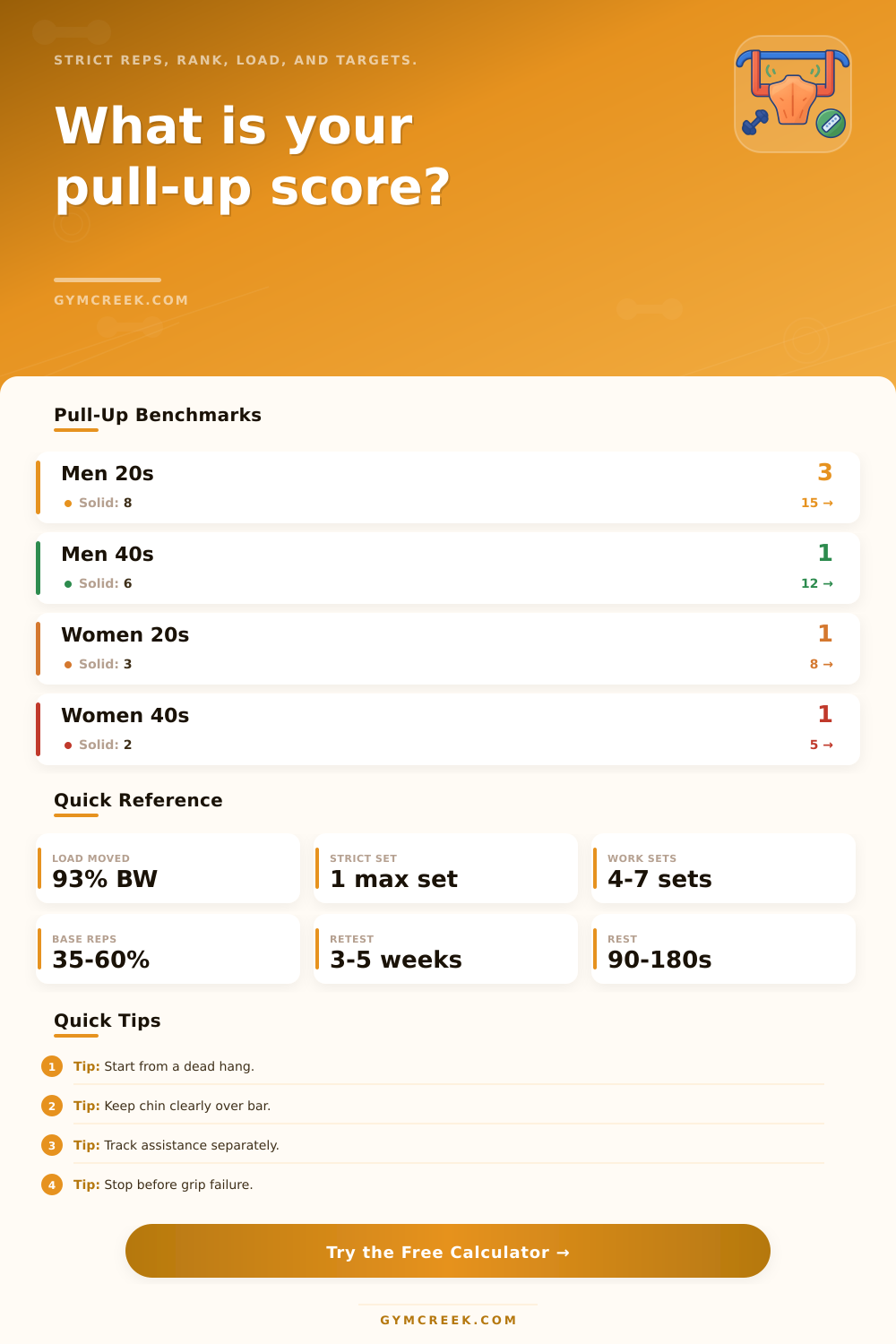
| 20-29 | 3 reps | 8 reps | 15 reps |
| 30-39 | 2 reps | 7 reps | 13 reps |
| 40-49 | 1 rep | 6 reps | 12 reps |
| 50-59 | 1 rep | 4 reps | 9 reps |
| 60+ | 1 rep | 3 reps | 7 reps |
| Female Age | Base | Solid | Strong |
|---|---|---|---|
| 20-29 | 1 rep | 3 reps | 8 reps |
| 30-39 | 1 rep | 3 reps | 7 reps |
| 40-49 | 1 rep | 2 reps | 5 reps |
| 50-59 | 1 rep | 2 reps | 4 reps |
| 60+ | 1 rep | 1 rep | 3 reps |
| Grip | Modifier | Best Use | Notes |
|---|---|---|---|
| Overhand | 1.00x | Testing | Default pull-up score |
| Chin-up | 0.94x | Volume | Often slightly easier |
| Neutral | 0.97x | Joint comfort | Good repeatability |
| Wide grip | 1.08x | Strict strength | Harder range control |
| Mixed | 1.02x | Grip variation | Alternate sides evenly |
| Goal | Weekly Volume | Set Zone | Retest |
|---|---|---|---|
| Max reps | 4-6x max | 40-60% | 3-4 weeks |
| Endurance | 6-8x max | 30-50% | 4-5 weeks |
| Strength | 3-5x max | 45-70% | 4-6 weeks |
| Skill | 3-6x max | 30-45% | 3-5 weeks |
| Return | 2-4x max | 25-40% | 2-4 weeks |
💡Tips
A pull-up bar seems pretty straightforward: Grab it, pull your bodyweight up, then let go. Either you can or you can’t, right? But it’s actualy far more complex than what we see. If you’re lean and twenty-five, a single rep isn’t the same thing as if you’re forty-five and stuck behind a desk. That’s why this tool take your raw effort and shows it in a way that matters to you.
Once you input all that info, the calculator above does the rest (i.e., spares you from estimating how your bodyweight or age adjusts baseline). It computes those factors against known norms, so you no longer have to wonder if you are strong enough; you will see exactly where you land on the spectrum. It counts your final reps (with or without the aid of a band), and it factors in that assist, along with whatever additional weight you’ve tied around your waist. Because while a full-bodyweight load is standard (e.g., moving 93% of your own bodyweight), a 20-pounder on the ol’ hips totally alters the equation.
How to Use the Pull-up Bar Calculator
The results include a recommended rep range, an estimated strict max, a suggested weekly volume goal, a benchmark rank in your age class, and a good idea of both where you stand now and what effort will be required tomorrow. Many lifters view the range of motion and tempo variables as boring, but they’re only half the battle: understanding the inputs. A rep done with momentum swings might feel easier in the moment, but it builds less specific strength then a controlled dead stop. That is why it’s a mistake.
The tool filters out this kind of noise by asking for your range quality and average pace. Rushed reps? Estimated capacity drops. Pauses at the bottom? Intensity rises. This distinction separates true strength from mere endurance or momentum tricks. You don’t necessarily want to know how many times you could fling yourself up off the ground before your grip gives out. Instead, you want to know what your body can actually handle under strict conditions.
Here’s how it lays it out, with some example tables from the page. These charts is for various demographics. For example, according to them, five repetitions is enough to get you into the “strong” category if you’re a forty-year old female. A younger guy would require fifteen to reach the same strength level compared to his peers. That avoids discouraging anyone, as getting discouraged is easy when you compare yourself to someone who is already good at something (or even just a teenager). Instead, by comparing yourself to people within your demographic group, you can set a reasonable goal. And again: the calculator adjusts based on your age and gender. This means the feedback you recieve will always be encouraging instead of discouraging. It recognizes that people are not physically the same throughout their lives and sets expectations to match.
Another variable we tend to neglect is how often you train. Doing one max set per week isn’t very efficient for most folks. Instead, spread it out over three or four training sessions so you can recover between workouts while still performing high-quality reps during each set. Depending on your goal (i.e., building raw strength for weighted pull-ups vs. Building muscular endurance for calisthenics flows), the tool will suggest what the right amount of volume should of be for a week. Then, it figures out the best combination of rep counts and sets per session to reach that target without wrecking your joints and frying your nervous system. That way, you aren’t guessing about whether you’re doing too much or not enough, you’re following a structured program, which takes the guesswork out of your workout programming. You have a clear lane, courtesy of the math.
The other subtle yet important factor is grip style. Generally speaking, pulling with an overhand grip feels slightly harder (and engages less bicep) compared to a chin-up. Using a wide grip reduces the need for shoulder leverage and transfers some of the work to the lat muscles. Whether your preference is for the overhand or the chin-up, the calculator includes modifiers that allow you to compare apples to apples. In this way, the tool is flexible enough to suit the needs of general fitness fans, tactical athletes, and climbers alike. While it maintains a common standard for progress, it still validates differences in approach.
To conclude. Pull-up tracking is more about managing expectations than anything else. It’s about making reps happen, but it’s also about how slow the body changes over time. Progress isn’t always linear; sometimes it comes in waves. There are weeks when you’ll be feeling strong and other weeks where it seems impossible to find your groove again. This is normal.
So what’s the key? You need consistency and honest testing. Set your baseline with the tool, stick to the recommended volume, and don’t retake the test until a few weeks of consistent effort have passed. Don’t chase instant results. They lead to burnout or injury. Instead, build up reps steadily, and before long you’ll have lasting capability. You want a back that will serve you for decades, not just one that makes you look good for a week. Trust the process, start from a dead hang, and keep your chin well above the bar. The effort will pay off and the numbers will come.