Pull Up Bar Height Calculator
Set a practical bar center height from standing reach, dead-hang toe clearance, movement style, ceiling height, and mounting limits.
📌Presets
Each preset loads a realistic mounting scenario and recalculates reach gap, ceiling room, and the likely step height.
⚙Calculator
Pull-up bar height snapshot
Enter reach and room limits to calculate a practical bar height.
📊Fit Metrics
📑Reference Tables
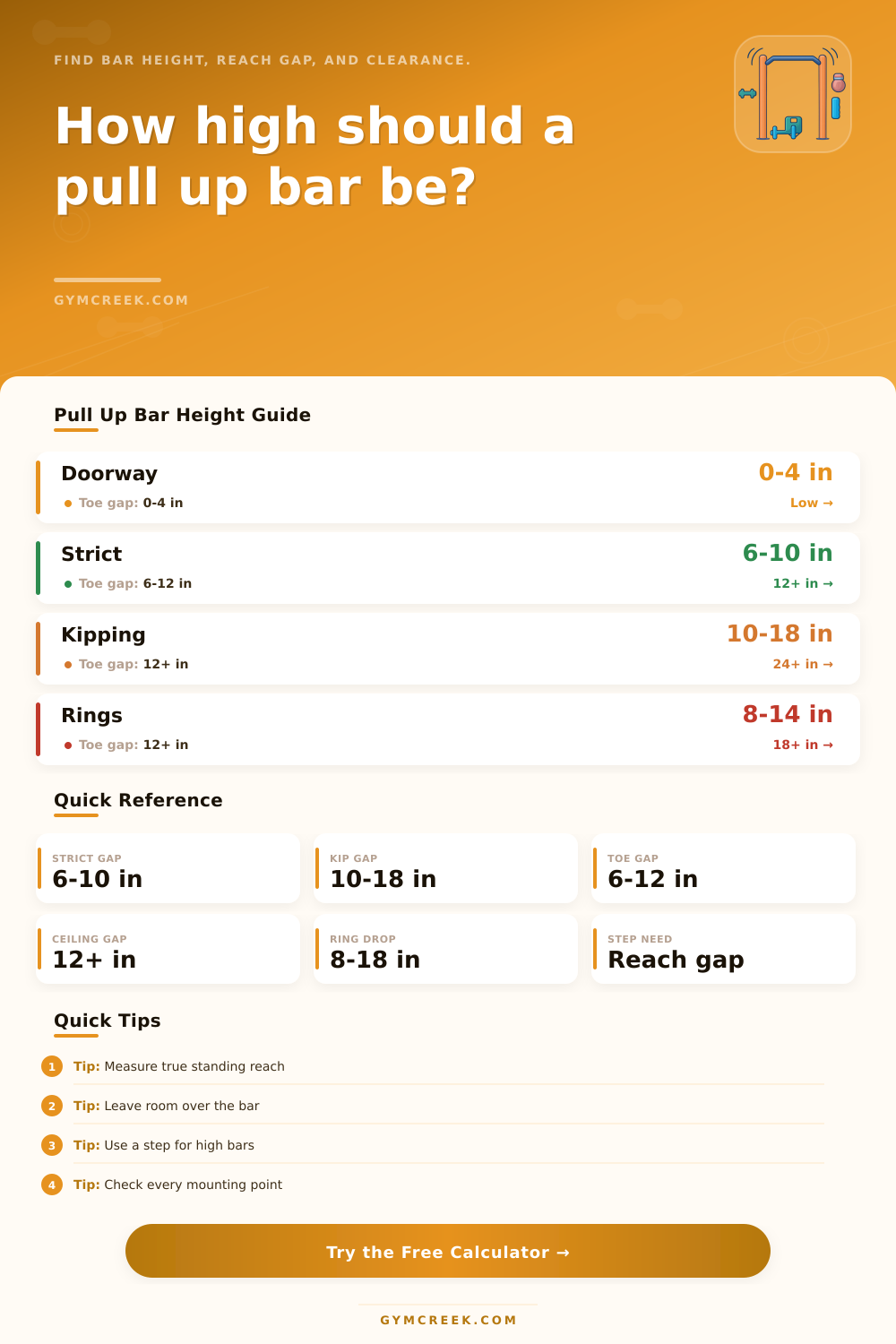
| Use case | Reach gap | Toe gap | Over-bar room |
|---|---|---|---|
| Doorway bar | 0-4 in | 0-4 in | Frame limited |
| Strict pull-up | 6-10 in | 6-12 in | 12+ in |
| Kipping work | 10-18 in | 12+ in | 24+ in |
| Bar muscle-up | 14-24 in | 12+ in | 30+ in |
| Measurement | How to take it | Use | Common error |
|---|---|---|---|
| Height | Wall mark | Fallback reach | Shoes included |
| Reach | Arm overhead | Main input | Shoulder shrug |
| Ceiling | Lowest point | Upper limit | Ignoring beam |
| Toe gap | Dead-hang feet | Lower limit | Knees bent |
| Mount | Typical limit | Best use | Check first |
|---|---|---|---|
| Wall | Ceiling room | Strict work | Stud spacing |
| Ceiling | Joist height | High bars | Lag depth |
| Rack | Upright holes | Shared gyms | Hole spacing |
| Doorway | Frame height | Low spaces | Trim strength |
| Formula item | Method | Why it matters | Output |
|---|---|---|---|
| Reach est. | Height x ratio | No reach tape | Estimated reach |
| Min height | Reach + gap | Access to bar | Low bound |
| Hang height | Height + toe | Foot clearance | Low bound |
| Max height | Ceiling - room | Head clearance | Upper bound |
💡Tips
Setting a proper height for a pull up bar require individuals to take several specific measurement of their bodies in order to ensure that their body is properly account for when determining the height of the bar. If the pull up bar is set too low, the individual’s feet will drag on floor. However, if the pull up bar is set too high, the individual may struggle to reach the bar with they hands.
To properly calculate the height of the pull up bar that will be most functional for an individual, there are several measurement that must be considered. The standing reach of the individual is the single most important measurement of the individual’s body, it is a measurement that will vary from person to person. Even if two individuals has the same height, those individuals may have different measurements of their arm lengths.
How to Set the Right Height for a Pull-Up Bar
It is important, therefore, to use the standing reach measurement instead of total body height in any calculation of the proper height for a pull up bar. Additionally, toe clearance is another measurement that should be considered. Toe clearance is the measurement of the distance between an individual’s feet and the floor while perform a pull up.
An individual performing strict pull up exercises will require less toe clearance then an individual performing kipping pull up exercises. Because kipping pull up exercises require more leg movement than strict pull up exercises, more toe clearance is required for those performing kipping pull up exercises to ensure that their legs do not come into contact with the floor during performance of the exercise. Thus, an individual’s toe clearance need must be accounted for in the calculatioin of the proper height for their pull up bar.
Another important measurement is ceiling height. Even if an individual calculates to the proper height for their pull up bar based off their standing reach, toe clearance, and body height, it is essential to ensure that the ceiling in the desired installation location allow for the height of the individual’s pull up bar. If the ceiling height is too low, the individual will not be able to properly install the pull up bar without compromising the individual’s safety.
Thus, ceiling height must be considered for installation of the bar. Additionally, the type of mounting for the pull up bar will affect the height of the bar that can be installed. For instance, doorway mounted pull up bars often do not provide an abundance of mounting height option for installation of the bar.
In contrast, wall mounted pull up bars may have some flexibility in their installation to accommodate the placement of studs in the wall. Finally, ceiling mounted pull up bars have the most flexibility in their mounting to accommodate various heights of individuals; however, in this case the individual would have to determine the direction of the joists in the ceiling and the depth of the lag bolts that they must be use to mount the bar. The tables that are provided in the pull up bar calculators provide information about the gap between bars for individuals that have different movement styles.
For instance, individuals that perform strict pull up exercises require less space between the pull up bar and the individual’s body than individuals that perform muscle up exercises. For muscle up exercises, more space is required above the bar for the individual’s body to clear the bar without straining their head against the ceiling. Thus, these numbers provide guidelines for individuals for the placement of their own pull up bars.
One of the most common mistakes in installing a pull up bar is to assume that the height of a pull up bar that will accommodate one individual in a household will be sufficient for all of the individual who live in that household. For instance, children, shorter adults, and athletes all have different reach measurement. Thus, the height of a pull up bar that is installed for one adult may not be sufficient for another individual with shorter arms.
The age and height fields in the calculator can be used to evaluate these scenarios and to determine whether a second pull up bar is required in the location. Another factor that may impact an individual’s installation of their pull up bar is the type of floor surface. For instance, rubber mats will provide more grip for an individual’s feet than a surface like polished concrete.
Additionally, if an individual plans to install the pull up bar on a raised platform, that will impact the distance between an individual’s feet and the pull up bar. While the type of floor will not significantly impact the calculations that are performed with the pull up bar calculator, it may have some effect upon the functionality of the pull up bar once installed. The reach ratio for an individual is a calculation of the standing reach of the individual divided by the total height of the individual.
For most individuals, the reach ratio will fall within a certain range; however, some individuals has longer or shorter arms than others of the same height. Thus, an individual with longer arms may have a higher ideal height for their pull up bar than an individual with shorter arms. Thus, the reach ratio is a factor that can help to explain the determination of the pull up bar height that is provided in the calculator.
If the height of the ceiling indicates that an individual will be unable to reach the ideal height of the pull up bar that was calculated for the individual, some decision must be made. The individual could choose to install a step into which the individual may step in order to reach the pull up bar, or the individual could choose to install the pull up bar at a higher gap between the bar and the individual’s body, in which case the individual will have to perform the exercises in the pull up bar with some degree of difficulty. The decision of which choice indicates that an individual must make based upon their individual situation.
Finally, the pull up bar calculator should be run again if an individual is moving into a new home or into a new room within their existing home. The height of the pull up bar that was correct for an individual at one location may not be correct at another location. Thus, by running the pull up bar calculator again, an individual can determine whether the installation of the pull up bar at the calculated height will be successful.
An incorrectly installed pull up bar will make it more difficult for an individual to focus upon their exercise routine.