Protein Timing Per Meal Calculator
Build a daily protein rhythm from body weight, goal, meal count, eating window, training time, source quality, and the protein you have already eaten.
📌Presets
Presets load realistic schedules and protein goals. Adjust any field to make the plan fit your day.
⚙Calculator
Protein timing plan
Enter your daily schedule to calculate protein per meal.
📊Timing Metrics
📑Reference Tables
| Daily protein goal | Typical range | Best fit | Calculator use |
|---|---|---|---|
| Maintenance | 1.4 to 1.8 g/kg | General training and stable weight | Lower target range |
| Muscle gain | 1.6 to 2.2 g/kg | Hypertrophy blocks and strength phases | Standard training target |
| Fat loss | 1.8 to 2.4 g/kg | Cutting phases and appetite control | Higher target range |
| High activity | 1.6 to 2.2 g/kg | Repeated sessions and sport recovery | Performance target |
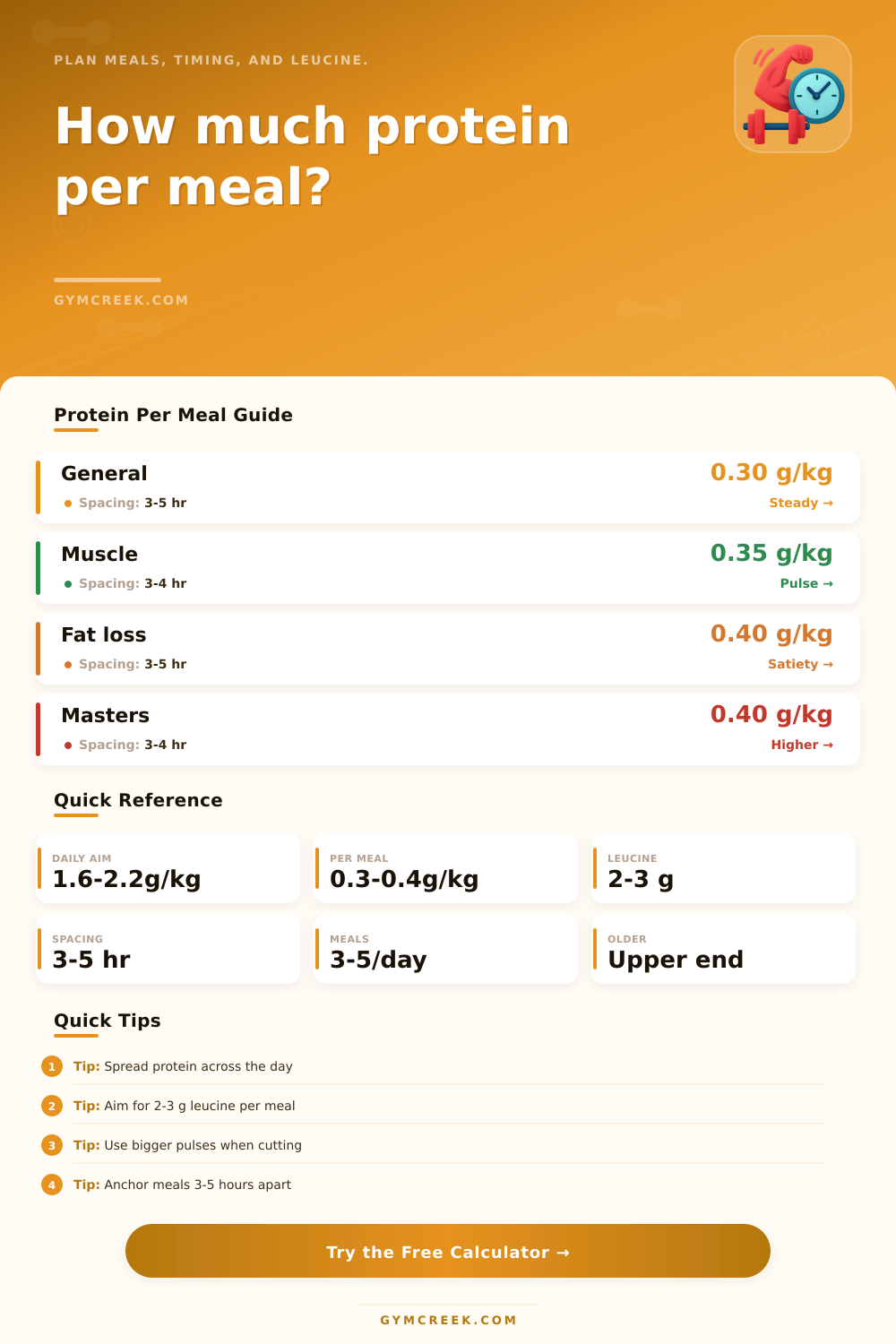
| Per-meal pulse | g/kg per meal | Leucine cue | Planning note |
|---|---|---|---|
| Light pulse | 0.20 to 0.29 g/kg | May be low | Works for snacks or smaller athletes |
| Standard pulse | 0.30 to 0.39 g/kg | Often adequate | Good default for most training days |
| Higher pulse | 0.40 to 0.49 g/kg | Usually strong | Useful for older adults or cutting |
| Large pulse | 0.50+ g/kg | More than needed | May be fine but not always necessary |
| Meal spacing | Signal | Best use | Watch point |
|---|---|---|---|
| Under 2.5 hours | Very close | Short eating windows | Pulses may overlap |
| 3 to 5 hours | Strong default | Most lifters and athletes | Keep meals realistic |
| 5 to 6 hours | Wide spacing | Three-meal schedules | Use higher meal protein |
| Over 6 hours | Long gap | Fasting schedules | Consider another pulse |
| Formula piece | What it uses | Why it matters | Output affected |
|---|---|---|---|
| Daily target | Body weight kg x g/kg | Sets the total day goal | Daily protein card |
| Average pulse | Daily target divided by meals | Shows meal protein load | Per-meal card |
| Leucine estimate | Protein grams x source percent | Checks meal quality signal | Leucine card |
| Spacing | Eating window divided by gaps | Builds practical timing | Meal schedule |
💡Tips
Someone has surely told you before that you should be hitting some arbitrary protein target each day. There are charts all over the internet which will tell you exactly how many grams of protein you should consume depending on your weight. When most folks see these numbers, they freak out because they skipped breakfast and try to “make up” for it by overeating during dinner. This is completely missing the point.
Your muscles don’t care about your daily number so much as your individual sittings. What matters is pulsing them with amino acids; a yearly total does little. It’s in spreading out these pulses where the magic occurs. Protein intake should be viewed as gardening. Would you water your garden by dumping a bucketful of water into soil weekly and hoping it penetrates? Or would you set up a slow drip system so roots stays consistently moist? The former method result in wasteful runoff and the potential for poor plant growth caused by drought stress. The latter yields better plants.
Why Spreading Out Protein Is Important
Your body behave this way with muscle protein synthesis. Eating a meal with high levels of leucine activate a signal telling your muscles to begin growing and repairing themself. Leucine is an essential amino acid primarily sourced from high quality foods such as eggs or dairy. This occurs for approximately three to four hours. After that period, the signal fades. If you then go eight hours without another large meal, you’re allowing that machine to remain idle for half the day. It’s not efficient by design.
That’s where this tool comes in: It lets you see that rhythm without having to do any fancy math in your head. Simply input your goal and weight, and the tool spits out how much protein you should aim to consume at each sitting to maintain that muscle building signal. Why is that important? Many of us front-load our intake. Consuming three small snacks throughout the day followed by a big ol’ steak for dinner. Unfortunately, those little snack rarely contain enough leucine to truly kick off the repair process. Evenly distributing your intake allows all meals to contribute something meaningful toward your recovery instead of merely stuffing your face.
The tool up top takes care of the distribution for you; now you just have to find some foods that meets those targets. And then there’s age. Anabolic resistance sets in as we age: our muscles begin to require a bit more protein to respond to eating it. That doesn’t imply you won’t grow anymore; just that the “threshold” for getting that repair signal will increase. For example, older people frequently require greater protein per meal different than younger people do to reap the same benefits of a smaller serving. This is why the recommended tables packaged with the calculator suggest slightly increased per-meal amounts for the master lifter or someone who is doing body recomposition. This is not necessarily because they should of eat more total food, but because they can concentrate the quality into fewer bigger meals that the tissue can actualy feel.
Timing also depends on context. Train later in the day and your body will be primed for nutrient uptake during and after the workout. So having something protein-based near your workout window is helpful in starting immediate recovery. That doesn’t mean you have to chug a shake right as you walk out the door or within thirty minutes like some old bodybuilding myths say. However, it does make sense to have that nutritional bridge between your last meal and your workout. This ensures you’re not breaking down muscle tissue for fuel because you have nothing in the pipeline. This is accounted for with the spacing recommendations and shifting the clock around based off when you train and when you start eating.
Perfection loses out to practicality in this case. Real life isn’t a life of perfect spacing with meals delivered on time at regular 4-hour intervals, sometimes you’re preoccupied. Sometimes you forget to eat. Sometimes you simply feel the desire for three large square meal. The calculator handles these variations so that you can bend the science to match your reality. Twice-a-day eaters need much bigger meals than once-every-four-hours eaters because they require more food stimulus during their smaller number of meals. Five-times-a-day eaters don’t need as much food as the twice-daily eaters, but they spread it out across more frequent portions. As long as both strategies meet or exceed the per-meal threshold regularly, then either will do the trick. Sustainability beats sticking strictly to an abstract grid.
In the end, it’s all about establishing a routine that serves your aspirations but doesn’t add stress to your life. You should distribute protein well enough to maintain your body in a positive state for as much of the day as possible. This is where what you do turns a loose daily aspiration into a set of achievable tasks. Where seeing the breakdown per meal makes prepping more and packing better snacks second nature. Where you no longer guess; now you feed your goals on purpose. That transition from total to timing is the distance between staying the same and making changes to your physique. It brings the garden back into balance, one steady pulse at a time.