Protein Per Meal Calculator
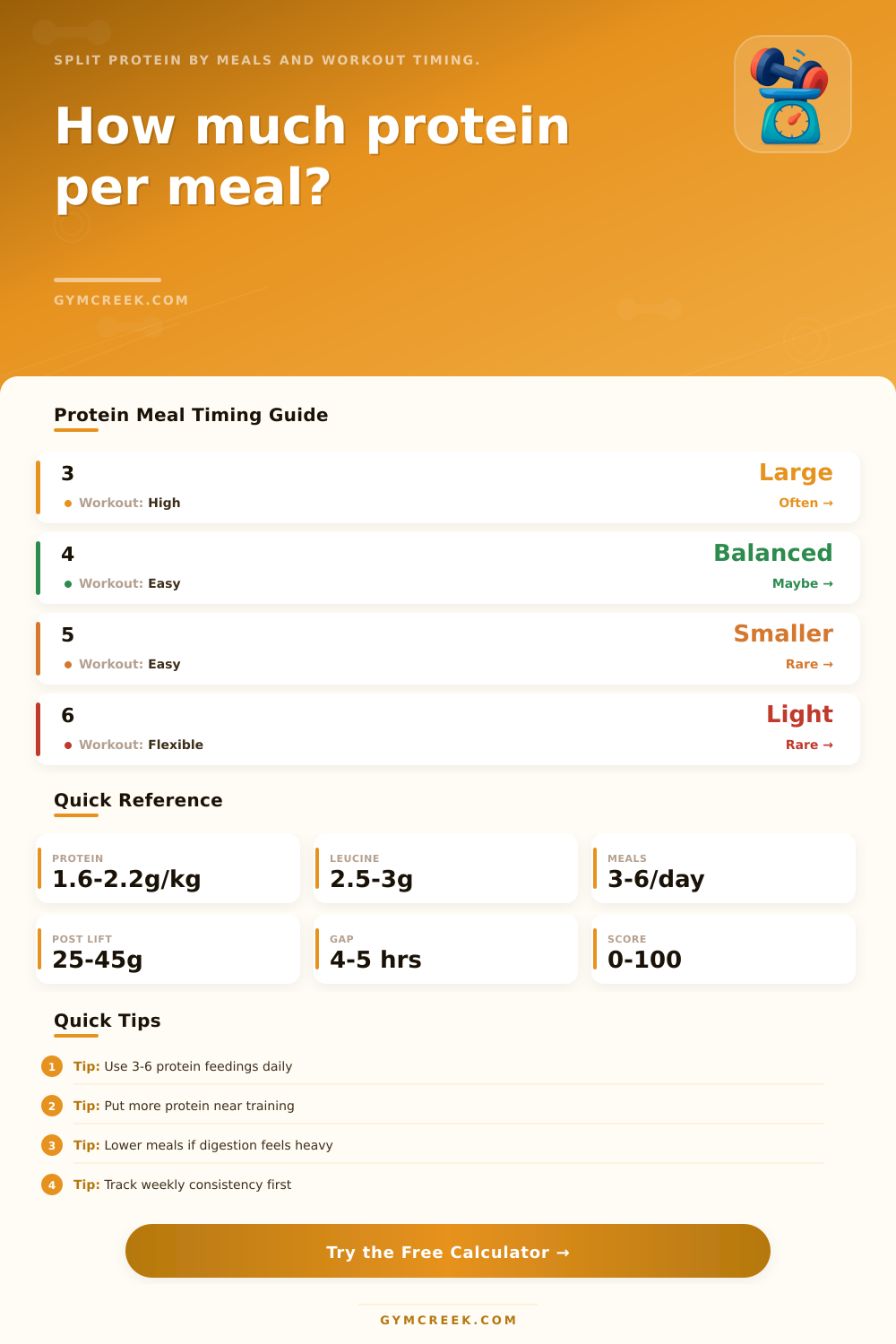
Split a daily protein target across meals, adjust pre- and post-workout allocation, estimate leucine-threshold coverage, score distribution quality, and flag snack gaps.
📌Per-Meal Presets
Presets load realistic meal-frequency and training-timing scenarios. They do not prescribe foods; they only distribute the protein target you choose.
⚙Calculator Inputs
Per-meal protein snapshot
Enter your protein target and meal pattern to calculate a distribution.
📊Protein Metrics Grid
📑Protein Reference Tables
| Goal | Common range | Meal note | Score cue |
|---|---|---|---|
| Muscle gain | 1.6 to 2.2 g/kg | 3 to 5 solid feedings | Even plus workout timing |
| Fat loss | 1.8 to 2.4 g/kg | Higher satiety priority | Avoid very low meals |
| Strength | 1.6 to 2.2 g/kg | Fuel around hard sessions | Post-workout adequacy |
| Endurance | 1.2 to 1.8 g/kg | Smaller meals can fit | Digestive comfort matters |
| Protein type | Leucine estimate | Protein for 2.5 g | Protein for 3 g |
|---|---|---|---|
| Mixed diet | 8% to 9% | 28 to 31 g | 34 to 38 g |
| Dairy / whey | 10% to 12% | 21 to 25 g | 25 to 30 g |
| Meat / eggs | 8% to 9% | 28 to 31 g | 34 to 38 g |
| Plant-forward | 6% to 8% | 31 to 42 g | 38 to 50 g |
| Meals/day | Typical use | Gap risk | Snack cue |
|---|---|---|---|
| 2 meals | Compressed eating window | High | Use a protein bridge if meals exceed 5 hours apart |
| 3 meals | Traditional pattern | Moderate | Add 15 to 25 g if one meal lands below threshold |
| 4 meals | Balanced lifter pattern | Low | Snack is optional when meals are steady |
| 5 to 6 meals | Small meal preference | Low | Keep each feeding meaningful, not tiny |
| Style | Primary bias | Best fit | Watch point |
|---|---|---|---|
| Even spread | Similar grams each meal | Simple tracking and consistency | May under-prioritize workout meals |
| Workout-biased | More near training | Hypertrophy, strength, and sport days | Keep non-workout meals above threshold |
| Front-loaded | More early protein | Morning appetite and early training | Dinner can become too low |
| Back-loaded | More evening protein | Later training or bigger dinner preference | Breakfast can become too low |
| Threshold priority | Raises low meals first | Muscle protein synthesis consistency | May flatten personal meal preference |
💡Protein Timing Tips
Protein timing are important for many reason, and protein timing can change how protein work for your body. Even if individual consume the same amount of protein each day, protein distribution has the power to change how individuals feel during there training routine and how hungry they feel in the periods in between meal. By adjusting protein distribution, individuals can change how they feel during their daily routine without adjusting their total protein intake.
Protein content within each meal is important to consider; meals with too little protein may not provide the amount of leucine necessary to initiate muscle protein synthesis. Muscle protein synthesis is the process by which muscle in the body undergo repair, and muscle protein synthesis require a certain threshold of the amino acid leucine to occur within those muscle. Therefore, meals with too little protein may not allow for muscle repair to occur, while meals with too much protein may lead to digestive discomfort for individual, and leave the remainder of the bodys protein intake underfed.
How to Spread Your Protein During the Day
The calculator can help individuals determine the amount of protein that the user should contain within each meal by considering each individual’s daily protein target, the number of meals that they eat, and the individuals training schedule. Individuals body weight and training goals will play a role in the amount of protein that is necessary for the body to perform its function and to repair those muscles. Individuals that train for strength may require a different amount of protein then individuals that train for endurance.
Both types of training, however, require the intake of protein near the training sessions. The protein distribution tool will automatically adjust to provide more protein to meal near training sessions if the individual selects a goal for the body; the tool ensures that the body’s protein is distribute in a way to support training goals. The leucine content within meals is another important consideration in protein timing.
There are different source of protein, such as whey, meat, eggs, and plant based protein, each with different leucine content. Consequently, protein from different sources can create different effect within the body. The calculator will estimate how many meal will include enough leucine for muscle protein synthesis based on the individuals selected type of protein.
Additionally, the calculator will alert individuals if the incorporation of plant-based protein may require alteration to total protein intake or distribution. Another factor to consider with protein timing is how long meal are spaced. Many individuals benefit from consuming a snack that contain protein if the gap between meals is longer than four or five hours.
The calculator will alert individuals if protein snack gaps are likely to occur within their schedule, and provide the amount of protein that should be contained in each snack. Individuals must also consider there protein digestion tolerance. Large meal may not be well-tolerated by all individuals, and incorporating too much protein into a single meal may lead to discomfort.
The tool will compare the size of the largest meals to the individuals stated protein digestion tolerance. Should the body recognize that a meal may be too large to be tolerated by the individual, it will alert the individual to that fact; in this case, the individual will need to incorporate one or more meal into the schedule to avoid discomfort. While many individuals may desire to consume protein in more meal than others, the quality of protein in each meal is still important.
A schedule that include meals with too little protein may not lead to the same benefits as a schedule with a few larger meal that contain sufficient protein for muscle repair. The protein distribution calculator will help individuals consider these benefit. Depending on the total amount of protein that an individual consume each day, the outcome of there training may be different.
The protein distribution tool allow individuals to experiment with different type of protein pattern in there training schedule. Once the individual finds a pattern that best suit that individuals body, training goals, and digestion capability, focus can be placed upon consistently consuming the amount of protein that is targeted by the plan.