Protein Per Kg Calculator
Set a daily protein target from body weight, goal, training status, calorie phase, age band, lean mass option, custom g/kg target, and meal count.
💪g/kg Presets
Presets fill the full profile and calculate instantly. You can still edit the target g/kg by hand.
⚙Calculator Inputs
Protein target
Your protein plan updates as inputs change.
📊Metrics Grid
📑Protein Rules and Tables
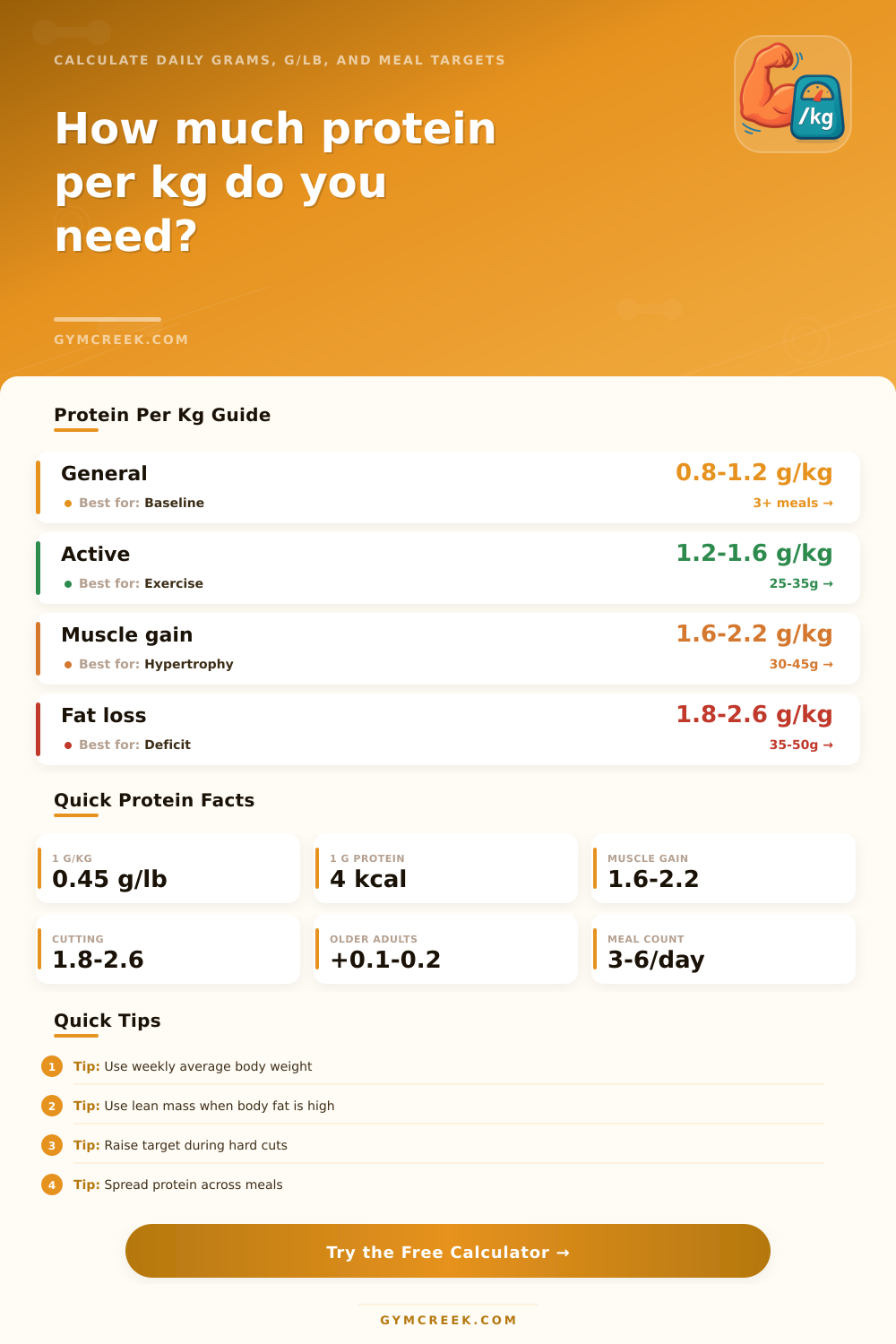
| Goal | g/kg range | g/lb range | Best use |
|---|---|---|---|
| General health | 0.8-1.2 | 0.36-0.54 | Baseline daily nutrition |
| Active maintenance | 1.2-1.6 | 0.54-0.73 | Regular training and weight stability |
| Muscle gain | 1.6-2.2 | 0.73-1.00 | Hypertrophy and strength blocks |
| Recomposition | 1.8-2.4 | 0.82-1.09 | Build muscle while controlling fat gain |
| Fat loss | 1.8-2.6 | 0.82-1.18 | Diet phases with resistance training |
| Endurance performance | 1.2-1.8 | 0.54-0.82 | High-volume running, cycling, or sport |
| Input | Lower bound | Upper bound | Rule |
|---|---|---|---|
| Training status | -0.1 to +0.2 | -0.1 to +0.25 | More lifting or sport raises the target range. |
| Calorie phase | -0.1 to +0.3 | -0.1 to +0.35 | Deficits raise protein; large surpluses reduce pressure. |
| Age band | 0 to +0.2 | 0 to +0.15 | Older adults receive a slightly higher floor. |
| Lean mass option | Same g/kg | Same g/kg | Daily grams use lean mass instead of total mass. |
| Meals/day | Use case | Per-meal goal | Planning note |
|---|---|---|---|
| 2 | Low meal frequency | Large doses | Harder to spread protein evenly |
| 3 | Classic meals | Moderate-large | Useful for simple routines |
| 4 | Training day default | Balanced doses | Often easiest for lifters |
| 5-6 | High intake or appetite limits | Smaller doses | Helpful during cuts or busy days |
| Body weight | 1.6 g/kg | 2.0 g/kg | 2.4 g/kg |
|---|---|---|---|
| 60 kg / 132 lb | 96 g | 120 g | 144 g |
| 75 kg / 165 lb | 120 g | 150 g | 180 g |
| 90 kg / 198 lb | 144 g | 180 g | 216 g |
| 105 kg / 231 lb | 168 g | 210 g | 252 g |
💡Tips
Protein need are not a single number because there are various factor that contribute to an individual’s protein needs. One of the factors to consider is the amount of muscle that the individual carries in there body. Another of the factors to consider is how hard the individual train.
Additionally, protein need can change based on whether the individual is trying to maintain they’re weight, gain weight, or lose fat while maintaining there performance in their chosen physical activity. A protein per kilogram calculator exist to help individuals determine the amount of protein they should consume in a day. A protein per kilogram calculator will ask for an individual’s body weight and several other variable that the calculator use to determine a safe and effective protein target for that individual.
Why protein needs change and how a protein per kilogram calculator helps
The first of these variable is the individual’s goal. If the individual is looking for general health, they will require less protein than if they are trying to gain muscle or lose fat. This is due to the body requiring more protein for the development of new tissue or to break down existing tissue in order to burn it for energy.
The next of these variable is the individual’s training status. An individual that train more often will require more protein than an individual that dont train as often. Additionally, an individual that perform weight training twice a day will require more protein than an individual that do not train as often.
The third of these variable is the individual’s calorie phase. An individual that is in a deep calorie deficit will require more protein than an individual that is in a calorie surplus. This is due to the body utilize it’s muscle for energy in a calorie deficit.
Age is a fourth variable that can impact an individual’s protein needs. After fifty years of age, the body experiences a blunting of its muscle response to protein. Therefore, an individual after fifty years of age will require more protein than younger individual to perform the same amount of physical activity.
The lean mass option is an accommodation for individuals with high amount of body fat. Because body fat do not require the same amount of protein as muscle, an individual with high body fat will require less protein than an individual with less body fat and a lower body weight. The number of meal that an individual consume during the day will not impact the total protein that they consume during the day but will impact the amount of protein that must be include in each meal.
An individual that eat three meal per day will require more protein per meal than an individual that eat five or six meal per day. The reference range are not rules for the individual but the starting point for an individual’s daily protein needs. An individual can adjust the custom gram per kilogram number based off their recovery status.
The protein per kilogram calculator does not calculate the target for protein as a permanent number for an individual. An individual should of revisit their protein target after gain weight or lose weight, after beginning a new training block, or after changing their calorie intake. Protein need are not static and vary from individual to individual and over time.
Using the protein per kilogram calculator force an individual to consider each variable that can impact their protein needs. While the body weight and training variable are obvious to most individuals, the calorie and age variable may not be as obvious. By understanding these variable and their impact on protein needs, an individual can make an informed decision about their protein intake and adjust their protein target accordingly.