Progressive Overload Calculator
Choose the next training move from load, reps, target range, RIR, recovery, exercise type, microloading, and last-session performance.
📌Progression Presets
Each preset loads a named progression situation and runs the recommendation engine.
⚙Calculator
Progression snapshot
Enter a recent set to calculate the next training action.
📊Fitness Metrics Comparison
📑Reference Tables
| Exercise Category | Typical Load Jump | Rep Range Use | Best Signal |
|---|---|---|---|
| Upper barbell lift | 1.25 to 5 lb or 0.5 to 2.5 kg | 3 to 10 reps | Bar speed and RIR |
| Lower barbell lift | 5 to 10 lb or 2.5 to 5 kg | 3 to 12 reps | Depth, speed, and recovery |
| Dumbbell movement | Smallest pair jump available | 8 to 20 reps | Range of motion consistency |
| Isolation accessory | Load, reps, or one set | 10 to 30 reps | Target muscle control |
| Progression Style | Add Load When | Hold When | Use Case |
|---|---|---|---|
| Double progression | Top reps reached with 1 to 3 RIR | Inside range but below top | Hypertrophy and accessories |
| Linear load jump | All work stays technically clean | Any form drift appears | Novice strength blocks |
| RIR autoregulated | Target reps feel too easy | RIR matches plan | Fatigue-managed training |
| Volume first | Load jump is too large | Recovery is only okay | Machines and dumbbells |
| RIR Input | Approx RPE | Training Signal | Progression Bias |
|---|---|---|---|
| 0 RIR | RPE 10 | Maximal effort | Hold or reduce |
| 1 RIR | RPE 9 | Hard but repeatable | Small increase only |
| 2 RIR | RPE 8 | Strong working set | Normal progression |
| 3 plus RIR | RPE 7 or lower | Under target effort | Add load or reps |
| Performance Trend | Meaning | Recommended Adjustment | Watch Point |
|---|---|---|---|
| More reps, same load | Adaptation is positive | Progress if top range is met | Keep technique identical |
| Same reps, lower RIR | Fatigue may be rising | Hold load | Sleep and soreness |
| Fewer reps, same load | Performance is down | Hold or deload | Two-session drop |
| Failed rep or form break | Load exceeded readiness | Reduce 5 to 15 percent | Technique standard |
💡Tips
The principle of progressive overload state that the demand placed upon the bodies has to be increased. The principle of progressive overload are necessary for the body to adapt to those demands; the body will only adapt to the demands if you increase those demands. To incorporate the principle of progressive overload into your training, it is necessary for you to introduce a small amount of difficulty to your training sessions.
If you dont introduce this small amount of difficulty into your training sessions, your body will not continue to adapt to the training that you provide for it. Many lifters find themselves struggling with the incorporation of the principle of progressive overload into their training routines. For instance, if you increase the demands placed upon the body too quickly, the body will fatigue much faster then it can recover from that fatigue.
How to Use Progressive Overload
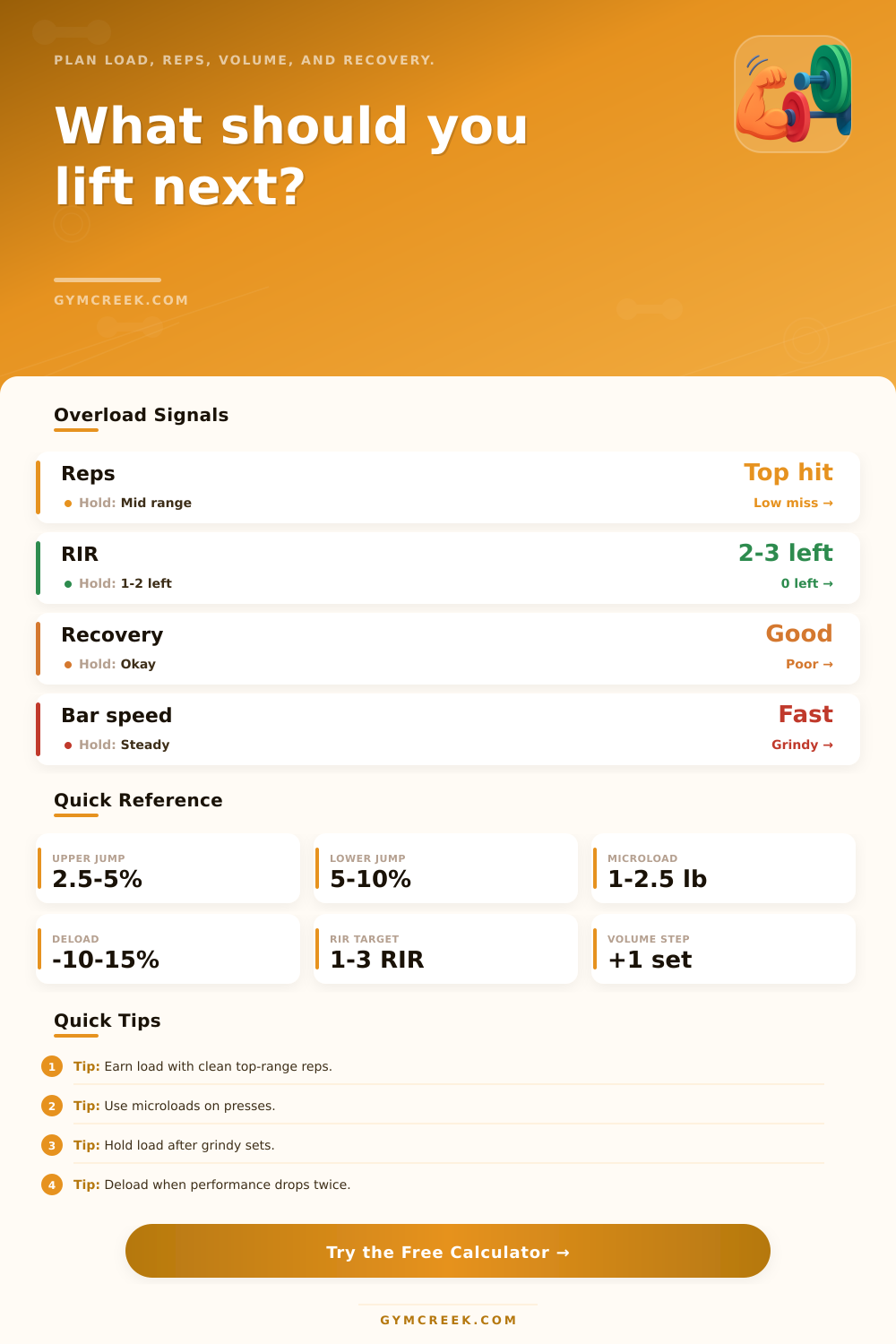
Alternatively, if the demands placed upon the body are are not increased enough, the body will cease to adapt to the training that it performs. In order to effectively incorporate the principle of progressive overload into your training routine, it is first necessary to evaluate the details of your training session that has just occurred. Factors to consider may include the number of clean repetitions that you completed during that session, the number of repetitions that you had left in reserve, and the speed at which you were able to move your barbell during that session.
The speed of your barbell can provide indications of the amount of effort that your training sessions required of you. If you were able to move your barbell quickly and performed the repetitions that you targeted during your training session, you have earned the right to increase the load that you will perform during your following training session. However, if you were not able to move your barbell at the targeted speeds, or if you did not perform for your targeted repetitions, you should of not increase the load that you perform during your following training session.
Recovery is another factor that you should consider. For instance, if you have poor sleep schedules or if you feel very sore after your training session, your recovery will be low. Thus, you should not increase the load that you perform if your recovery are low.
Some exercises will require different methods of implementing the principle of progressive overload than other exercises. For instance, because the joints in your upper body are more sensitive than the joints in your lower body, you may require very small increases in the load that you lift in your upper body exercises. In contrast, compound exercises that target your lower body may be able to take larger increases in the load.
Additionally, isolation exercises may not require increases in the load that you lift, but may benefit from an increase in the number of repetitions of that exercise, or the number of sets of that exercise. Tables illustrates which signals to evaluate for each exercise type. Thus, the signals that are important for exercises that target your upper body may be different than those that are important for exercises that target your lower bodies.
The principle of progressive overload is not a linear process. For example, some training sessions will indicate that your body has adapted to the load that you are performing, while other training sessions may indicate that your body is fatigued from the load that you are performing. One method for determining whether your body is ready for increased load is through the use of the calculator that is included with these training plans.
The calculator uses specific data points regarding your training and recovery as compared to the general feelings that you may have after performing your sets. Thus, if you are able to increase the repetitions that you can perform while maintaining good recovery, you should increase the load that you are performing. However, if you are decreasing the repetitions that you are able to perform for two training sessions in a row, you should hold the load that you are performing, or you may even need to reduce the load that you are performing as a means of allowing your body to recover from the fatigue that you may be experiencing.
Microloading is one method for incorporating the principle of progressive overload if it is difficult to increase the load that you are using for your training. Microloading allows for very small amounts of increased load to be incorporated into your training; small amounts of load may be provided in the form of fractional weight plates, for instance. Additionally, you could also incorporate microloading if you choose to increase your target repetitions rather than the load that you lift.
Regardless of the method that you choose for microloading, the principle of progressive overload will apply to any lifts that you may perform with barbells, dumbbells, or exercise machines. Progressive overload always demands of the athlete that you earn the right to increase the demands placed upon your training routine. Finally, to effectively use the principle of progressive overload, you must remain consistent in the way that you evaluate your training data.
If you are consistent in evaluating your training sessions and tracking your performance, youll be able to effectively determine whether you need to increase the load that you are performing, or if you need to repeat the same load that you have been using for your training.