Pro Agility 5-10-5 Calculator
Analyze a pro agility shuttle with split balance, turn efficiency, change-of-direction index, average speed, timing method, surface, and athlete benchmark context.
📌Presets
Each preset loads a realistic athlete profile, split pattern, timing method, surface, and current testing goal.
⚙Calculator
5-10-5 shuttle snapshot
Enter a valid total time and three segment splits to calculate agility metrics.
📊Agility Metrics Grid
🧮Formula Cards
📑Reference Tables
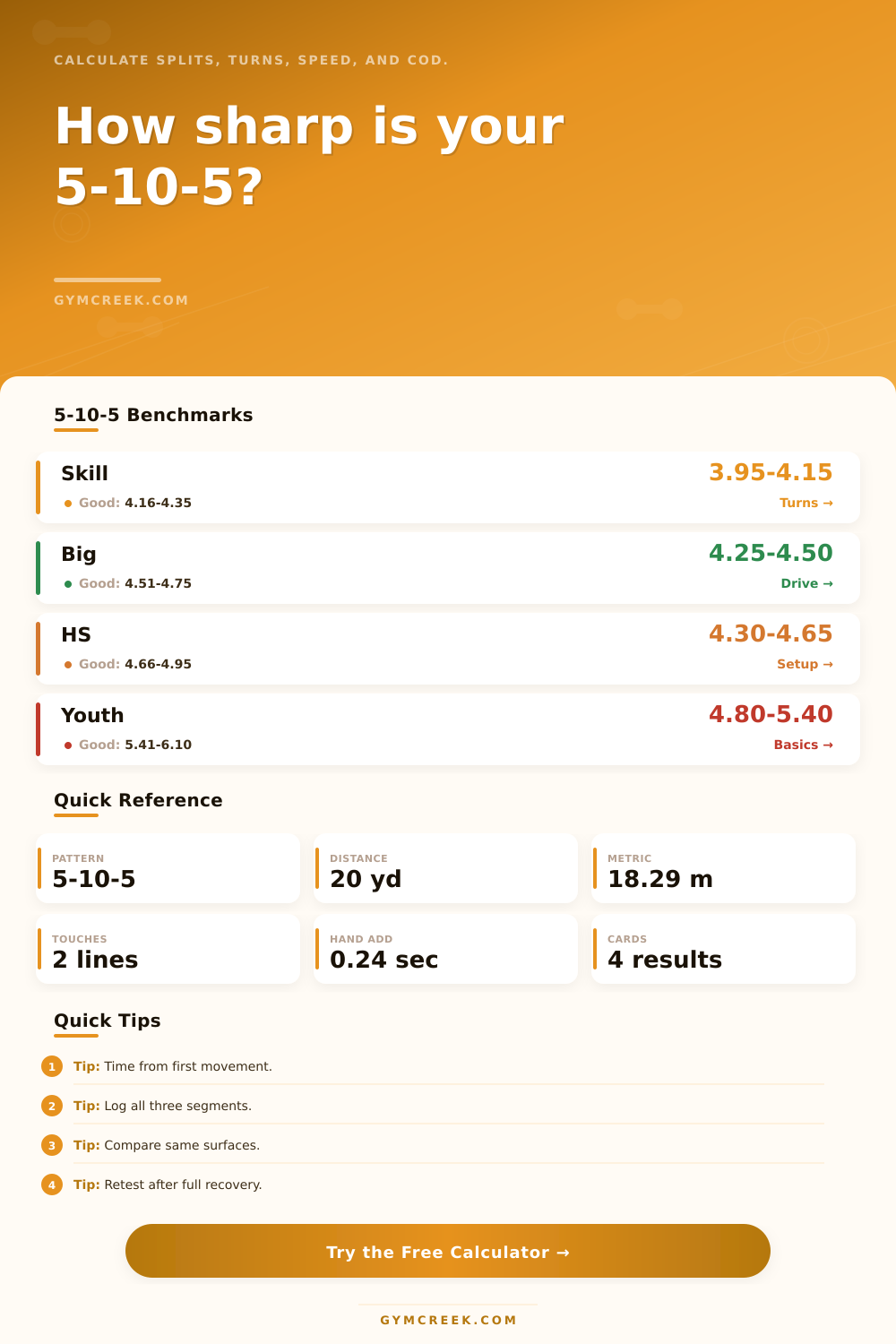
| Group | Elite Range | Competitive Range | Usually Needs |
|---|---|---|---|
| Football skill | 3.95–4.15 sec | 4.16–4.35 sec | Cleaner first plant |
| Big skill | 4.25–4.50 sec | 4.51–4.75 sec | Re-acceleration |
| Linebacker | 4.15–4.35 sec | 4.36–4.60 sec | Hip level at touch |
| High school varsity | 4.30–4.65 sec | 4.66–4.95 sec | Approach control |
| Segment | What It Shows | Fast Marker | Training Clue |
|---|---|---|---|
| Start to first 5 | Stance and first push | 0.95–1.08 sec | First step projection |
| Middle 10 | Brake, touch, and exit | 1.90–2.10 sec | Plant angle and hip height |
| Final 5 | Second turn and finish | 0.98–1.12 sec | Exit posture and arm drive |
| Split balance | Left-right control | Under 6 percent | Symmetry under speed |
| Timing Method | Calculator Add | Best Use | Caution |
|---|---|---|---|
| FAT / electronic | 0.00 sec | Official comparison | Needs proper start trigger |
| Laser gate / video | 0.05 sec | Training groups | Gate position matters |
| Phone app / video | 0.10 sec | Practice estimates | Frame rate can drift |
| Hand timed | 0.24 sec | Informal testing | Reaction bias is large |
| Scenario | Typical Pattern | Result Clue | Next Check |
|---|---|---|---|
| Fast start, slow middle | Good first 5, long middle 10 | Braking is costly | Film first plant |
| Slow first 5, solid finish | Delayed start, balanced exits | Setup issue likely | Repeat stance cues |
| Wide first plant | Middle split drifts high | Path is too long | Touch line angle |
| Uneven final 5 | Final split lags first split | Second turn leaks speed | Compare both sides |
💡Tips
What’s cool about the pro agility test is it show all of your flaws in how you move. How quickly do you have to go? Turn? And can you goes again without losing any momentum?
Most athletes think it’s just about the 5 yard dash, but they’re missing the point. It’s all inside the turns and the splits and the real story lie there.
How to Improve Your Pro Agility Test
We break it down for you with actionable data points… We run the math for you and give you your total time broken down.
In all, you’re running 20-yards in this test (five yards to the first cone, ten yards past the second while touching it, then five more back to starting line). Sounds easy enough? But it’s mechanicaly demanding. You have to be able to change directions quickly, decelerate sharply, and accelerate again from nearly a stop. That put major stress on your knees and your hips, which is why the reference table spell out benchmarks for various types of athlete. The numbers will provide some context to help you understand how well you did.
They won’t, however, tell you why you were slow.
The first 5 yards are your starting stance and first burst. If this is slow you need to do some work on your start technique. Are you standing up too tall? Taking too small steps? Are you leaning back?
The middle 10 yards is where you make the first turn and it’s the graveyard for unprepared athletes. It require you to plant your foot at the proper angle, explode out of the turn and then brake hard. So if you have a slow middle split here, most likely you’re standing up too tall before accelerating, or you’re overrunning the cone.
The final five yards shows you whether you can recover and maintain your balance. Most athletes blow up on the final leg because they cannot reset their posture from the second turn. The calculator looks at how far off your first and last five yard splits are. If there is a big difference, it indicate you have a weakness on one side. It could be something like a technical flaw with your left/right turn, or maybe it is just a structural imbalance.
The final thing is that it has a change of direction index, which compare your shuttle time to what you would expect from a straight sprint. So the higher the index, the more time you’re spending turning instead of running.
Your results also depend heavily based off surface and timing method; hand timing has been known to be unreliable. Electronic timing is better (if set up correctly) because it adds a standard correction factor to your time to account for errors. Since the times you see when testing on grass are going to obviously be slower then when running on fast turf or even a track, the tool normalizes those variables so you can look at your times in comparison no matter what type of surface you’ve tested on. It doesn’t let you make a bad decision about how to train based off poor data.
To get the best performance you want to decrease the duration of this mid-section, which means maintaining a lower body posture with your foot nearer to the cone. Long strides while turning is inferior to shorter, more punchy steps. Watch a video of yourself from the side and observe how high your hips come on the turn when it is time to plant your foot. Keep your center of gravity lowered until you start pushing off. You don’t want your hips up when your foot hits the ground; you’re wasting energy there.
The tool also uses your athlete profile, since everyone’s benchmark is all over the map, a lightweight skill player will be far different than a bigger linebacker. There’s no use comparing yourself to the wrong group. Choose your build and position category, then compare your time against those guys. This way, you’ll get relevant feedback and know if you’re elite for your role or an elite sprinter.
You get better at agility through practice, but you can’t practice blindly. Use the information to refine your drill work. Need to work on first step acceleration? Then that’s where you should of spent some time. Clumsy turns? Work on your plant mechanics.
The five-ten-five test is like a mirror; it shows you exactly how well you move. Take the numbers as hints (not judgments). Crack down on the leaks, analyze the splits, and go faster next time around.