Preacher Curl Load Calculator
Estimate your strict preacher curl max, choose a target set load, and check weekly curl volume without turning cheat reps into fake strength numbers.
📌Preacher Curl Presets
Each preset loads a realistic preacher curl setup with apparatus, current set performance, target reps, and strictness settings.
⚙Calculator
Preacher curl load snapshot
Enter a clean set and calculate a strict working load.
📊Fitness Metrics Grid
📑Reference Tables
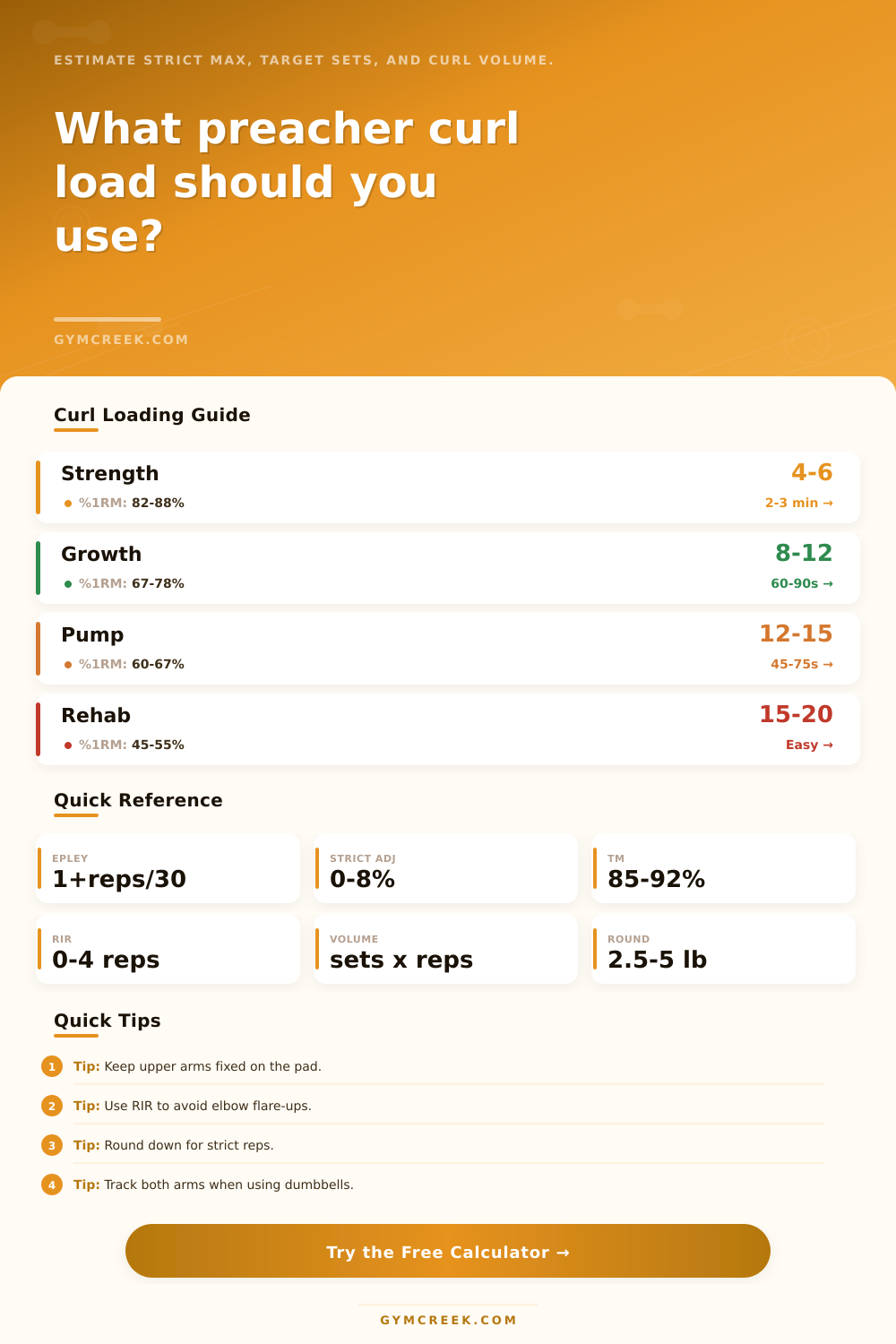
| Goal | Target Reps | Approx % 1RM | Preacher Curl Use |
|---|---|---|---|
| Strict strength | 4-6 | 82-88% | Heavy curls with long rests |
| Biceps hypertrophy | 8-12 | 67-78% | Most productive load zone |
| Pump volume | 12-15 | 60-67% | Higher reps after main work |
| Technique rebuild | 15-20 | 45-55% | Easy tempo and clean range |
| Setup | How To Enter Load | Typical Jump | Calculation Note |
|---|---|---|---|
| EZ-bar | Total bar load | 2.5-5 lb | Best general preacher option |
| Dumbbell pair | Both dumbbells combined | 5-10 lb total | Compare to bar total load |
| Single-arm DB | One dumbbell | 2.5-5 lb | Volume doubles across arms |
| Cable or machine | Stack number used | 5-10 lb | Stacks vary by machine |
| Strictness Choice | Adjustment | When It Fits | Load Advice |
|---|---|---|---|
| Strict pad contact | 0% | No shoulder lift | Use full result |
| Controlled minor sway | -3% | Clean but imperfect | Round down next set |
| Loose top reps | -8% | Upper arm drifts | Rebuild technique load |
| Partial range | -12% | Missed stretch or lockout | Retest with full range |
| Relative Level | Male Ratio | Female Ratio | Meaning |
|---|---|---|---|
| Novice | 0.25 x BW | 0.15 x BW | Learning strict control |
| Intermediate | 0.40 x BW | 0.25 x BW | Solid arm strength |
| Advanced | 0.55 x BW | 0.35 x BW | Strong strict curl base |
| Elite | 0.70 x BW | 0.45 x BW | Very high isolation strength |
💡Tips
When you sit down to do preacher curls, more times than not, you run into ego in the gym. You put on plates that make you look like a badass and think your ego is a good training variable. But the preacher curl is the mirror of the gym. There’s no way to cheat with hip drive or momentum. There is no place to hide but the pad underneath your bicep. If you’re doing it sloppy, the weight falls out. If you rely on poor form for your strength, the results will be harsh.
Once you plug in your rep reserve and number of reps, the calculator does the math for you. No need to guess how strong you realy are. And it helps you avoid blowing out your elbow.
How to Use the Preacher Curl Calculator Safely
Too many people want to use arm exercise as an ego lifting session. The core issue with arm training is not a lack of effort; it is a lack of honesty. The problem is being honest about them. If you’re doing curls, don’t load ’em like a leg press and bend over so far that your back bends in a semi-circle. Respect the joint.
With your arm on the pad, your upper arm doesn’t move. What moves? Almost everything is braced by the bicep and brachialis. It is great for muscles. But if you aren’t careful, it’s murder on tendon.
Your bodyweight helps determine your relative strength compared to others. It accounts for rep ranges, whether you want a pump or strength, and then it starts you out at a realistic number. Keep in mind that there’s a difference between hypertrophy loading and strict strength training.
For size, you typically shoot for a moderate intensity (about sixty-seven to seventy-eight percent of your one-rep max). It’s an area where you’re not so fatigued that you can’t go on, but not so light that you aren’t getting enough time under tension. If you don’t build up your tolerance for connective tissue then you’ll be jumping into the heavy stuff, risking tendonitis.
Look at the table below for rep scheme and rest time adjustments based off your objective. There’s no guessing involved here. Just choose a lane and stay in it for several weeks.
Strictness is not mentioned much, but it is important because defining a rep changes its effective load. For example, a shoulder-up rep is easier than one where your elbow stays planted. To account for sloppy reps, you can enter a loose-form penalty into the calculator. That’ll reduce your estimated max to match how hard your muscles was working. This is important for progression: adding weight while deteriorating form means that you’re not getting stronger, only better at cheating. The strictness adjustment makes you confront that fact. It forces your strength gains to be genuine rather than a result of momentum.
Weight-wise, tempo plays into things as well. The slower and more controlled you are in the lowering phase, the more tension you put on the muscle fibers. Thus, what feels like a lighter weight will be a bit heavier. If you try to rush through that eccentric portion of the move, you’re missing out on muscle-building stimulus. That’s where the tool comes in to play… You get to designate the speed of your lowering and it will adjust the load recommendations based on that. Again, little thing, but it matters. By default, two seconds is the norm. However, you can choose a three- or four-second drop for a harder challenge without having to add any plates.
Another piece of the puzzle: How much do you do each week? That’s what the “volume” refers to (your weekly volume). A single set doesn’t mean anything by itself. Look at all the sets over the course of a week. Not enough volume = no growth. Too much will cause joint pain and overtraining.
The calculator estimates your total tonnage based on the sets you log. It takes into account the number of sets you log and estimates your total tonnage. This helps you determine if you’re doing too much or not enough. For most people, eight to twelve sets per week is optimal when it comes to direct arm work. Beyond that, you’re likely seeing less benefit (particularly if you’re also pulling with rows and pull-ups).
For more context regarding how strong you are compared to average standards, look at the reference tables. They show you a ratio between how much you can curl and how much you weigh. That’s a better measurement than knowing how much another person lift in comparison, that person could be twice your size. Curling in terms of percentages gives you a better idea of where you stand in relation to everyone else. An elite lifter could reach 70% of his or her body weight; a beginner will probably get around 25%. Having that knowledge allows you to manage your own expectations. When people lift heavier amounts, remember that they might also weigh more.
Preacher curls also put unique stress on the biceps tendon and you want to make sure you’re never putting elbow health at risk. Do not try to push through the pain. There’s a comfort setting on the tool which will reduce your recommended load if you report soreness or stiffness. That’s not to say you need to get wimpy. It’s to say you need to take care of yourself so you can keep doing this for years to come. If you tear your tendon, it ain’t easy to fix.
Listen to your body. The numbers are there as guidance, not instruction. They won’t tell you when you need to suffer. After all, the preacher curl is a test of patience. Heavy but sloppy reps won’t get you far; instead, clean, strict reps will be rewarded. This is where the calculator comes in: It uses your performance data as load targets for the future, so you can hit that sweet spot between clean reps and heavy reps. No more noise, just a clear path forward. Build real strength while respecting your joints and planning out your sets. The pad doesn’t lie, neither should your training log. Work with what you can do strictly and go slow from there. Let the muscle growth follow the work.