Pre Workout Meal Timing Calculator
Estimate when to eat before training from meal size, macros, intensity, duration, and personal digestion comfort.
📌Presets
Presets load realistic meal and session combinations, then calculate the timing window immediately.
⚙Calculator
Pre-workout timing snapshot
Enter your meal and workout details to calculate a timing window.
📊Timing Metrics
📑Reference Tables
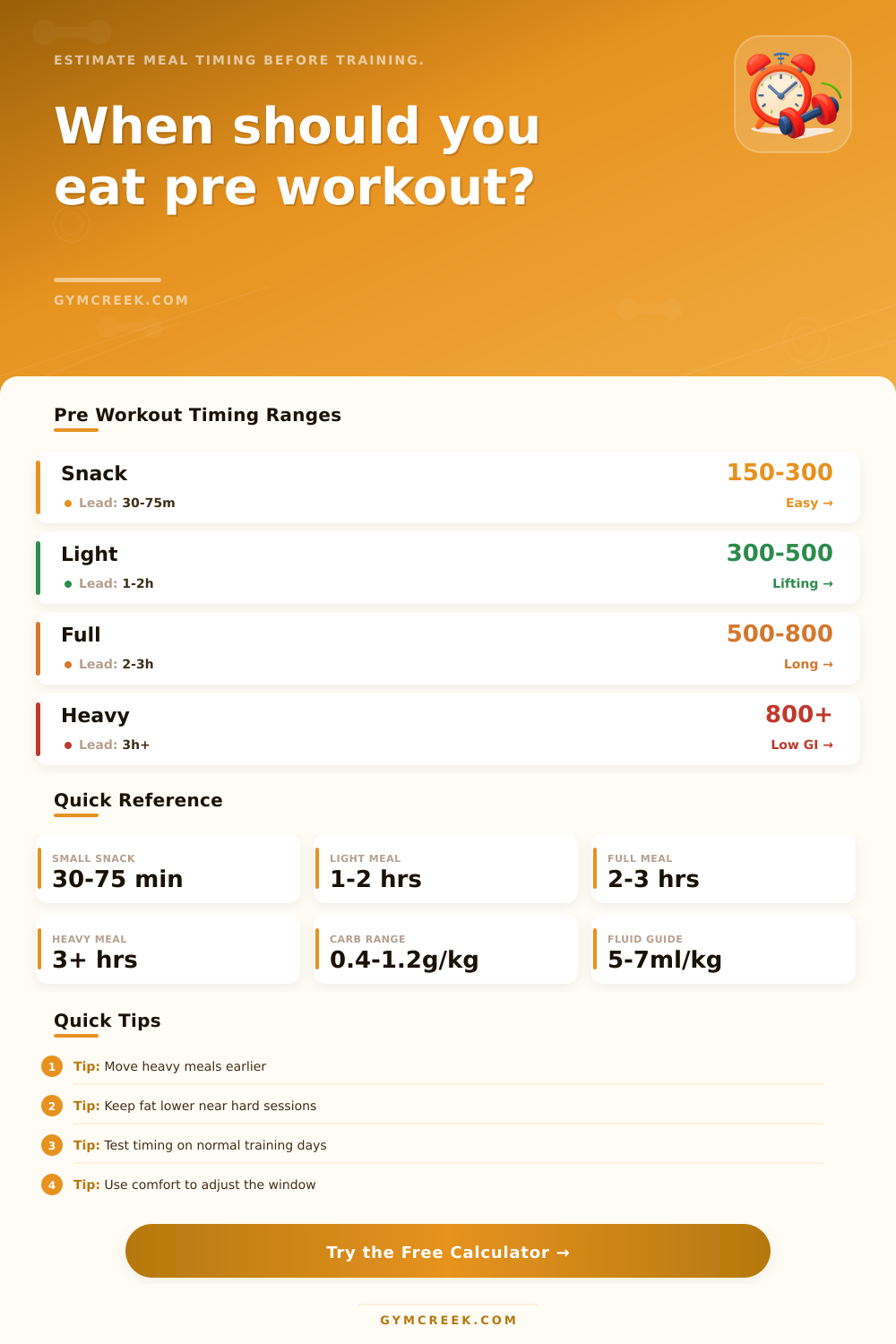
| Meal size | Calories | Typical lead | Calculator adjustment |
|---|---|---|---|
| Small snack | 150-300 | 30-75 minutes | Lowest base timing |
| Light meal | 300-500 | 60-120 minutes | Moderate base timing |
| Full meal | 500-800 | 120-180 minutes | Higher base timing |
| Heavy meal | 800+ | 180+ minutes | Highest base timing |
| Session type | Comfort pressure | Fuel pressure | Timing note |
|---|---|---|---|
| Strength | Moderate | Moderate | Usually tolerates a closer meal. |
| Running or jumping | High | High | Often needs an earlier meal. |
| Cycling or rowing | Lower | High | Can handle steady fuel timing. |
| Mixed intervals | High | High | Use the conservative end. |
| Input | Why it matters | Pushes timing | Planning cue |
|---|---|---|---|
| Fat grams | Slows emptying | Earlier | Lower near hard work. |
| Fiber grams | Adds bulk | Earlier | Test before key sessions. |
| Intensity | Raises gut stress | Earlier | Leave more clearance. |
| Sensitivity | Personal tolerance | Earlier | History beats averages. |
| Formula piece | Base used | Output | Use |
|---|---|---|---|
| Meal load score | Calories, fat, fiber | Low to high | Classifies meal size. |
| Lead window | Meal load plus modifiers | Minute range | Main timing output. |
| Carb target | Weight, duration, intensity | Gram target | Fuel comparison. |
| Fluid guide | Body weight | Milliliters | Pre-session range. |
💡Tips
We’ve all been there: You eat too much, then get on your bike or go to gym. Anxiety sets in. Fortunately, it’s usually not about what you ate but when you ate it. To understand why, know that your body must transport fuel from food to your bloodstream via the digestive system. When you cut that process short, your body divert blood away from gut and toward working muscles. That’s when you have a meal stuck in your stomach.
Performance benefit from getting this right. Variables make the guesswork dangerous. To be clear: That’s a lot of variables that gets factored into the calculator (above), stripping away the guesswork. For starters, it captures your macronutrients and calorie consumption. Then it consider how comfortabley you are digesting during exercise, and what kind of training you do.
The Best Time to Eat Before Working Out
Fueling up before heavy weight training is different than eating before an interval run around town. If you’re running, your abs will engage and bounce while running, so food in your belly is no bueno. This is a physical truth the calculator accounts for, nudging you to eat sooner if your activity will involve sharp torso twists or jarring impact.
There’s also some individual variation in terms of how well you tolerate fuel during exercise based off your own body chemistry. For example, some individuals consume a big sandwich one hour out from exercising with no problems whatsoever. And then others find that consuming a banana thirty minutes out cause them to cramp up. The slider on sensitivity tackles this head-on by letting you input your own tolerance as part of the calculation. What’s important here: past experience trumps averages. If it turns out you’re sensitive to such things, the system will account for this, giving you some additional buffer time so that your belly is empty enough when you need to perform, but also not so empty that you lack any glycogen left.
So many believe there is only one rule that applies to all, but there is a lot of individual variability here. How fast does the food leave my stomach? What’s the fat and fiber content? Fat and fiber are important for health reasons, but they also dramatically slow digestion. High-fiber or fatty meals takes longer to digest then a simple carb-heavy snack. Because this is such an important factor of pre-workout nutrition success (or lack thereof), the tool considers this heavily. It may be a low-calorie meal, but if it’s loaded with fat or fiber, your gut still has work to do!
What does it give me? It provides a window for when I should of had a main meal and what a lighter snack should look like. It recognizes that certain types of fuel require different digestion periods. The same is true for hydration. Not drinking enough will also cause dehydration that lead to thickening of your blood and decreased oxygen to your muscles… It feels like fatigue! Your body takes about 2-3 hours to absorb fluids and flush out extra liquids. Hydrate at least 2-3 hours before exercise. Otherwise, you’re working with sloshing liquid in your system.
Check out the table below to see correlation between lead time and meal size (from the page). If you had a large meal, give yourself 3+ hours to digest. You can get away with having a small snack right before starting. The next step is to test it during training. Take the estimated window and treat it like a guideline, not gospel. Go ahead and try it on a moderate workout day first to get a feel for it. Move it backwards if you feel too full, forwards (or add more carbs) if you feel unfueled.
Remember, this is all about tuning yourself, not forcing yourself to fit into someone else’s schedule. Fueling pre-workout is about balancing your need for energy. You must also push back against your desire for comfort while doing it. You want enough to go hard but not so much that you are fighting digestion. When you learn how intensity and macros work together you eliminate guesswork and adopt a plan. The next time you walk in the gym you won’t be wondering if you made a mistake. You’ll know you fueled right. That allows your body to do what it’s built to do without the burden of a full belly weighing you down. And that clarity is always worth spending an extra minute planning.