Pre Workout Caffeine Calculator
Estimate caffeine per serving, body-weight dose, suggested scoop range, timing, and remaining daily allowance from your pre-workout label, tolerance, sensitivity, workout time, and other caffeine.
📌Pre-Workout Caffeine Presets
Presets load realistic label and schedule scenarios. Edit any value after loading to match your product and day.
⚙Calculator Inputs
Pre-workout caffeine snapshot
Your caffeine per serving, mg/kg, scoop range, timing, and daily allowance update as inputs change.
📊Caffeine Metrics Grid
📑Rules and Reference Tables
| Dose band | mg/kg | Typical use | Caution note |
|---|---|---|---|
| Very low | Under 0.5 | Flavor or placebo-like boost | May be too small to notice. |
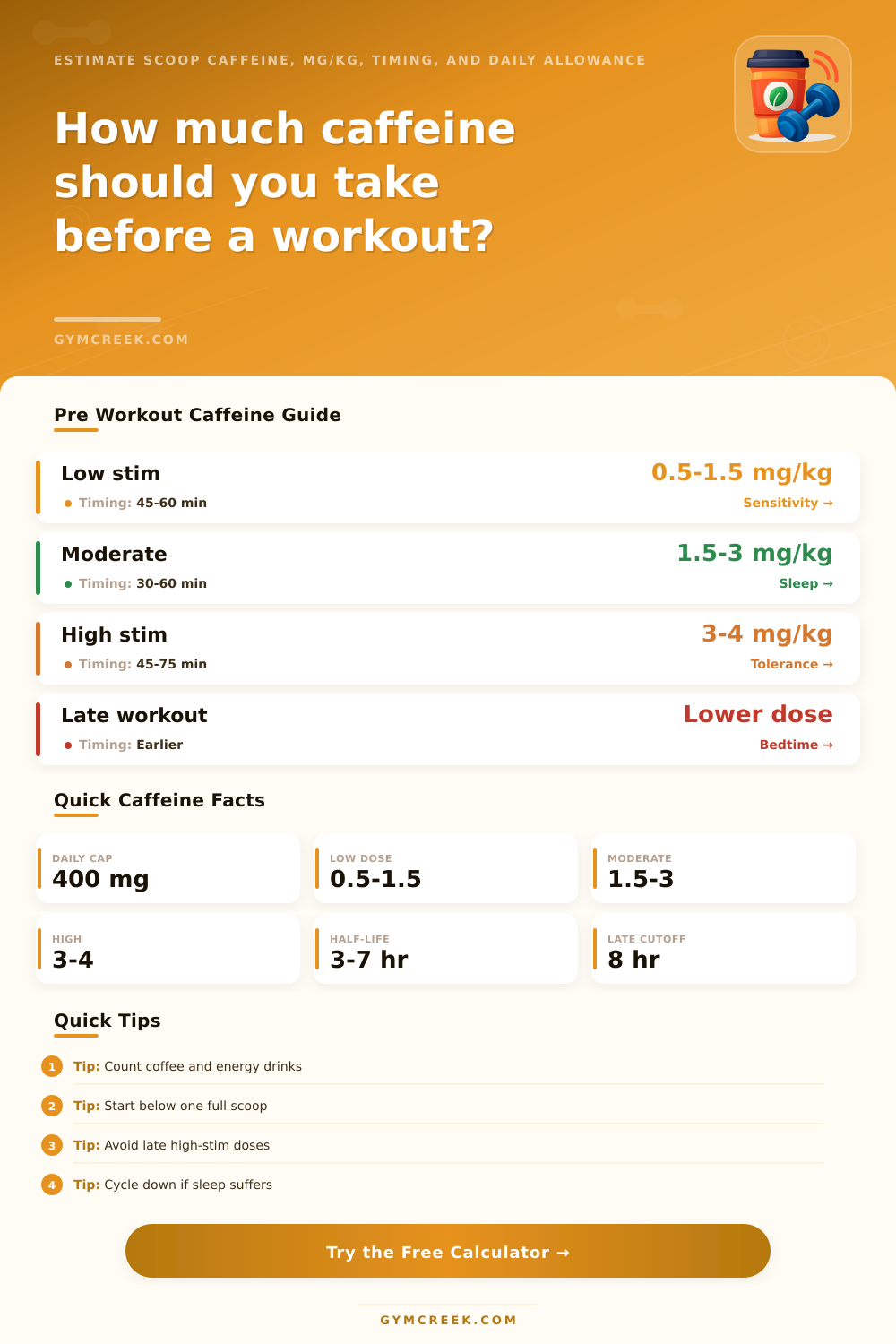
| Low | 0.5 to 1.5 | Sensitive users or late sessions | Often a good starting range. |
| Moderate | 1.5 to 3.0 | General lifting and conditioning | Watch total daily caffeine. |
| High | 3.0 to 4.0 | Hard sessions with tolerance | More side-effect risk. |
| Very high | Above 4.0 | Not a default target here | Review label and health context. |
| Input profile | Starting range | Adjustment | Calculator effect |
|---|---|---|---|
| Strength or power | 2.0 to 3.5 mg/kg | Higher if tolerant | Suggests moderate-high scoop range. |
| Hypertrophy | 1.5 to 3.0 mg/kg | Lower if pump or sleep matters | Balances focus and side effects. |
| Endurance | 2.0 to 3.0 mg/kg | Split intake may be better | Flags all-day stacking. |
| Focus | 0.8 to 2.0 mg/kg | Lower peak stimulation | Keeps scoop suggestion conservative. |
| Protect sleep | 0.3 to 1.2 mg/kg | Late workouts reduce dose | Raises timing caution. |
| Workout time | Suggested timing | Dose behavior | Sleep flag |
|---|---|---|---|
| Early morning | 20 to 45 minutes before | Normal range | Usually lower sleep risk. |
| Morning | 30 to 60 minutes before | Normal range | Count later caffeine. |
| Afternoon | 35 to 60 minutes before | Slight cap if sensitive | Watch bedtime distance. |
| Evening | 45 to 75 minutes before | Reduced range | Higher sleep risk. |
| Late night | Consider no caffeine | Strong reduction | Highest sleep risk. |
| Step | Rule | Inputs used | Output |
|---|---|---|---|
| Caffeine serving | Scoop caffeine x servings | Label mg and scoops | Planned pre-workout mg |
| mg/kg dose | Serving caffeine / body weight kg | Body weight and serving | Body-weight dose |
| Target range | Goal range modified by tolerance, sensitivity, and time | Goal profile inputs | Recommended mg/kg range |
| Scoop range | Target mg range / label caffeine per scoop | Target mg and label mg | Recommended scoops |
| Daily allowance | Daily cap - other caffeine - serving caffeine | Other caffeine and dose | Remaining mg |
| Timing | Time window plus late-session caution | Workout time and sensitivity | Pre-workout timing note |
💡Tips
Caffeine is a stimulant that increase an individual’s focus. Additionally, caffeine can reduce the feeling of effort that an athlete feel during there training. However, the amount of caffeine that are effective for one athlete may make another athlete feel jittery or have sleep issues.
The way that caffeine affects an individual depends on there body weight, caffeine tolerance, the amount of caffeine that they consume throughout the day, and when they train. These variable affect how caffeine affects an individuals body. One scoop of caffeine powder contain a specific amount of milligrams.
Find the Right Amount of Caffeine for Your Body
However, that specific amount of milligrams of caffeine can affect individual in different ways. For instance, 200 mg of caffeine will have a higher dose for a 120-pound individual than for a 220-pound individual. Individuals can use a calculator to calculate the amount of caffeine that will work best for their body weight and performance goal.
The calculator can show the dose of caffeine that is best for an individual depending on their goals for strength or endurance. An individuals caffeine tolerance affect how they respond to caffeine. For instance, if an individual drinks coffee all day, they will have a higher caffeine tolerance.
A higher caffeine tolerance means that the individual’s nervous system are used to having more caffeine in their system. The caffeine calculator will ask the individual if they have a high caffeine tolerance so that the dose of caffeine that is recommended for them is not too low for their body. If an individual has a low caffeine tolerance, they may feel jittery or anxious after consume caffeine.
In this case, the caffeine calculator will recommend a lower caffeine dose. An individuals caffeine sensitivity is a limit on the amount of caffeine that their body can process. Beyond that limit, the individuals performance will decrease with caffeine.
Finally, when an individual consumes caffeine, the timing of that caffeine can affect their sleep. If an individual consumes caffeine during an early morning training session, the caffeine will have many hours to leave their body prior to sleep. However, if you consume caffeine during your training session, the caffeine may remain in your system and disrupt your sleep.
The calculator adjust the recommended dose of caffeine based on the time of day that you train. Additionally, the calculator also keeps track of your daily allowance of caffeine. Since sleep is one of the tool that your body uses to recover from the training that you perform, it is essential to avoid sleep disruption by avoiding excessive caffeine, even if you dont notice the decrease in sleep quality after consuming caffeine.
You must also account for other sources of caffeine as other sources of caffeine will also contribute to your total daily intake of caffeine. Energy drinks, tea, gel, and certain pain relievers all contain caffeine, and can lead to the caffeine accumulate in your system. By entering the amount of caffeine that you consume into the calculator, the calculator will allow you to see how much more caffeine that you may consume that day before you reach the daily limit of caffeine.
By tracking your total daily intake of caffeine, you can avoid excessive caffeine accumulation within your system, which can lead to elevated heart rate on non-training days. Reference tables are provided that detail the typical doses of caffeine in milligrams of caffeine per kilogram of body weight. These tables are provided to allow you to understand where your bodys caffeine dose falls in comparison to other individual and practices in the world, but they are not a replacement for understanding how caffeine makes you feel.
It is recommended that you utilize smaller dose of caffeine, such as half scoop, to allow your body time to gather data regarding your response to caffeine. Due to the various factor that impact an individual’s response to caffeine, there is no guarantee that the caffeine dose that you experienced during your most recent training session will be the same as another training session. For instance, a dose of caffeine may feel stronger for an individual if they had poor sleep the previous nights, or if they are experiencing deficiency in hydration or medications.
While the caffeine calculator create a framework for caffeine consumption for an individual athlete, the individual athlete must make the final decision regarding the amount of caffeine to consume. By utilizing this caffeine calculator, an individual can gather data about their bodys response to various amount of caffeine, as well as ensure that they are protecting their sleep and enabling their body to recover from the strength of their training.