Powerlifting Weight Class Calculator
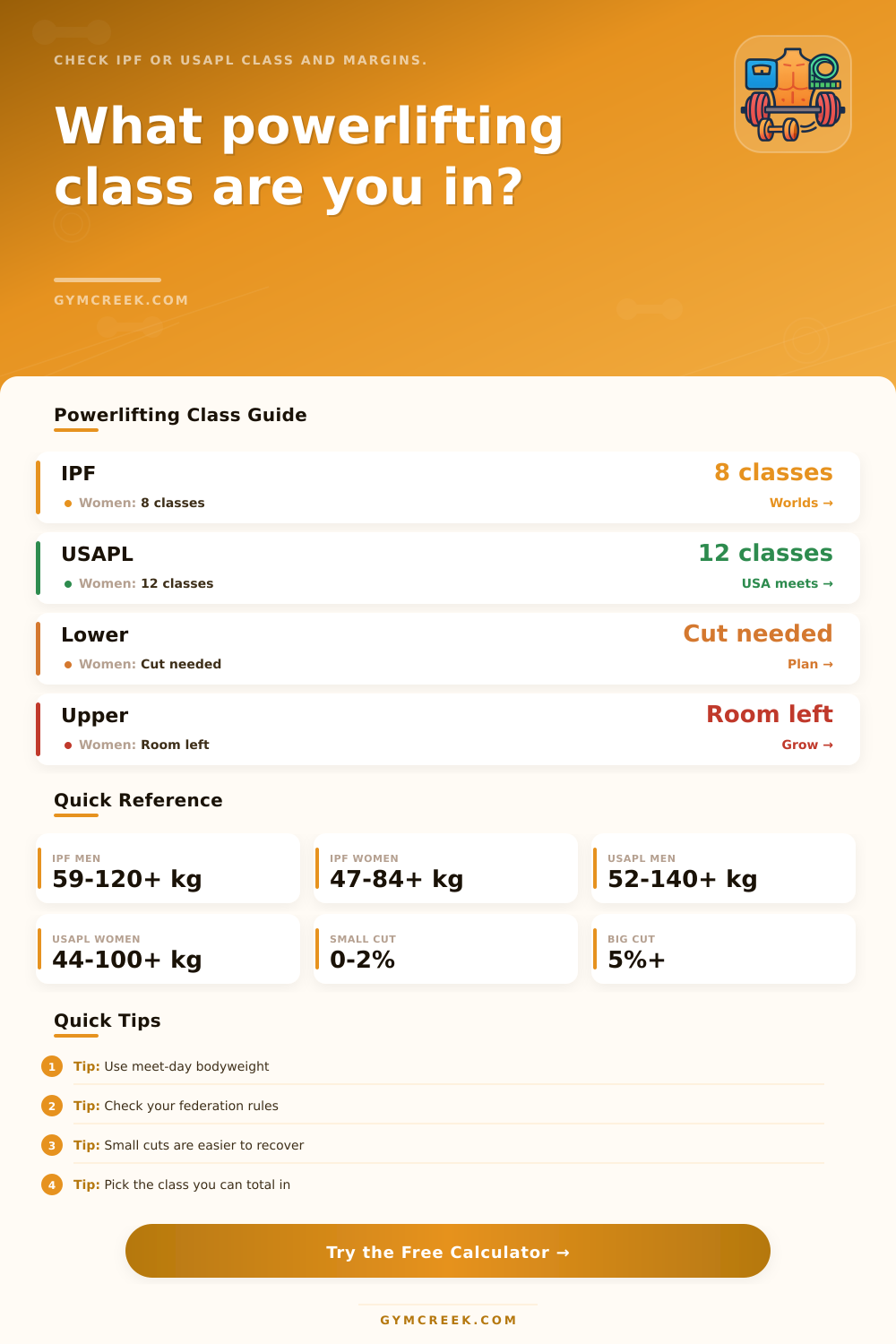
Find your IPF or USAPL weight class, see your lower-class cut, upper-class room, and compare your total to bodyweight.
📌Presets
Each preset loads a realistic meet profile and recalculates the class margins immediately.
⚙Calculator
Weight class snapshot
Enter bodyweight and federation to calculate your class.
📊Class Metrics
📑Reference Tables
| Federation | Male classes (kg) | Female classes (kg) | Notes |
|---|---|---|---|
| IPF | 59, 66, 74, 83, 93, 105, 120, 120+ | 47, 52, 57, 63, 69, 76, 84, 84+ | International standard |
| USAPL | 52, 56, 60, 67.5, 75, 82.5, 90, 100, 110, 125, 140, 140+ | 44, 48, 52, 56, 60, 65, 70, 75, 82.5, 90, 100, 100+ | USA Powerlifting |
| Lower class | Must weigh at or below cap | Must weigh at or below cap | Cut amount matters |
| Plus class | Above top capped class | Above top capped class | No upper cap |
| Cut size | % bodyweight | 2 hour weigh-in | 24 hour weigh-in |
|---|---|---|---|
| Tiny margin | 0-1% | Usually simple | Usually simple |
| Small cut | 1-2% | Manage carefully | Often manageable |
| Moderate cut | 2-5% | Risky for strength | Plan with care |
| Large cut | 5%+ | Often poor choice | High recovery cost |
| Metric | Formula | Output | Use |
|---|---|---|---|
| Class lookup | BW <= cap | Class | Meet entry |
| Lower cut | BW - lower cap | Weight | Cut plan |
| Class room | Cap - BW | Weight | Gain room |
| Total ratio | Total / BW | Multiplier | Compare sizes |
| Strategy | Signal | Class choice | Training cue |
|---|---|---|---|
| Natural class | Near middle | Stay current | Keep lifts moving |
| Easy lower | Under 2% | Consider lower | Protect recovery |
| Too heavy | Over cap | Move up | Avoid missed weigh-in |
| Room to grow | 3%+ below cap | Fill current | Slow gain |
💡Tips
Choosing a weight class for powerlifting involve more than just looking at the numbers on the scale to measure bodyweight. The number on the scale can impact your ability to compete with strength. Being on the higher end of the weight class can affect your recovery after competing on the platform.
However, being within the weight class can allow a lifter to feel more recovered after competing on the platform. The choice of weight class will impact the training a powerlifter perform to prepare for the next powerlifting meet. The body performs better when it remains within a specific range of weight rather than having to cut or bulk excessively.
How to Choose the Right Weight Class for Powerlifting
Bodyweight alone will not provide the full information require to make a decision regarding the best weight class for powerlifting. Two powerlifters can have the same bodyweight, but one may be closer to the limit for the next weight class, while the other may already be over that limit for the weight class. Once a powerlifter goes over the limit for the specific weight class, they must choose to either drop weight or move up to the next weight class.
These two choice can impact the total strength and recovery of the powerlifter. A weight class calculator can help a powerlifter to make these decisions. A powerlifter can enter their bodyweight into the calculator.
Additionally, the powerlifter can enter the rules of the federation, as well as their target lift into the calculator. The calculator will convert all of the units to the same unit and find the boundaries of the weight class that apply to the powerlifter. The calculator will also calculate the distance between the powerlifter and the next lower weight class limit, as well as how much space remain within the current weight class of the powerlifter.
Additionally, the calculator will also calculate the ratio of the total strength to the bodyweight of the powerlifter. While the calculator will not replace the judgment of a coach, it will make the calculations that the powerlifter must make to determine the best weight class for themselfs. The rules of the federation will have an impact on the structure of the weight classes.
International federations has fewer weight classes than domestic federations. The domestic federations have more weight classes so that lifters of all bodyweights can find a home within the federation, but it also mean that there are more decisions to be made by the powerlifter regarding their weight class. The age of the powerlifter can also have an impact on the choice of their weight class.
Younger lifters often have more rapid recovery time and have a better ratio of strength to their bodyweight. Additionally, masters athletes may find that the best weight class for them in their younger years may not still be the best for them now. A tool that flags the age of the powerlifter can help them to remember to adjust the strength and performance that they expect from themselfs within a specific weight class.
Powerlifters often make a mistake in determining their weight cut margin. A two percent weight cut may seem small, but it can have an impact on the grip strength and mental sharpness of the powerlifter if the time between dropping weight and competing on the platform is only two hour. A five percent cut will have a greater impact on the powerlifter if attempted within the same short time window.
The weight class calculator will calculate the raw number and percentage of the weight cut that the powerlifter must make. This will allow the powerlifter to determine if dropping the indicated amount of weight is worth the risk to there performance in the competition. One additional feature that can be helpful is the ability to enter a planned weight change into the calculator.
A positive number will indicate that the powerlifter intends to increase their bodyweight to qualify for the next weight class. If a negative number are entered, the calculator can help to determine if it is possible to compete in a lower weight class without losing too much total strength. This calculator will calculate both the current and planned weight of the powerlifter to determine if such a change will result in a better weight class for the lifter.
The level of training that a powerlifter performs can impact their choice of weight class. Powerlifters that perform more training may contain more muscle and water weight that will place them closer to the higher limit of their current weight class. Powerlifters that perform less activity outside of powerlifting may have a different body composition different than the same bodyweight as an athlete that is training hard.
While the activity level does not have any impact on the boundaries of the weight classes, it does serve as a reminder to the powerlifter that their bodyweight is the result of both their training and the rest of their life. The ratio of the total strength to the bodyweight can provide additional context for the powerlifter regarding their strength. A total strength of 500 kg for an athlete that weighs 75 kg is not the same as 500 kg for an athlete that weighs 90 kg.
Additionally, this ratio will allow the powerlifter to compare their strength to other powerlifters in their weight class. Many powerlifters make the mistake of treating the determination of their weight class as a permanent decision. A powerlifter may find themselfs in a lower weight class, and while they may drop weight to achieve this class, they may find it harder to remain in that class as their strength increase.
The opposite can also happen, where the powerlifter may too soon move up to a higher weight class, but does not immediately experience the gains in strength that they had assumed that the higher weight would provide. While the weight class calculator will not prevent these mistake from being made, it will make them visible to the powerlifter prior to they entering any meets. The best way to use the calculator is to consider the calculators output to be just one of the many data point that must be considered in determining the best weight class for the powerlifter.
Factors such as the strength that the lifter feels during training, the results of their last weight cut or bulks, and how much time they will have to reach their target bodyweight will all impact their decision. The calculator will remove the uncertainty of where the weight class line are, allowing the powerlifter to focus on the other aspect of their plan to compete in their next powerlifting meet.