Kilo Calculator Powerlifting Meet Planner
Convert pound gym numbers into meet-ready kilos, round attempts to federation increments, check kilo jumps, load competition plates, compare weight-class cutoffs, and convert the final total.
📌Meet Presets
Each preset fills lifter details, attempt entries, meet rounding, and kilo plate stock so the output stays meet-specific.
⚙Lifter And Meet Setup
📝Attempt Card
Enter all attempts in kilograms, or switch to pounds to convert gym numbers into legal meet kilos.
🏋Kilo Plate Stock
Inventory counts are total plates available. The loading table uses balanced pairs and reports if a legal attempt cannot be built from listed plates.
Powerlifting kilo plan
Enter attempts to convert, round, load plates, and total the meet.
📊Meet Metrics
📋Attempt Conversion And Loading
| Lift | Attempt | Input | Legal kg | LB equiv | Jump | Per side plates |
|---|---|---|---|---|---|---|
| Calculate to fill the attempt chart. | ||||||
📑Reference Tables
| Table | Classes | Notes | Verify |
|---|---|---|---|
| Men | 59,66,74,83,93,105,120,120+ | Common open classes | Meet rules |
| Women | 47,52,57,63,69,76,84,84+ | Common open classes | Meet rules |
| Junior | Same cutoff table | Age division differs | Federation |
| Masters | Same cutoff table | Age group differs | Federation |
| Item | Formula | Example | Purpose |
|---|---|---|---|
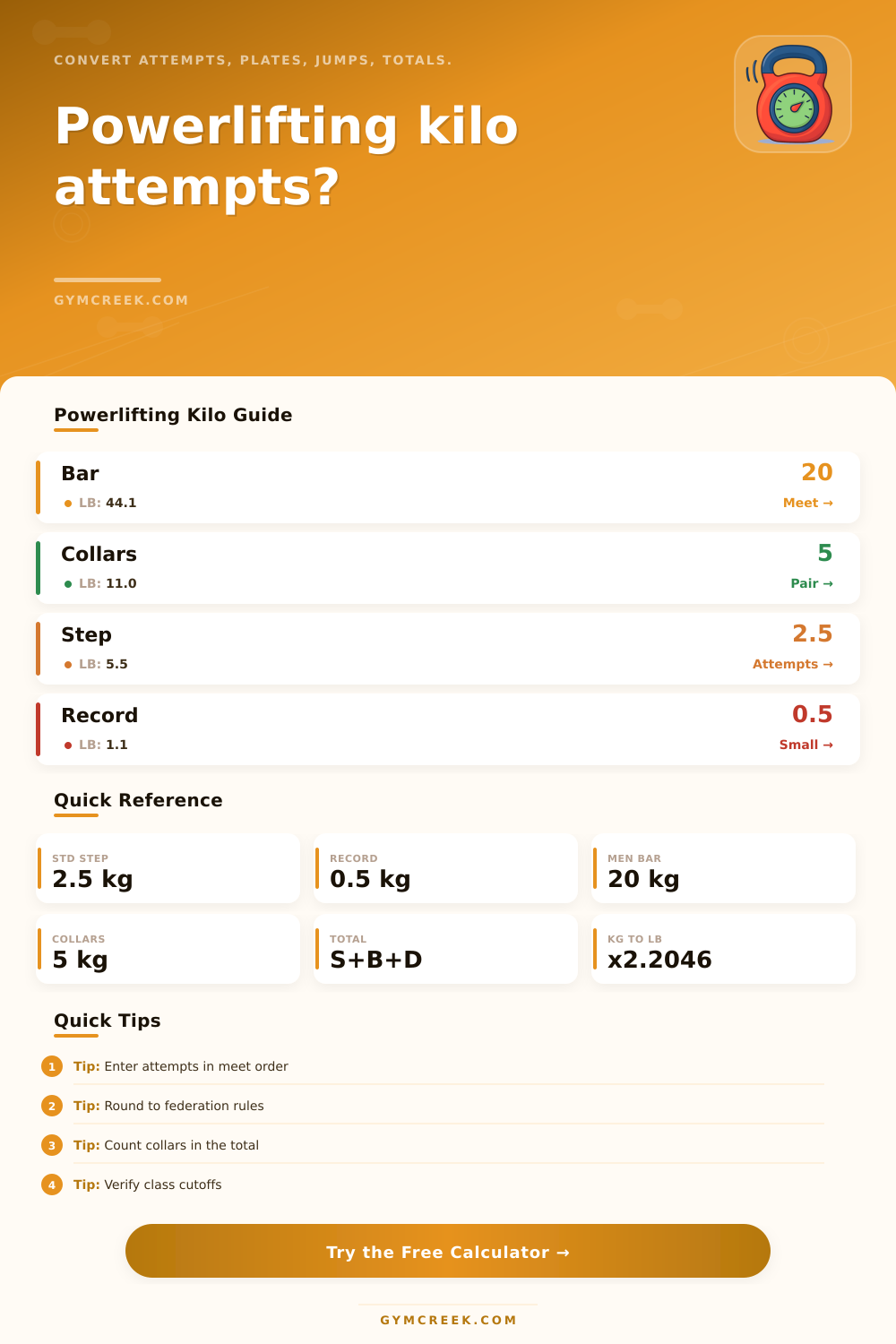
| Pounds to kilos | lb / 2.2046226 | 405 lb = 183.7 kg | Gym to meet |
| Kilos to pounds | kg x 2.2046226 | 200 kg = 440.9 lb | Total conversion |
| Standard attempt | Round to 2.5 kg | 183.7 to 182.5 | Legal cards |
| Record attempt | 0.5 or 1 kg step | 201 kg | Small jumps |
| Equipment | KG | LB | Included in total |
|---|---|---|---|
| Power bar | 20 | 44.1 | Yes |
| Collar pair | 5 | 11.0 | Yes |
| Pair of 25s | 50 | 110.2 | Plates only |
| Pair of 2.5s | 5 | 11.0 | Plates only |
| Jump | KG | LB | Read |
|---|---|---|---|
| Small bench | 2.5 to 5 | 5.5 to 11 | Conservative |
| Normal bench | 5 to 7.5 | 11 to 16.5 | Moderate |
| Squat/dead | 7.5 to 12.5 | 16.5 to 27.6 | Common |
| Large jump | 15+ | 33.1+ | Aggressive |
💡Meet Calculation Tips
To plan a powerlifting meet, you must convert your training number to the amount of kilogram you will use on the platform. Your training numbers and kilograms wont always be the same because the allowable increment for a powerlifting meet are not often the same as the training lift. You need to have a system in place to determine your competition kilograms and how you will declare them to the referee on the attempt card.
You must first decide on the unit of measurement you will use for your attempts. Many powerlifter will use pounds as their unit of measurement because this is the unit of measurement they use during their training. However, many powerlifters will also use the unit of measurement for kilograms as there attempts will be in kilograms on the powerlifting platform.
How to Plan Your Powerlifting Weights
Both unit of measurement is allowed for the attempt as long as the conversions are accurate to the number of kilograms for each lift and your federations rules on rounding. Most powerlifting meets will use 2.5 kg increment for the lifts. Some record attempt may allow for 1 kg or 0.5 kg increments.
The increments will determine which third attempt you can go for and how close to your personal best your attempts will be. Bodyweight is something that you will need to plan for your upcoming meet. Your target bodyweight will show you how much weight you will have to lose to compete in your target weight class.
If you plan your weigh-ins for the morning, you will have less time to adjust your bodys water and food intake than if you were to weigh in every 24 hour. If you adjust your food and water intake, this will have an impact on how you recover between your squat and your deadlift. Using a calculator will allow you to test various weight class to see if your projected body weight will be under, on or over the limit for each class.
Plate loading is another consideration prior to the meet. You will need to make sure that the weightlifting plates you use for your lift are available to you on competition day. The weight of the bar and the collars must be deducted from the total weight to be divided equally between the sleeve of the bar.
If you dont have enough pair of plates of the apropiate sizes, the calculator will deny your attempt at building your lifts. Checking the availability of the plates will help to ensure that the loaders have the 5 kg plates that is needed for the competition. The size of the jumps between each of your powerlifting attempts is another that must be considered.
A small jump may be used for your bench press attempts; however, such a jump may be aggressive for your deadlift attempts as there is less time to recover between deadlift attempts. Checking the largest jump between each of your three lift will tell you if your attempt card follows the normal jump size for powerlifters or if your jumps are too large for your recovery time between each attempt. It is common for one lift to have a larger jump than the others.
A large jump between powerlifting attempts may be an indication of a powerlifter that has left strength on the table for that particular lift or that they may be attempting to miss that lift all together. Age division for powerlifting has an impact on the numbers used for each lift. The same weight class may be used for a subjunior powerlifter and an open weight class powerlifter.
However, the recovery time between each lift will differ between these two division. Masters lifters will have a different recovery time than younger lifters. Masters lifter will use attempts that are close together because the joint begin to degrade with age.
For younger lifters, a lifter may choose larger jumps in lift weights to keep the session as short as possible. Although a calculator cannot replace a coach for powerlifting, a calculator will provide the math for the attempts. Common mistake for powerlifters include the mistake of the weight of the collars being forgotten in the calculations for each lift.
If the weight of the collars is not accounted for in each calculation, the powerlifter will be 5 kg short of their calculated lift. Other common mistake for powerlifting includes failing to convert training numbers to kilograms prior to entering them into the calculator. Such a mistake will cause the total weight of the lifts to either be too light or too heavy.
Choosing a weight class based off training strength will also cause problems for the powerlifter as there will be no buffer for the powerlifter should their body weight be higher than their training weight. Being able to calculate the weight of each lift will provide a lifter with the ability to make decision based on their training. The calculations will allow the powerlifter to determine what would happen to their total weight if they chose to decrease their deadlift by 2.5 kg.
The calculations can also inform the powerlifter what may happen to the total weight if they were to compete in a higher weight class to avoid having to lose any body weight prior to the competition. These types of calculation are difficult to determine in one’s head while also managing other aspect of the powerlifters life. Once the attempts have been locked in and the weight of each lift and the weights of the plates have been determined, the powerlifter can focus on execution.
While the calculator cannot lift the bar for the powerlifter, it can remove the arithmetic of the competition attempt that the powerlifter must perform in the mind prior to the competition. With the arithmetic removed, the powerlifter can focus on their warm up and recovery between each lift, and if their opening lift was light enough to allow for the jumps that they have planned.