Power Yoga Calorie Calculator
Estimate calories burned from power yoga by session length, flow intensity, body stats, active minutes, temperature, heart rate, and class structure.
📌Presets
Presets load realistic power yoga sessions, then calculate active calories, total burn, per-minute pace, and effort context.
⚙Calculator
Power yoga calorie estimate
Enter your class details to estimate calorie burn.
📊Fitness Metrics Grid
📑Reference Tables
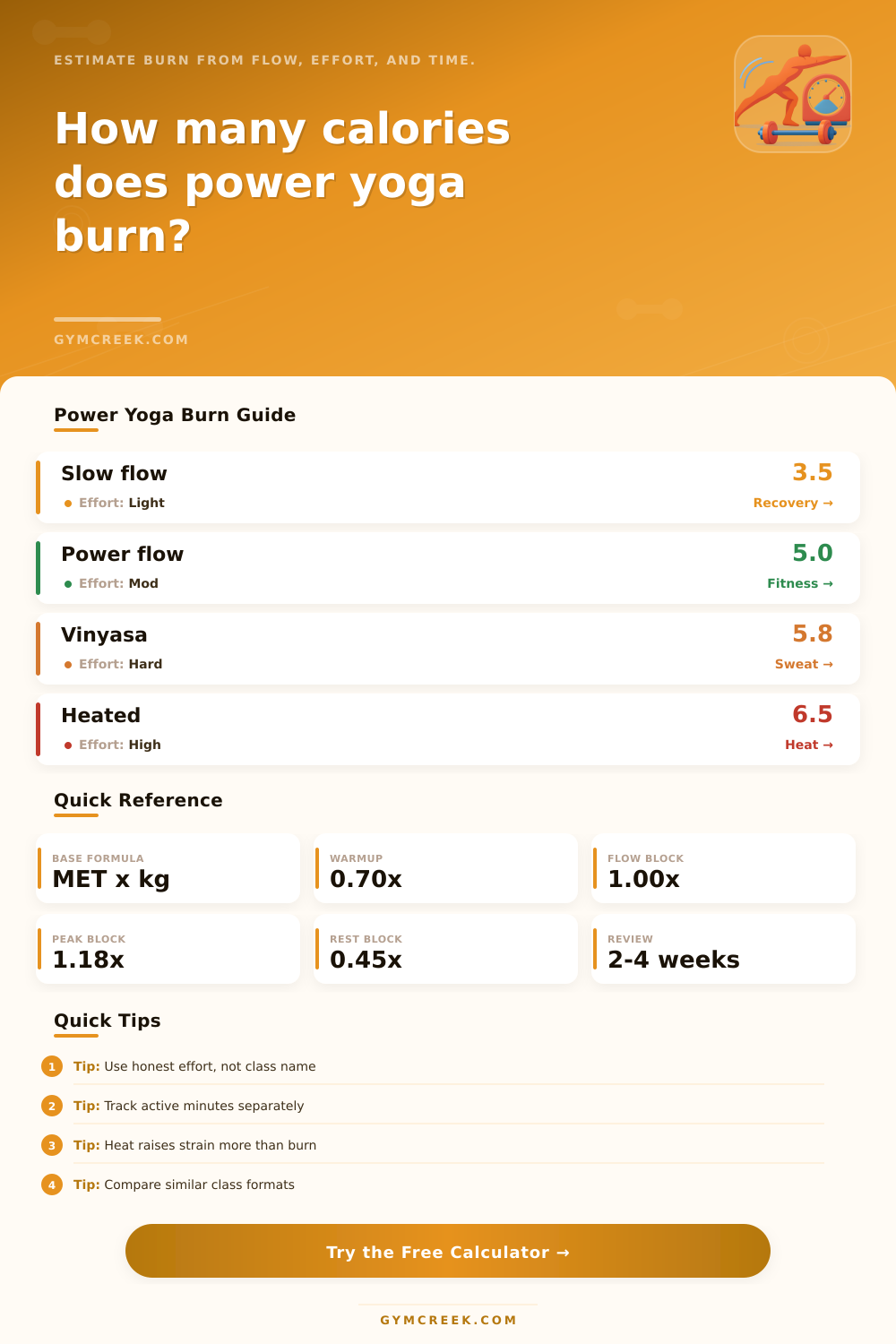
| Style | MET | Session cue | Burn read |
|---|---|---|---|
| Slow power | 3.5 | Long holds | Light |
| Power yoga | 5.0 | Steady flow | Moderate |
| Vinyasa | 5.8 | Frequent transitions | Hard |
| Hot sculpt | 7.0 | Weights and heat | High |
| Class part | MET factor | Typical share | Calorie cue |
|---|---|---|---|
| Warm-up | 0.70x | 10-20% | Lower |
| Main flow | 1.00x | 45-65% | Base |
| Peak flow | 1.18x | 15-40% | Higher |
| Cool-down | 0.45x | 5-20% | Low |
| HR reserve | Zone | Yoga feel | Note |
|---|---|---|---|
| <40% | Easy | Recovery | Light |
| 40-59% | Moderate | Steady | Most flows |
| 60-74% | Hard | Sweaty | Athletic |
| 75%+ | Very hard | Peak | Check pace |
| Body weight | 45 min | 60 min | 75 min |
|---|---|---|---|
| 120 lb | 185-245 | 245-325 | 305-405 |
| 150 lb | 230-305 | 305-405 | 380-505 |
| 180 lb | 275-365 | 365-485 | 455-605 |
| 210 lb | 320-425 | 425-565 | 530-705 |
💡Tips
The caloric burn from yoga isnt easy measured due to the different amounts of energy that is required from the different types of yoga. Individuals who have attended power yoga classes may feel very exhausted after those classes, but exhaustion is not a means of accurately measuring the number of calories that burns during yoga. An individual may feel as if power yoga classes are the type that burn a significant amount of calories, but restorative yoga classes requires very little energy to participate in.
Furthermore, most fitness trackers does not account for the difference in calories that may be burned within each of these types of classes, as they often group all forms of yoga into one category. As a result, the calorie estimates that these fitness trackers provide can be inaccurate. The name of the class that is being attended does not always indicate the level of intensities of that type of yoga class.
How Many Calories You Burn in Yoga
For instance, Vinyasa yoga classes can be slow and mindful when they are held in one area of the studio, yet they can include poses that an individual performs at a rapid rate during another class. In these cases, an individual should focus upon there perception of the effort that they felt while performing the yoga as the most accurate means of measuring the caloric burn of that class rather than the name of that class. Furthermore, the calorie calculator that is used takes into consideration the actual movement that an individual perform during the class.
The weight of an individual is another primary factor in calculating the calories that may be burned during a session of yoga. An individual of a higher weight will have to use more energy to perform each movement compared to an individual of a lower weight. For instance, an individual who weighs 200 pounds will burn more calories performing a sun salutation pose than an individual who weigh 120 pounds.
This is due to the fact that the individual of more mass will require more energy to move their body. This factor is accounted for in the calculation of calories that may be burned during yoga. The density of the flows that are performed during a class is another factor that impacts the calories that burn during yoga.
Most yoga classes do not continuously include the same types of movements for the entire class; they include warm up poses, centering poses, and resting poses. As a result, if an individual counts the entire length of the yoga class as the length during which calories is burned, the individual may overestimate the number of calories that were burned. Instead, the individual should calculate only the number of minutes that includes active movements for yoga poses rather than the total length of the class.
During a yoga class, the body may experience heat. In hot yoga studios, individuals may sweat more and have higher heart rate while performing the poses. However, the reason that individuals sweat is as a means of regulating their body temperature.
Thus, while the body may experience heat while in a yoga pose, heat does not double the number of calories that are burned during class. However, the calorie calculator may include a modest adjustment to account for the heat that is experienced during yoga classes. An individuals heart rate helps to indicate the level of effort that is required for an individual to attend a yoga class.
For instance, if an individual calculates the average heart rate of an individual throughout the class and compares it to their resting heart rate, they can determine the level of effort that they require to attend that class. If the average heart rate is within the moderate range, the individual is likely building aerobic capacity. If the average heart rate is within the hard range, the individual is using anaerobic energy system during class.
Power yoga classes requires individuals to develop muscular tension. Furthermore, the muscular tension that is developed during power poses indicates that there is a burn of calories due to the bodys need to maintain that tension. These poses can include planks or poses that hold the body in a certain position for long periods of time.
Furthermore, the performance of these poses can contribute to an afterburn effect on the body. These different data points regarding caloric burn during yoga can be used to provide an individual with a means of maintaining consistency in their diet and training regime. In other words, these numbers can help an individual to balance their nutrition and training regime.
Furthermore, by accounting for each of these variables related to yoga, an individual can gain a better understanding of their body and how many calories it burn during yoga poses.