Pound for Pound Strength Calculator
Compare a single lift, push-pull, powerlifting total, or custom strength total with bodyweight scaling, formula choices, coefficient style scoring, sex category, equipment context, and a clean relative score.
📌Pound-for-Pound Presets
Presets intentionally mix body sizes, totals, single lifts, age groups, and equipment. Use them to see how coefficient scoring differs from a simple lift divided by bodyweight.
⚙Calculator Inputs
Pound-for-pound strength snapshot
Enter bodyweight, lifts, formula, and equipment to compare scaled strength.
📊P4P Metrics Grid
📑Reference Tables
| Band | Score range | Typical meaning | Best comparison |
|---|---|---|---|
| Developing | Under 90 | Technique, consistency, and base strength are still the main story | Same lift, same bodyweight trend |
| Recreational | 90 to 124 | A useful gym-strength result with repeatable testing value | Similar equipment and lift selection |
| Strong | 125 to 159 | Good pound-for-pound strength for regular training contexts | Comparable bodyweight and formula |
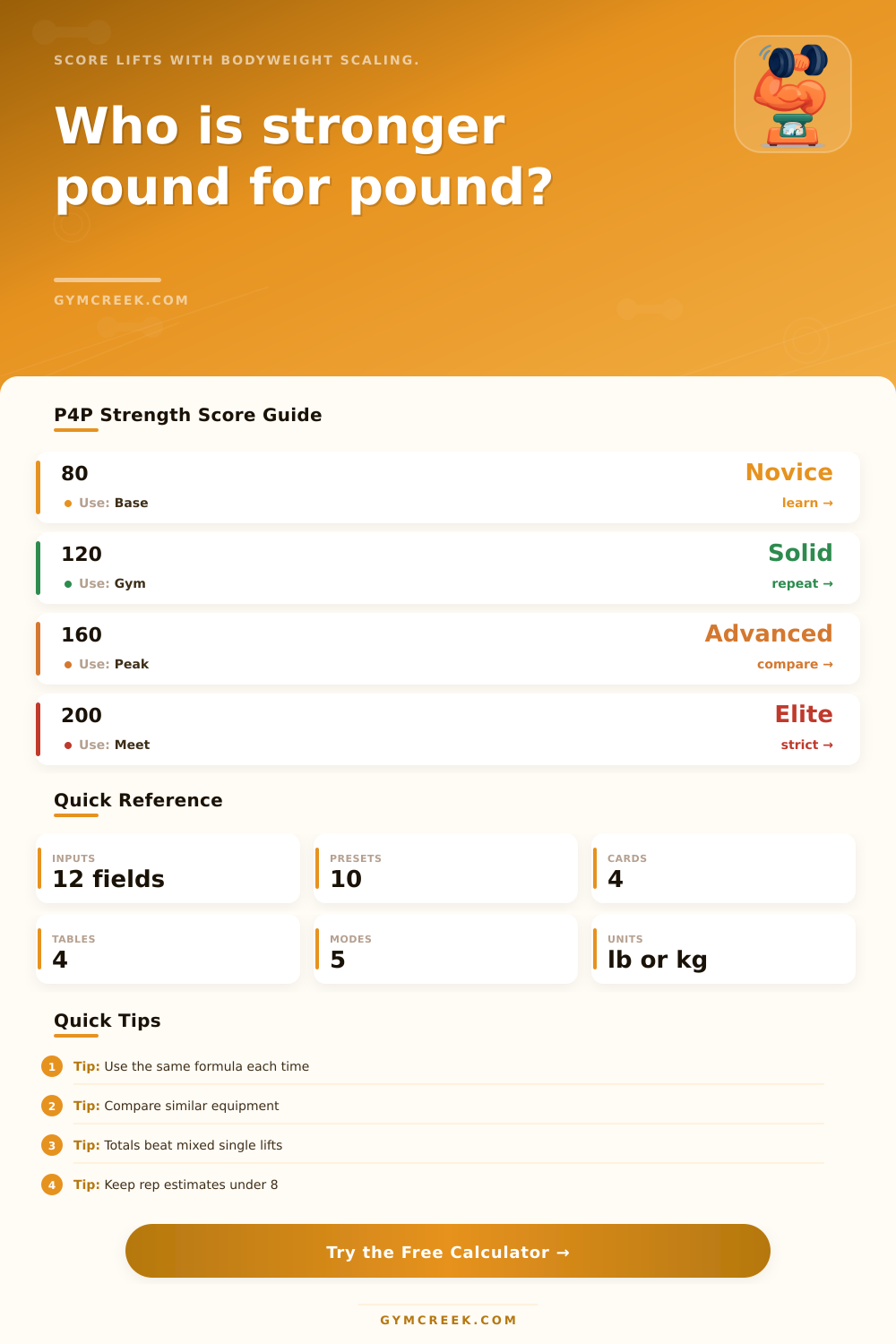
| Advanced | 160 to 199 | High scaled strength where technique and standards matter a lot | Strict depth, pause, lockout, and meet style |
| Elite context | 200 plus | Exceptional broad reference band, not an official federation rank | Judged attempts and matching rules |
| Formula | Bodyweight effect | Best use | Watch-out |
|---|---|---|---|
| Balanced P4P coefficient | Blends ratio, logarithmic bodyweight, and allometric scaling | General gym comparisons across different sizes | Educational score, not a federation formula |
| DOTS-style coefficient | Uses a bodyweight polynomial inspired by modern total scoring | Powerlifting-style totals with raw or sleeves context | Use as a trend tool, not an official meet score |
| Wilks-style coefficient | Uses a curve that heavily normalizes bodyweight | Older-style strength comparisons and what-if checks | May rank very light or heavy lifters differently |
| Allometric exponent score | Raises bodyweight to exponent b | Testing how much strength remains after body-size scaling | Pick one exponent before comparing athletes |
| Simple strength ratio | Divides total by bodyweight directly | Quick gym shorthand and easy tracking | Often over-rewards lighter lifters |
| Context | What is scored | Coefficient note | Comparison caution |
|---|---|---|---|
| Single lift | One rep-estimated lift or known max | Score is lower than a total because only one lift is present | Compare bench to bench, deadlift to deadlift, not across all lifts |
| Powerlifting total | Squat plus bench plus deadlift | Most coefficient formulas make the most sense here | Use matching depth, pause, and lockout standards |
| Push-pull total | Bench plus deadlift | Score is useful inside push-pull only | Do not rank it against full power totals |
| Olympic total | Snatch plus clean and jerk | Higher exponent context is often useful | Speed and technical precision matter more |
| Wraps or equipped | Same loads, stricter interpretation | Calculator flags the equipment context | Keep assisted and raw scores separate |
| Step | Formula | Variables | Result role |
|---|---|---|---|
| Lift 1 estimate | Lift 1 max = load x (1 + reps / 30) | Lift 1 load, reps capped at 12 | Turns a rep set into an estimated max |
| Total selection | Total = selected lift sum | Mode, lift 1 max, lift 2, lift 3 | Defines the load being scored |
| Coefficient score | Score = total kg x coefficient x mode factor | Total, bodyweight, formula | Main P4P score card |
| Relative ratio | Ratio = total / bodyweight | Total kg, bodyweight kg | Simple comparison shown beside the score |
| Allometric score | Score = total kg / bodyweight kg^b | Total, bodyweight, exponent | Independent body-size scaling check |
| Target total | Needed total = target / coefficient / mode factor | Target score, coefficient | Shows the load needed for the chosen P4P score |
💡Pound-for-Pound Notes
Pound-for-pound strength are a method that can be used to compare the strength of different lifter. Pound-for-pound strength is useful in that it can scale a lifters strength relative to that lifters bodyweight. Many lifter use numbers to describe the strength of another lifter, such as the amount of weight that the lifter can lift.
However, these numbers does not account for the bodyweight of those lifters. For instance, a lifter that weighs 220 pounds and lifts 315 pounds is not performing the same feat as a lifter that weighs 165 pounds and lifts 265 pounds. The concept of pound-for-pound strength account for this difference by dividing the strength of that lifter by the bodyweight of that lifter.
How to measure strength by bodyweight
To calculate pound-for-pound strength, there are many different formula that can be used. Each formula will produce different results from the other lifting formulas. One of the more simple method of calculating pound-for-pound strength is the use of a ratio.
To create this ratio, the lifter divides the total amount of weight that was lifted by the bodyweight of the lifter. Another means of calculating pound-for-pound strength is the use of a coefficient. Coefficients are more complex than the use of ratios because strength and bodyweight do not always increase at the same rate.
The third and final method of calculating pound-for-pound strength is the use of allometric approach. Allometric approaches use exponents to adjust the bodyweight of the lifter prior to dividing the strength by that bodyweight. Each of these different methods will weight the same lifter differently due to the use of these different formulas.
In order to calculate pound-for-pound strength for any given lifter, a pound-for-pound strength calculator can be used. The calculator will require that you provide the lift numbers for the lifter, the bodyweight of the lifter, and the formula that you are to use to calculate the pound-for-pound strength score. The formula that you choose will have an impact on the resulting pound-for-pound strength score.
For instance, the pound-for-pound strength score calculated using the simple ratio method will be different than the score calculated using the coefficient method. As a result, pound-for-pound strength scores allow for the comparison of the strength of each lifter to those other lifters, and using the same formula will ensure the accuracy of those comparisons. In addition to the factors related to bodyweight and the strength of the lift that those lifters perform, there are additional factors that will impact how the strength of a lifter is perceived.
Such factors include the age of the lifter, the type of equipment that the lifter uses to perform their lifts, and the physical mechanics of the lifters themselves. The age of the lifters may impact their strength due to the strength that they are able to build in their muscles with time, and the physical recovery capability of those lifters with age. Additionally, the equipment that the lifter uses may enable the lifters to perform more strength in their lifts, thus allowing for greater strength in their lifts compared to lifters who do not have access to that type of equipment.
Additionally, the physical mechanics of the lifters may allow for stronger lifts than other lifters who may have more even limb lengths, for instance. Thus, any factor outside of pound-for-pound strength may impact the actual physical capabilities of those lifters. There are some mistake that should of been avoided when calculating pound-for-pound strength scores.
For instance, one mistake that you should avoid is comparing pound-for-pound strength scores from different category of lifts. For instance, it may not be appropriate to compare raw lifts to equipped lifts, or lifts that perform only one movement to lifts that perform multiple movement. Additionally, another mistake that should be avoided is the use of the calculated pound-for-pound strength score as a permanent measurement of the strength of that lifter.
The strength of an individual can fluctuate with changes in sleep, stress, and training. Thus, it is important to use the same formula to calculate pound-for-pound strength to track how the strength of a lifter change over time. Furthermore, it is also important to use pound-for-pound strength scores to make decisions regarding training.
For instance, pound-for-pound strength can be used to understand if adding bodyweight is increasing the relative strength of the lifter, or if a particular type of training is increasing the strength of a lifter once bodyweight is accounted for. Thus, pound-for-pound strength is a useful tool in viewing the strength gains of a lifter. However, pound-for-pound strength is only one tool that can be used, and it doesnt replace the necessity of performing training to increase strength.