Potato Carb Calculator
Estimate total carbs, fiber, net carbs, cooked weight, raw weight, skin effect, cooling effect, and portion target share for raw, baked, boiled, mashed, roasted, or chilled potatoes.
📌Potato Carb Presets
Presets set a realistic potato type, portion, entry basis, cooking yield, skin status, cooling state, and carb target. You can edit any field after choosing one.
⚙Calculator Inputs
Potato carb snapshot
Enter potato type, weight basis, cooking method, skin status, cooling state, and targets to estimate your serving.
📊Potato Carb Metrics
📑Reference Tables
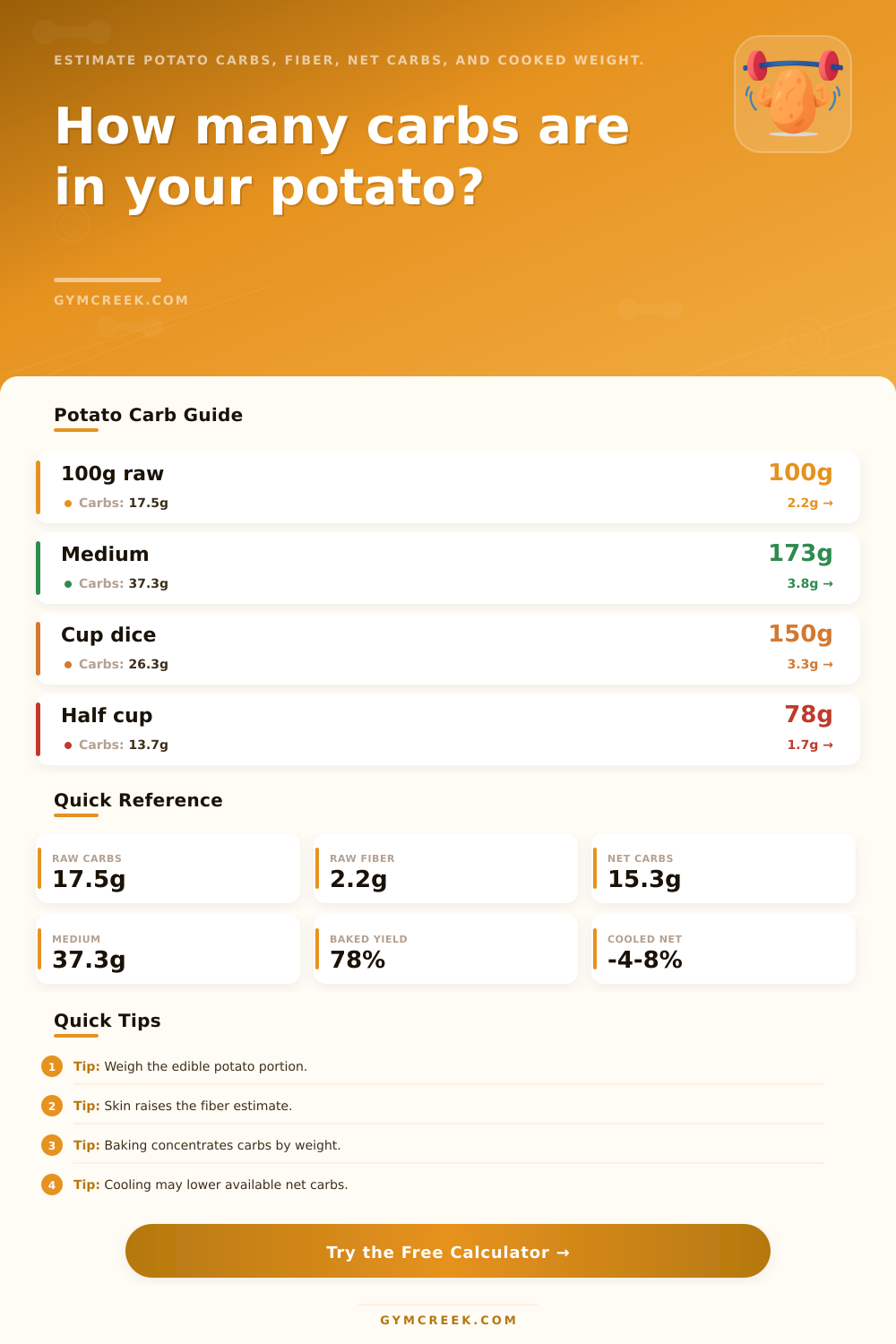
| Portion | Raw Weight | Total Carbs | Fiber |
|---|---|---|---|
| Small potato | 138 g | 24.2 g | 3.0 g |
| Medium potato | 173 g | 30.3 g | 3.8 g |
| Large potato | 299 g | 52.3 g | 6.6 g |
| Half cup diced | 78 g | 13.7 g | 1.7 g |
| One cup diced | 150 g | 26.3 g | 3.3 g |
| Cooking Method | Cooked Yield | Carb Effect | Best Entry |
|---|---|---|---|
| Raw reference | 100% | Baseline | Raw grams |
| Boiled or steamed | 94% | Slight loss | Cooked grams |
| Baked potato | 78% | More dense | Raw or cooked |
| Roasted pieces | 72% | Dense bites | Cooked grams |
| Mashed plain | 105% | Diluted | Cooked grams |
| Potato Type | Carb Shift | Fiber Shift | Use Note |
|---|---|---|---|
| Russet | Higher | Average | Baked potato |
| Yukon Gold | Average | Average | Mash or roast |
| Red potato | Lower | Slightly high | Boiled side |
| New potato | Lower | Higher | Small portions |
| Sweet potato | Higher | Higher | Training carbs |
| Cooling State | Net Effect | Fiber Change | Accuracy Note |
|---|---|---|---|
| Hot fresh | None | No change | Standard net |
| Warm rested | Small | No change | Estimate only |
| Cooled | Moderate | No change | Resistant starch |
| Reheated | Small | No change | Some remains |
| Chilled salad | Largest | No change | Best cooled case |
💡Tips
When you think about potatoes, chances are that you view them as just another pile of carbohydrates. One medium potato must be equal to roughly thirty grams of carbs… Equal to thirty grams of glucose inside your bloodstream. So what’s up? Why does a baked potato cause a spike in blood glucose while a boiled potato leaves it flat? What gives? Nothing magical, that’s for sure. Rather, it’s an interaction between chemistry and physics, the way your digestive system converts starch, that makes all the difference.
Knowing this allows potatoes to become a reliable fuel source instead of a mysterious food group. That’s what the calculator does above: It crunches the numbers for you. And knowing why it asks certain questions make the result useful.
Why Potatoes Affect Your Blood Sugar Differently
First step is the cooking method. Start with the cooking method, because how food cooks affects its density (i.e., grams per bite). When a potato is baked or roasted, water escapes. That leaves behind denser stuff, which contains more carbs per gram than when the veggie was uncooked. On the other hand, boiling reverses this, by infusing some water back into the starch molecule. So a cup of boiled potatoes will be heavier on the scale then a cup of roasted wedges, but deliver fewer active carbs.
Without understanding that, you can’t accurately keep tabs on what’s going in. And then there’s the skin, most frequently considered optional decoration instead of nutrition information. Potato skins contains fiber, and fiber is important. This reduces your net carb load. When you remove a potato skin prior to cooking, you’re consuming nothing but plain old starchy goodness, no resistance to digest. Leaving the skin in creates bulk which slows down absorption. A little thing, yes, but it makes a big difference in how it affect blood sugar. To account for this, the tool tweaks the fiber estimate depending on what part of potato you consume: flesh only vs. Whole.
There’s one other variable that few home cooks consider: cooling. When you put cooked potatoes at cool temps they start behaving differently due to a phenomenon called retrogradation; the amylose and amylopectin molecules line up again, forming structures your enzymes has trouble breaking down. That gives us resistant starch (which behaves like soluble fiber inside the gut). Instead of spiking blood sugar, it ferments with gut bacteria. Reheating the potato will partially offset this effect, but it doesn’t undo it completely. Because of this, a potato salad eaten cold typically have fewer net carbs than hot mashed potatoes fresh out of the pot.
The last trap is portion size perception. Our eyes interpret weight in terms of volume, not mass. Even when one potato appears small (like a large russet) on the plate, it may still pack almost fifty grams of carbohydrates! If you’re keeping a strict low-carb regimen, that’s more than enough to undo a day. With the scale, there’s no guessing involved. Potatoes come in such widely varying sizes. Some farms have larger ones then others, and they also differ with the time of year. Because of this, your visual estimate is unreliable. The calculator will take whatever weight you put on the scale and convert it into the raw weight so that your carb count is correct, no matter if you weigh them before or after cooking.
In other words, how you eat your carbs matters, too. Faster digestible starches after a workout for rapid glycogen replacement makes sense. Because the body wants fast. Skins on or cooled potatoes work great for this. A low-fiber baked potato also works well because it is fast. On the flip side, something like skins on potatoes or cooled potatoes makes more sense for a relaxing weekend meal where slow-release energy is wanted. This becomes strategy, eating isn’t just about filling bellies, but matching preparation to how the body works.
This is laid out nicely in a reference table on the page, which provides standards to compare with what happens when you log your own cookings. No need to memorize the numbers. Just know that there are relationships between temperature, fiber content, and moisture loss. And once you grasp how water weight dilutes or concentrates starch, then the variations makes sense.
Balanced eating doesn’t mean no potatoes. It is a versatile ingredient that plays by its own rules depending on what happens to it at the dinner table. Take charge of variable by thinking about the thermal history of your dish and weighing your portion. Then the numbers make sense. No more guessing, more measuring: That’s when the numbers fall into place. Just science applied to dinner.