Post Workout Protein Timing Calculator
Estimate your post-training protein serving, practical timing window, leucine target, next protein spacing, and remaining daily protein from your session profile.
📌Presets
Presets load realistic workout, feeding, and daily protein situations. You can adjust any field before calculating.
⚙Calculator
Post-workout protein plan
Enter your training details to estimate timing and protein needs.
📊Fitness Metrics
📑Reference Tables
| Pre-workout protein | Practical window | Reason | Priority |
|---|---|---|---|
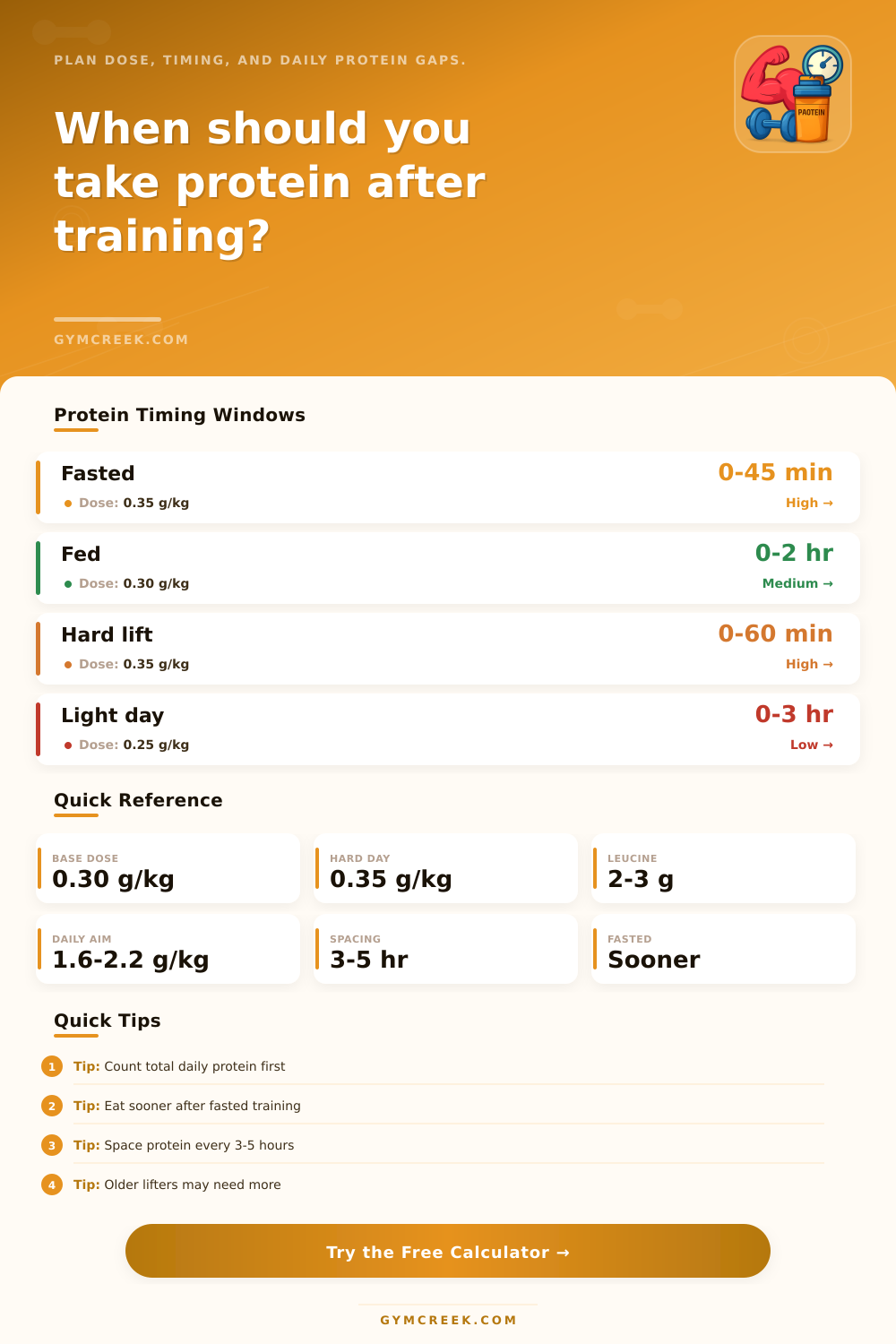
| No protein in 5+ hours | 0-45 minutes | Fasted training has less amino acid carryover. | High |
| Protein 3-5 hours before | 0-90 minutes | Some carryover, but another dose is useful soon. | Medium high |
| Protein 1-3 hours before | 0-2 hours | Recent amino acids make the window less urgent. | Medium |
| Protein within 1 hour | 1-3 hours | The pre-workout serving still counts as nearby protein. | Low |
| Dose target | Range | Useful for | Calculator cue |
|---|---|---|---|
| Lower end | 0.25 g/kg | Light sessions or smaller daily gaps. | Easy skill day |
| Middle | 0.30 g/kg | General lifting, mixed training, and routine recovery. | Default result |
| Upper end | 0.35 g/kg | Hard lifting, long workouts, or fasted sessions. | High urgency |
| Cap check | 0.40 g/kg | Large athletes or older lifters needing a larger pulse. | Upper guardrail |
| Scenario | Timing cue | Daily target | Planning note |
|---|---|---|---|
| Muscle gain | Soon but flexible | 1.8-2.2 g/kg | Prioritize total daily protein and repeat servings. |
| Fat loss | Do not skip | 1.8-2.4 g/kg | Higher protein helps keep the day structured. |
| Endurance | Pair with recovery meal | 1.4-1.8 g/kg | Protein supports repair after longer sessions. |
| Maintenance | Match meal rhythm | 1.4-1.8 g/kg | Spacing matters more than exact minutes. |
| Formula item | How it is used | Typical value | Output affected |
|---|---|---|---|
| Serving dose | Body weight kg times session factor. | 0.25-0.40 g/kg | Protein grams |
| Leucine estimate | Protein grams times 8.5%. | 2-3 g target | Leucine card |
| Daily target | Body weight kg times selected g/kg. | 1.6-2.2 g/kg | Remaining gap |
| Meal spacing | Last dose plus about 3-5 hours. | 180-300 min | Next spacing |
💡Tips
The idea that we have to get some sort of protein inside our bodies within 30 minutes after exercise are a concern for most lifter. Don’t freak out if it’s only been a few minutes and a few seconds. If you took an extended period in the shower or if you were texting your friends, hey, chill, we’re fine.
The key here is to determine where this food entry occur relative of your overall daily protein consumption. Another consideration: How long has it been since you ate something prior to training? It is about logistics, not panic.
Protein Timing is Simple
The calculator above handle the heavy lifting by combining your workout intensity, body weight, and pre-training nutrition into a single coherent plan. Simply tell it what kind of exercise you performed, if you fasted during your training, and roughly how many grams of protein you’ve had today. Then it’ll spit out a serving size estimate for you.
It also accounts for varying workout types. Some deplete resources more different than others (e.g., easy skill drills vs hard strength). Since you’re starting with lower levels of amino acids when training on an empty stomach, the algorithm recommend eating earlier. And if you just had breakfast, it lets you wait longer, since those nutrients will remain in your system.
Many people make this common mistake: they think all workouts should be treated like emergencies that require immediate protein. Knowing what goes in will change your approach to recovery. Generally, a recovery dose of 0.25 to 0.40 grams/kg of bodyweight are recommended. That’s more than enough leucine to stimulate muscle repair while avoiding wasteful protein consumption.
Not sure if you’re getting enough? Don’t worry; the calculator do that work for you. It’ll tell you how many more grams of protein you have left to eat before bedtime. Doing so ensures you avoid the front-loading mistake and skip out on meals following workouts. Eating regularly during the day is preferable than gorging yourself post-workout.
The second-serving question: When? The recommendation here is that you space out meals so that they is anywhere from three to five hours apart. That allows for a constant high state of muscle protein synthesis throughout the day rather then having it spike up and immediately drop back down.
For someone looking to gain muscle, that sustained state promote tissue repair. For someone trying to get leaner (while taking in fewer total calories), it’s a way to maintain lean tissue while still eating less. Tables on the page illustrates how those goals alter urgency of need.
Because anabolic resistance can occur in advanced lifters, they might has to consume a bit more protein per meal. Those who do endurance exercise will be interested in combining their protein with carbs to restore glycogen stores. Your situation is covered by the presets.
If you work out twice per day then you’ll want a greater number of calories each day with meals spaced more closely together. If you work out late at night, you may want to shift the timing of your last meal toward bedtime (and thus include a slower-digesting protein). That’s where generic advice falls short. It doesn’t consider your exact situation.
Enter it into the tool, and you recieve a plan tailored specifically for your day. The fields is adjustable if your day doesn’t fit into any one particular box. It gives you much-needed flexibility.
The timing isn’t biology, it’s a way to organize your food intake. If you’re hungry, eat sooner after a fasted training session. Why wait? Youve got an empty system. If you only consumed a protein shake post-training and took it easy, eating three hours later is perfectly fine. Just get your total daily protein in and spread it out.
It doesn’t matter what time; worrying about the clock takes energy away from running and lifting. Plan your meals with the estimates but eat as usual. Consistency matters. The stopwatch don’t.
If you control the total day, progress will follow. Not the perfect minute.