Post Workout Carb Calculator
Estimate recovery carbohydrate grams from body size, workout demand, goal, depleted muscle groups, and how soon you train again.
📌Recovery presets
Presets fill the whole form, including unit system and training context, then recalculate the carb target.
⚙Athlete profile
💪Workout demand
Post-workout carb target
Enter workout details to estimate grams of carbohydrate for the recovery window.
📊Fitness metrics
📋Post-workout carb ranges
| Training demand | Typical range | Best fit | Calculator note |
|---|---|---|---|
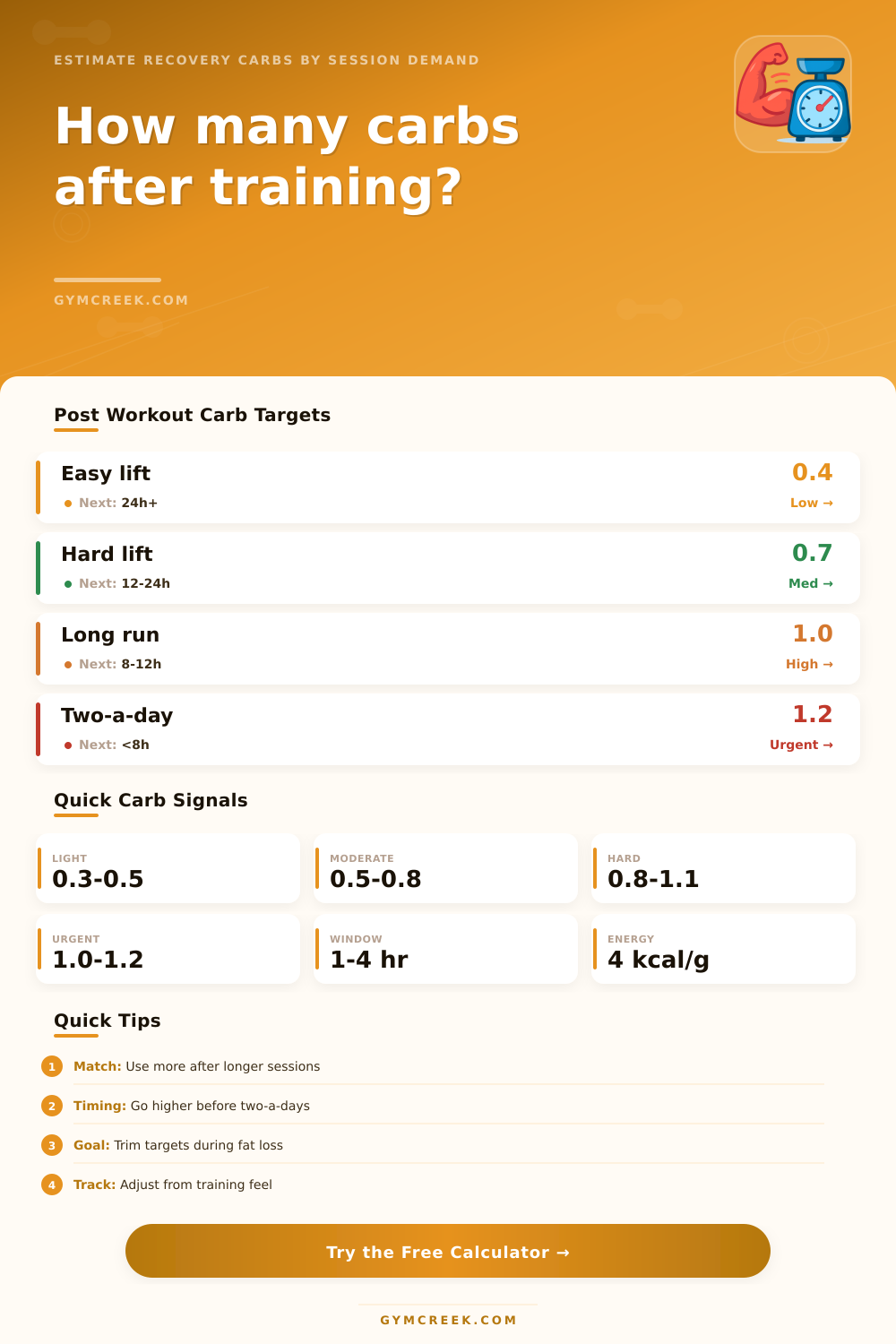
| Easy strength or skill work | 0.3 to 0.5 g/kg | Low glycogen use | Often enough for maintenance days |
| Hard strength or hypertrophy | 0.5 to 0.9 g/kg | Moderate to high volume lifting | Higher if legs or full body were trained |
| Intervals or mixed conditioning | 0.7 to 1.0 g/kg | Repeated hard efforts | Next-session timing can move this up |
| Long endurance or two-a-day | 0.9 to 1.2 g/kg | High glycogen demand | Urgent refueling favors the upper range |
📝Scenario comparison
| Scenario | Inputs that matter | Expected target | How to read it |
|---|---|---|---|
| Strength maintenance | 75 min, moderate, 12-24h | Moderate | Carbs support training without pushing high |
| Fat loss lift | 60 min, balanced, 24h+ | Lower | Goal modifier trims the target |
| Long ride | 150 min, hard, lower body | High | Duration and muscle demand raise grams |
| Two-a-day athlete | 90 min, very hard, <8h | Urgent | Next-session timing raises priority |
🔢Formula reference
| Step | Formula | Variable | Purpose |
|---|---|---|---|
| Body weight | lb / 2.2046 or kg | kg | Normalizes carb target by size |
| Baseline carbs | kg x session g/kg | grams | Sets the workout-specific starting point |
| Adjustment factor | intensity x duration x next x goal | multiplier | Moves target toward lower or upper range |
| Daily context | Mifflin-St Jeor x activity | TDEE | Compares recovery carbs to daily energy |
✅Carb calculation tips
Recovery after training requires specific adjustments to an athletes nutrition. The amount of carbohydrate an athlete need to recover from training depends on several different variable. Because most athletes dont know the amount of carbohydrate they needs after a training session, the amount of carbohydrate required to recover from training also depends on other factors related to the athlete and training session.
The amount of carbohydrate an athlete consume is dependent upon the amount of carbohydrate the athlete needs to replenish their glycogen levels after training. If an athlete consumes too much carbohydrate after training, they consume unnecessary calories. If an athlete consumes too little carbohydrate after training, they may feel flat during their next workout.
How Many Carbs to Eat After Training
The amount of glycogen an athlete burns during training depends on several different factors. The length of the training session is one factor that determine the amount of glycogen an athlete uses. However, another factor is the intensity of that training session.
High-intensity efforts use up more stored carbohydrate than low-intensity efforts. Additionally, the number of muscle groups engaged during training will impact the amount of glycogen used. A long ride or a workout that use the bodys lower muscle groups will use up more glycogen than a workout that only uses the upper body.
Environmental factors such as heat, humidity, and altitude can also impact the amount of glycogen an athlete uses during training. In hot environments, athletes lose fluids and use up more glycogen. Altitude can also impact glycogen use because athletes have to work harder to breathe at high elevations.
An athlete’s primary goal will also impact the amount of carbohydrate that they need to consume after training. For fat loss, athletes will use less carbohydrate to replenish their glycogen stores than if they were trying to gain muscle or increase their endurance. The calculator takes into account body weight, session type, intensity, duration, time until the next session, primary training goal, and the environment in which training occurs to determine a specific number of carbohydrate grams that an athlete should consume after training.
The timing of an athletes next training session also impacts the carbohydrate recommendation. If the athlete has less than eight hour until their next training session, they should aim for a higher target for carbohydrate consumption. After training sessions that are more than twenty-four hours apart, the athlete can spread the carbohydrate consumption over their meals.
The amount of carbohydrate consumed during the training session will also impact the carbohydrate recommendation post-training. If the athlete consumed a sports drink during training, or consumed a snack post-training, the athlete should subtract the grams of carbohydrate consumed during these period from the target amount. While the protein intake will not impact the carbohydrate calculation, the athlete should also consider the protein intake for the preparation of the athletes recovery meal.
While an athlete’s daily activity levels will inform the athlete of the importance of carbohydrate consumption post-training, their daily activity levels will not dictate the amount of carbohydrate that they should consume post-training. An athlete may perform many activities throughout the day that burn up the athletes glycogen stores. However, the total number of calories burned daily will also inform the athlete of the relative importance of recovery carbohydrate for that athlete.
Athletes may make common mistakes in the preparation of an athletes recovery meal. Athletes may eat the same meal after every training session. This is a mistake because not all training sessions are of the same length or intensity.
Another mistake is to consume too little carbohydrate after intense workout sessions. This can lead to an athlete feeling bad during their next training session. An athlete should adjust the carbohydrate intake based on their goals for that training session and how they feel the following morning after training.
An athlete who feels lethargic and whose legs feel heavy the following morning likely consumed too little carbohydrate during their training session of the previous day. Environmental factors such as heat, cold, and altitude can also impact carbohydrate consumption after training. High temperatures cause athletes to consume more fluids, and the body burns more glycogen when it is hotter outside.
At high altitudes, athletes use more carbohydrate because they have to work harder to breathe. The calculator accounts for these environmental factors through the use of various multipliers. Recovery carbohydrate is only one element of the recovery process.
An athlete also needs to get enough sleep, consume enough protein throughout the day, and maintain an energy balance within themselves to recover from training. A well-timed meal of carbohydrate and protein will aid in recovery, but will not fix an athlete who does not get enough sleep or consume enough protein. While the calculator informs an athlete of one specific recovery decision, it does not account for the other decisions that an athlete must make regarding their diet.
An athlete can develop a habit of using the calculator to determine carbohydrate needs after training by running the calculator several times with the different types of training sessions that the athlete performs. This can help an athlete understand whether their training routine under-fuels or over-fuels them. Small adjustments to an athletes carbohydrate intake can make a big difference in their performance in their next training session.
Therefore, making these small adjustments can avoid poor performance during an athletes upcoming training session. The goal of the calculator is to remove error in an athletes carbohydrate intake after training so that the athlete can fuel their muscles for the work that they have finished of that training day and the work that they have yet to do.