Pole Dancing Calorie Calculator
Estimate calories burned in pole dancing classes, open practice, choreography rehearsals, spin pole flows, static pole conditioning, climb blocks, invert training, floorwork, and performance run-throughs.
📌Presets
Each preset loads a realistic pole training profile and recalculates from skill level, pole mode, climb and invert volume, floorwork share, routine density, rest, and body weight.
⚙Calculator
Pole dancing calorie snapshot
Enter session structure and pole workload to estimate calories.
📊Fitness Metrics
🧮Formula Cards
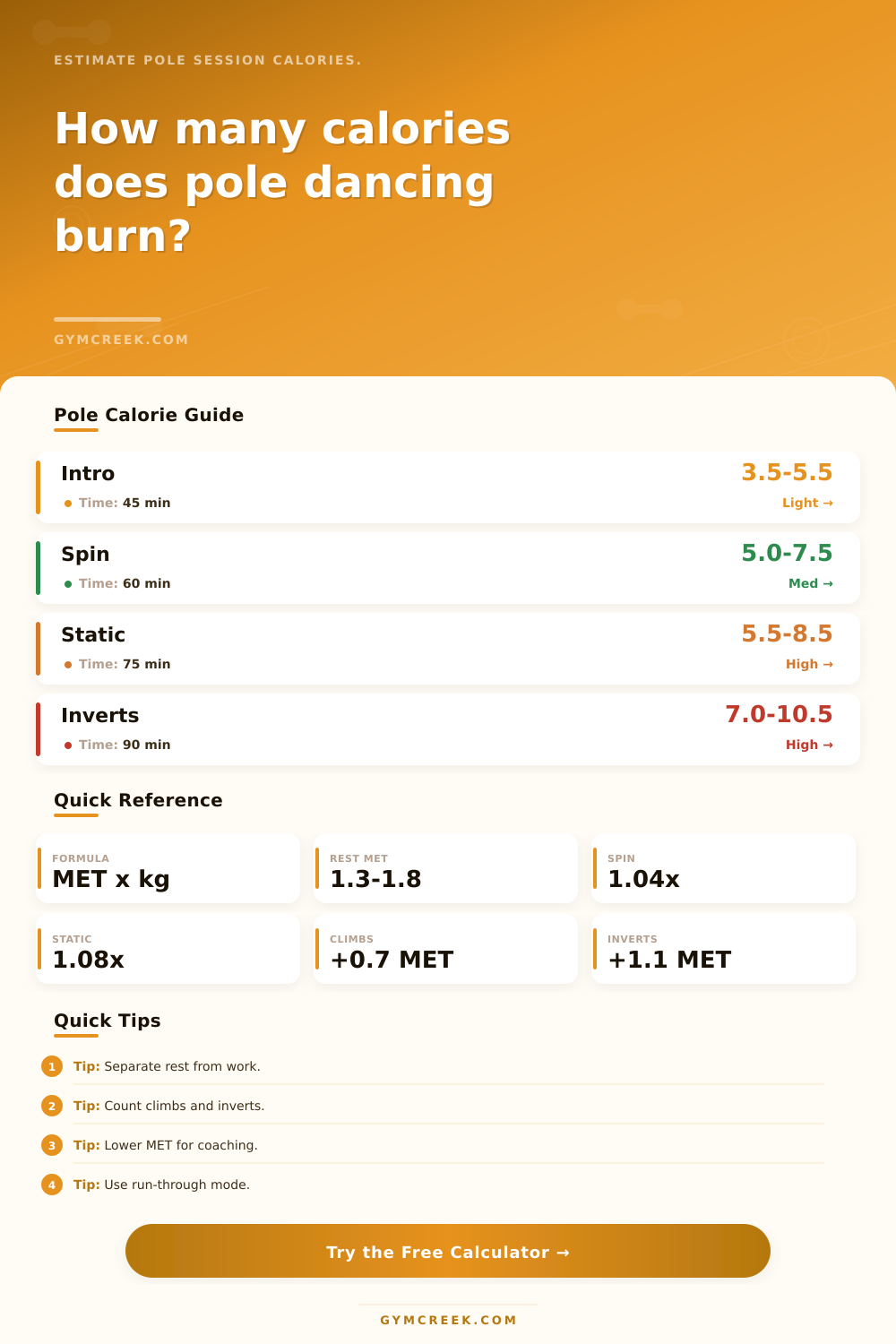
Calories per minute = MET x 3.5 x body weight in kg / 200. The calculator applies this to pole work, floorwork, strength volume, and rest separately.
Beginner, intermediate, advanced, and competition levels start with different MET bands. Static pole, spin pole, mixed sessions, and floorwork focus apply separate multipliers.
Climbs and inverts add a strength load score. The score increases adjusted MET and estimates a separate strength calorie contribution for aerial effort.
Rest ratio shifts part of the session to low MET burn. Mifflin-St Jeor estimates BMR and TDEE so the session can be compared with daily energy use.
📑Reference Tables
| Skill Level | Base MET | Typical Work | Best Use |
|---|---|---|---|
| Beginner foundations | 3.8 to 5.2 | Walks, spins, sits | Intro classes |
| Low intermediate | 4.8 to 6.4 | Climbs, holds | Technique days |
| Intermediate combos | 5.8 to 7.8 | Combos, sits | Mixed practice |
| Advanced tricks | 7.0 to 9.4 | Inverts, drops | Trick blocks |
| Competition level | 8.2 to 10.8 | Repeated runs | Prep sessions |
| Pole Mode | Modifier | Load Pattern | Calorie Effect |
|---|---|---|---|
| Floorwork focused | 0.88x | Dance flow | Lower grip |
| Mostly spin pole | 1.04x | Control and core | Steady load |
| Mostly static pole | 1.08x | Pulls and holds | High strength |
| Mixed spin/static | 1.10x | Varied effort | High average |
| Volume Signal | Light | Moderate | High |
|---|---|---|---|
| Climbs | 0 to 10 | 11 to 28 | 29 plus |
| Inverts | 0 to 5 | 6 to 18 | 19 plus |
| Floorwork share | 0 to 20% | 21 to 50% | 51 plus |
| Rest ratio | 0 to 15% | 16 to 35% | 36 plus |
| Formula | Variables | Output | When Used |
|---|---|---|---|
| MET kcal | MET, kg, min | Calories | Main estimate |
| Strength score | Climbs, inverts | Load class | Aerial work |
| Rest kcal | Rest MET, min | Break burn | Session pauses |
| TDEE share | kcal, TDEE | Percent | Daily context |
💡Tips
So most people think: like running, I’m going to burn calories steadily and at a rate proportional to how long I was there. No. Instead, the burn pattern is lumpy, spiked during an intense static hold and smoothed out during extended rests as you wait for the pole, catch your breath, etc. And this is why estimating based off simply on duration alone doesn’t cut it.
You have to account for how you mix strength, rest, and skill work. Enter the calculator. Plug in the structure of your sessions and it handles the math for you (saving you the trouble of guessing about conversions/coefficients). It shows the difference between active work and the downtime, and gives you a truer picture of what’s actualy happened in the studio.
Why a Calculator Is Better Than Guessing
“First off, let’s get clear on what we mean by spin versus static pole. Static pole require much more muscular endurance because you have to lift your entire body weight against gravity without using momentum. Conversely, spin pole feels like a fast dance; it’s almost as if it looks harder, so it must burn more, right? But the tool know that a graceful spin is different than a taxing static hold/climb and adjusts the energy burn accordingly. Since your workout consist mainly of static work, the estimate will skew higher, yes. No mistake there. It’s physics.”
And then, there’s the number of particular tricks. There’s more than just moving. Inverts and climbs is strength tests. Holding a trick like an invert or climbing up to one requires a burst of anaerobic energy that isn’t produced from steady dance flow. This shifts the mean energy output for the hour; and the calculator prompt you to enter the numbers to find that value.
For example, a novice could be on the floor for forty minutes, warming up, attempting simple spins. That would elicit a moderate burn. Another person who’s been dancing longer could do five challenging inversions with a held flag during those same forty minutes. Same amount of time, different amount of energy spent.
To capture this, the tool introduces a strength load score to the baseline calculation. Again, it’s a small tweak, but when you’re measuring improvement, that adds up.
Another thing people overlook: rest time. Depending on the type of group class, you may spend 20% of the session in recovery grip. You might also be sitting and listening to instruction or waiting your turn on the pole. That’s all still part of the exercise; it just doesn’t burn as many calories per minute as when you’re actively working out.
With the calculator, you can specify how much of this is rest. This stops the estimate from being too high, since it doesn’t assume you climbed continuously throughout each minute. It also provides context for everyday life. If you know the pole session accounted for a certain percentage of your total energy used during the day, you can better adjust your diet, without going too far in one direction or the other. Was that pole session a major part of your day? Or was it just a moderate activity?
But it’s also true that skill level is a factor (though maybe not as you expect). Novices burn fewer calories because they can’t maintain the effort required for fancy footwork. They’ll go slower, rest more, and take more breaks. At higher levels of skill, the movements gets trickier and require greater speed, increasing the metabolic cost. So the more you know, the more you burn.
That’s what the page’s reference tables map out: they connect expected workload with skill level. You’ll see the competition athlete has a higher estimate, obviously, since they’re doing so much more per session. That’s why we ask for your skill level. It grounds the estimate in real-world activity, not an aspirational one.
And then there’s floorwork. It is fluid and dance-heavy. The constant movement keeps heart pumping while decreasing the demand on your grip. It scores lower in grip but higher in aerobic endurance. That’s great news if you’re a dancer whose strength routine is driven more by aesthetics (performance) than brute force. This tool understand that not every kind of pole fitness looks like pole fitness.
The point isn’t chasing a number. The point is making an effort and understanding what that cost you. If you’re competing, trying to get fitter, or just having some fun, knowing how much of your energy went towards achieving that helps you train smarter. It helps you figure out whether you should of do more cardio, more strength training, or more rest.
The calculator provides the data. You supply the sweat. And that’s what makes this partnership go from guessing to planning.
It’s a lumpy burn, but now you know exactly where those spikes are.