Plyometric Volume Calculator
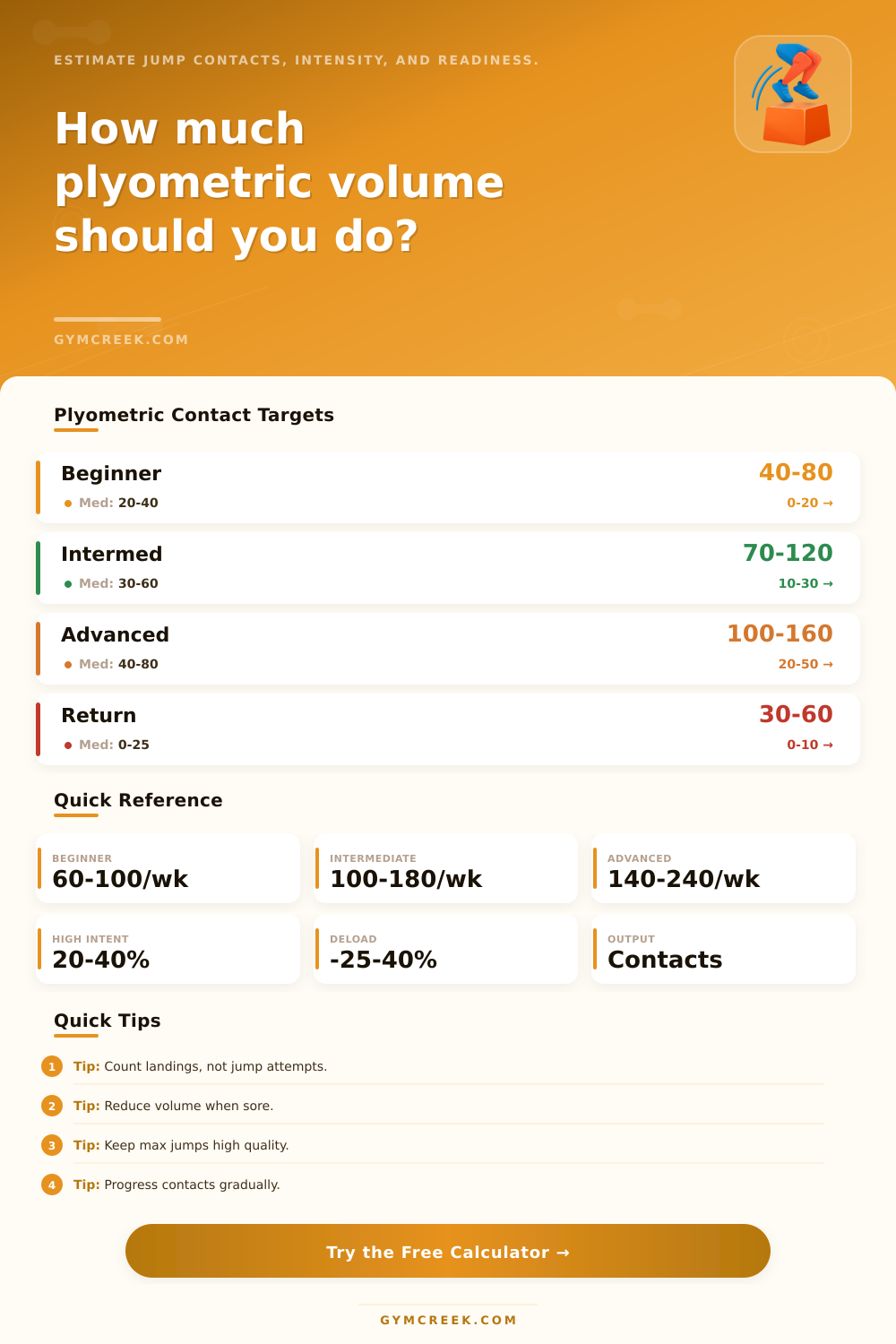
Plan weekly jump contacts from training goal, jump intensity, athlete level, surface stress, and readiness before adding more explosive work.
📌Presets
Each preset loads a realistic jump-contact scenario and recalculates weekly volume, high-intensity exposure, and readiness-adjusted limits.
⚙Calculator
Plyometric volume snapshot
Enter contacts, intensity, and readiness to calculate weekly plyometric load.
📊Plyometric Metrics
📑Reference Tables
| Experience | Weekly Contacts | High-Intensity Share | Best Use |
|---|---|---|---|
| New to plyometrics | 40-80 | 0-15% | Landing skill and rhythm |
| Beginner | 60-120 | 10-25% | Basic hops, skips, and box jumps |
| Intermediate | 100-180 | 20-35% | Bounds, repeated jumps, sport prep |
| Advanced | 140-240 | 25-45% | Reactive jumps and power blocks |
| Elite exposure | 180-300 | 30-50% | Carefully monitored high output |
| Jump Type | Intensity Weight | Contact Note | Volume Cue |
|---|---|---|---|
| Pogos / line hops | 0.75x | Low amplitude contacts | Can use higher counts |
| Skips / low bounds | 0.9x | Moderate rhythm work | Build gradually |
| Box jumps | 1.0x | Lower landing impact if stepped down | Quality over height |
| Broad / lateral bounds | 1.25x | Forceful horizontal landings | Limit when sore |
| Hurdle / depth jumps | 1.45-1.7x | High reactive demand | Keep contacts low |
| Readiness | Volume Factor | High-Intensity Rule | Session Call |
|---|---|---|---|
| Green - fresh | 100% | Use planned dose | Train as planned |
| Yellow - normal fatigue | 85% | Trim last hard sets | Keep quality high |
| Orange - sore or tired | 65% | Cap at low exposure | Switch to lower jumps |
| Red - poor readiness | 35% | Avoid high contacts | Technique only or rest |
| Scenario | Session Contacts | Weekly Split | Watch Point |
|---|---|---|---|
| Basketball in-season | 30-60 | 1-2 sessions | Count sport jumps too |
| Speed / power block | 40-80 | 2-3 sessions | Stop when pop drops |
| Return-to-jump | 15-40 | 2-4 exposures | Keep landings quiet |
| Advanced reactive | 20-50 | 1-2 hard days | Long rest between efforts |
💡Tips
Many athletes mistakenly treat plyometrics like a volume game, assuming more jumps automaticly mean more power. Wrong. The nervous system doesn’t adapt the way muscle fibers adapts to heavy squatting. It only adapts to how well it is loaded under certain conditions. Go beyond that and a power workout become a risk for injury.
Jumping harder each week isn’t necessary. Focus on landing in a way that matches how well you can recover. Once you’ve entered how ready you are each day and what type of training you’ve done, it does all the calculations for you (above). You no longer have to guess, convert, or calculate coefficients.
Why Less Is Better for Plyometrics
It makes you differentiate between high-intensity depth jumps and low-intensity hops. People generally log sets but not contact. You can generate far more ground reaction force with one depth jump compared to five lighter pogo hops. Mixing up the two without accounting for intensity mean you’re underestimating your total load. The tool tells them apart and gives heavier weight to harder movements. That way, you have an accurate representation of amount of stress on your bones and tendons.
Your level of readiness can change from day to day and often goes unnoticed from week to week. Sport practice or heavy lifting may has left you feeling fresh one day but wrecked another. The calculator reduces volume based off your rating of readiness. So if you’re feeling sore (orange) or didn’t sleep well (red), it will recommend far less volume. It’s not a quit signal, it’s a preservation signal.
When we’re fatigued, power training falter as speed vanishes prior to force. Rather than developing power, you practice slow movements that lock-in poor habits.
Most people don’t realize surface makes a big difference. A single jump onto concrete transmits all those shock waves into your skeletal system; something turf just soaks up. To handle it, the tool also changes the perceived load depending on what you land on. For example, many indoor athlete fail to appreciate how hard wood feels in comparison than a rubber gym floor. Over time (say six weeks of regular training), that gap really adds up. Maybe you’re making the same number of contacts, but the toll on your body is completely different.
Newbies make this error: they dive too far into the intensity scale without building their tissues first. They skip low-volume pogo hops, but instead jump all-in with max-height box jumps. That’s ignoring the need to develop the ability to manage reactive forces by building up your body gradualy. The safety ranges is outlined in the reference tables on the page. Don’t think that staying down at the lower end of your range makes you weak. Think that makes you smart. You’re getting tough first, adding intensity second.
It should be boring. Sure, we all like the idea of making slow and steady progress (ten percent per week seems reasonable on paper). But it breaks down in practice. Aggressive jumps gets flagged by the calculator; they don’t fit a cautious ramp rate. You should of known that.
You’re piling up contacts each session? Something’s amiss. Most athletes aren’t deficient in volume. They’re deficient in recovering between sessions. Hard blocks must be combined with deload weeks. This isn’t optional maintenance. It’s when your body gets stronger.
Don’t make everything as hard as you can. It’s about building muscle while avoiding tendon pain that makes you chronically sore. Let the tool act as your ceiling, but go down a little from there if/when life happens. Over time consistency trumps intensity. Land quietly, count honest reps/volume and let result come.