Plate Pinch Hold Calculator
Score a plate pinch hold from load, hand mode, plate width, hold time, chalk, set count, body weight, and RPE with grip-specific benchmarks.
📌Presets
Each preset loads a realistic plate setup, hand mode, surface, chalk level, RPE, and hold duration so the grip score updates immediately.
⚙Calculator
Plate pinch hold snapshot
Enter a valid plate load, width, time, body weight, and RPE to calculate pinch strength metrics.
📊Grip Metrics Grid
🧮Formula Cards
📑Reference Tables
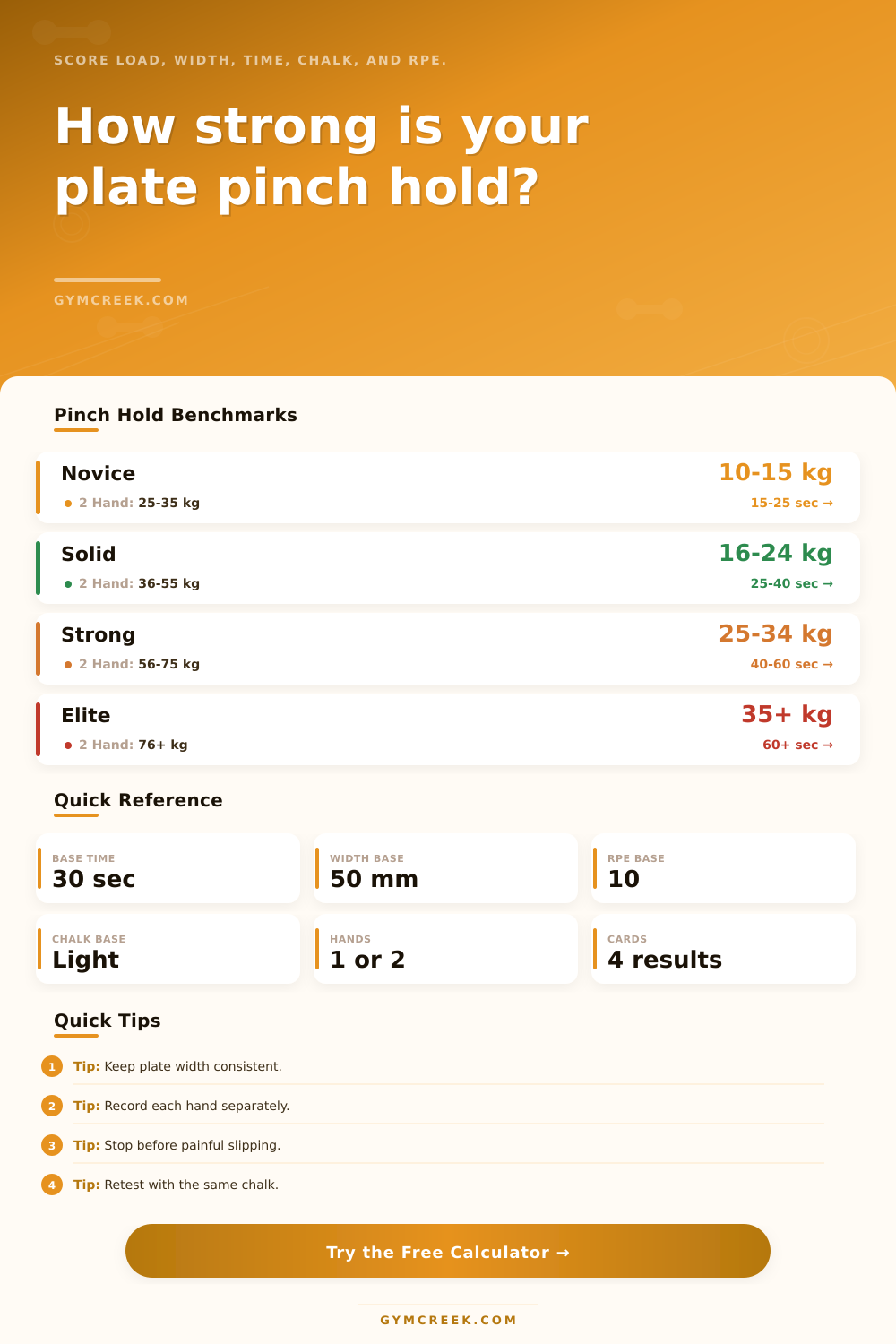
| Level | One-Hand Load | Two-Hand Stack | Typical Hold |
|---|---|---|---|
| Novice | 10-15 kg per hand | 25-35 kg total | 15-25 sec |
| Solid recreational | 16-24 kg per hand | 36-55 kg total | 25-40 sec |
| Strong lifter | 25-34 kg per hand | 56-75 kg total | 40-60 sec |
| Advanced grip athlete | 35+ kg per hand | 76+ kg total | 60+ sec |
| Plate Setup | Width Clue | Friction Clue | Compare With |
|---|---|---|---|
| Two thin iron plates | 35-45 mm | Moderate | Same plate pair |
| Two bumper plates | 60-90 mm | Rubber assist varies | Same brand and age |
| Smooth calibrated plates | 45-55 mm | Lower texture | Competition-style tests |
| Hub or lip-assisted hold | Variable | Mechanical edge help | Separate category |
| Input | Calculator Role | Higher Means | Best Practice |
|---|---|---|---|
| Plate load | Main strength demand | More force required | Weigh plates if unsure |
| Plate width | Pinch leverage penalty | Harder thumb position | Measure the stack |
| Hold time | Endurance scaling | More time under tension | Stop at clean failure |
| RPE | Reserve estimate | Closer to max effort | Use honest best set RPE |
| Formula | Variables | Result | Use |
|---|---|---|---|
| Per-hand kg | load kg / hands | kg per hand | One vs two hand comparison |
| Time factor | sqrt(seconds / 30) | endurance multiplier | Standardizes short and long holds |
| RPE reserve | 1 + (10 - RPE) x 0.04 | estimated max factor | Converts submax holds |
| Session work | load x sec x sets | kg-sec total | Training density tracking |
💡Tips
Your bench press and deadlift number. Everyone knows these numbers. But what about your pinch strength? Most people has no clue. Pinch strengthens the finger and thumbs alone, something farmer walks and thick bars can’t quite replicate. It’s a test of whether your digits can generates enough force to create pure friction against gravity.
Time, width and load is calculated by the tool for you. That lets you focus on actualy lifting the thing.
Why You Should Test Your Pinch Strength
The largest variable that trips folks up are the size (width) of the plate. Ten pounds can seem light on a plate. If the plate is wide, the mechanical disadvantage skyrockets. That leads to a mechanical disadvantage. You have to work harder for your thumb to overcome that distance’s torque. Getting the actual width matter more then guessing at it by weight. So the calculator adjusts this with a width factor.
This means a wider, lighter pinch isn’t being unfairly compared against a narrow, heavier pinch. It makes a small input adjustment. And it changes accuracy of your strength profile.
Add a new variable called Chalk. Most casual trainees overlook this. Liquid vs. Sweaty hands change the hold. The friction coefficient shifts the demand on your finger flexors. Consistency is required when attempting to measure progress. Compare apples-to-apples. Try comparing chalked holds against other chalked holds. Don’t switch variables weekly; otherwise, you gets noise in your data.
Look at the load and hold times in table on the page to see how they compare. Notice the shift? Keep your testing environment static. Only then can you observes real improvement over time.
Also consider time under tension. Can you hold a moderate amount of weight for thirty seconds? That’s building endurance which will help with your long heavy pull or climb. For testing out peak strength, try holding a max weight for ten seconds. These efforts is converted to an equivalent standard. Now you can compare a longer, lighter hold to a shorter, heavier hold. Avoid the error of believing that because something lasted longer it was stronger. Consider the lighter weight being held.
Pinch with one hand. It highlights the differences covered up by the two handed lift. Most athletes have a dominant side that carries extra weight without them realizing it. Without knowing it they carry an additional load on their dominant side. Try testing both hands individually. You will find your weak link if you drop the plates with your left and hold them with your right, fix this imbalance. Avoid injury. Strengthen structural integrity across the board.
Not all grip is crush. Grip is tendon health and fine motor control. It’s maintaining tension while stressed. If you’re a powerlifter looking to hold onto the bar when it rolls or you’re a climber wanting to improve how you transfer your footwork, knowing these metrics let you train smarter.
You should of known that. So stop guessing where your limit is. Plug in your real numbers. Take a look at the breakdown. What can your fingers really handle? The numbers don’t lie. They need truth fed into them.