Plate Pinch Grip Calculator
Estimate your pinch score from plate width, surface friction, hand setup, hold time, load, chalk use, bodyweight, and thumb span.
📌Presets
Presets change plate finish, width, chalk, bodyweight, thumb span, and hand setup so the score reflects more than load alone.
⚙Calculator
Plate pinch snapshot
Enter your plate setup to estimate pinch score, friction demand, and safer progression targets.
📊Pinch Metrics
📑Reference Tables
| Grip Score | Level | Typical Signal | Next Focus |
|---|---|---|---|
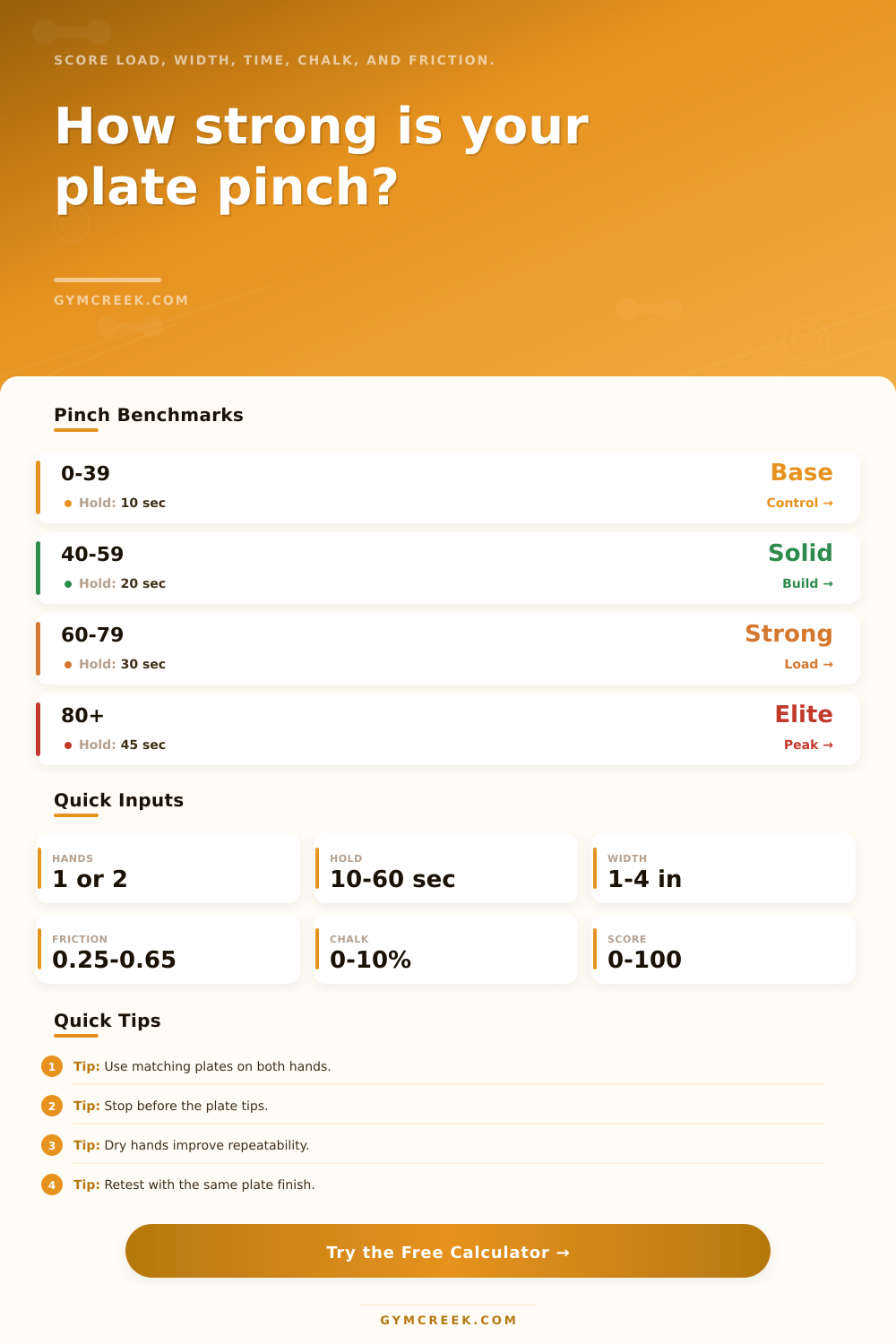
| 0-39 | Base | Light load or short hold | Stable start and release |
| 40-59 | Solid | Good gym baseline | Add time before load |
| 60-79 | Strong | High load or hard width | Retest with matched plates |
| 80-100 | Advanced | Heavy, long, or slick setup | Use strict attempts only |
| Surface | Friction Range | Feel | Calculator Use |
|---|---|---|---|
| Slick paint | 0.25-0.32 | Hard to secure | Use for smooth plates |
| Worn iron | 0.33-0.40 | Moderate bite | Use for old gym plates |
| Cast texture | 0.41-0.48 | Reliable grip | Use for rough iron |
| Rubber coat | 0.49-0.58 | High friction | Use for rubber plates |
| Pinch block | 0.59-0.70 | Very grippy | Use for textured tools |
| Pinch Width | Demand | Best Use | Common Limiter |
|---|---|---|---|
| Under 1.25 in | Narrow | Speed and confidence | Less thumb spread |
| 1.25-2.25 in | Balanced | General strength | Friction consistency |
| 2.25-3.25 in | Wide | Thumb web strength | Hand span comfort |
| Over 3.25 in | Very wide | Specialty testing | Control and release |
| Formula Piece | Variables | What It Estimates | Use With |
|---|---|---|---|
| Per-hand load | Total load, hands | Actual load per side | One or two hand tests |
| Clamp force | Load, friction, chalk | Normal force demand | Surface comparisons |
| Width factor | Width, thumb span | Geometry difficulty | Wide plate stacks |
| Grip score | Load, time, width, BW | Overall challenge | Progress tracking |
💡Safety Tips
Most folks consider grip strength to be “how hard can I pinch between my fingers?” That’s a limited perspective. A weighted pinch on a weight plate measure something much more specific, and thus more mechanicaly challenging than a traditional barbell curl. It zeros in on one of the first levers to give out from stress… The thumb versus finger.
It is not just a test of brute force; it is also a test of these things: 1) Control 2) Friction management 3) Connective tissue holds a stable position without slipping. The calculator do all the math for you, but knowing what those variables mean shifts your approach to training.
More Than Just Strong Fingers
But there’s more to it than just the load. There’s also this thing called friction, the quiet partner in all of our pinch attempts. Under pressure, the slick, painted steel plate feel smooth and the rough, cast-iron surface bite into your skin. That’s going to change how much clamp force you realy need to produce.
The chalk is artificially boosting the grip between those two surfaces and allowing you to pin heavier loads with less actual squeeze. It’s a tradeoff. Chalk helps with the mechanical task at hand, but it masks the fact that you may still have weak hands. Understanding the difference help you evaluate assisted performance vs true strength.
Another challenge comes from the width of the plates. Wider plates creates more distance between your thumb and edge, making it harder to keep your thumb in contact as the stack increase. This isn’t purely about strength. It’s also about geometry.
Your ability to lift depend on your thumb span compared to the width of the plate. You’re at a disadvantage if your thumb span is relatively more smaller than the plate width. To account for this, the tool looks at both pinch width and your thumb span. Having a wider pinch (on a small hand) is much more difficult then the same pinch (on large hands).
That’s why two people lifting the same weight can have dramatically different grip scores, because the one with a larger span find it easier to hold that angle of attack.
The last stressor is hold time. You can handle 5 seconds at maximum effort (peak force), or 20 seconds which require endurance. Gym rats don’t make that differentiation. Pick up a big ol’ plate, clench for a few seconds and declare victory. Little more than a bruise form from that exercise.
To develop real pinch strength, you need to combine duration with perfect form. Table on the page plots scores against hold times so you can see how they correlate. A high score isn’t simply a matter of picking up something really heavy. Rather, it reflect your ability to maintain that same weight over an extended period, in control, with good form.
Remember: Pinch strength can give out at any time. A pinch slip isn’t like doing a barbell curl, you don’t gradually fatigue your biceps. It’s usually instant. You’re holding ’em one second; the next, they’re sliding down towards your feet.
This is what the calculator mean by “safety” in regards to plate control. Never load yourself up to the point that your plates starts sliding or tilting uncontrollably. If your plates do this, that’s when injuries occur. That’s the failure point.
You should of increase the weights only if you can hold them easily and maintain perfect stability.
This all boils down to precision. It removes the brutishness and forward momentum that take over in other lifts. You’re left with pure steel and pure skin. There’s no wiggle room, no advantage, only the space where two things meet and try to hold each other back.
If you’re lifting for sport, work, or simply trying to pry off a stubborn lid from a pickle jar, it doesn’t matter; the principle is the same. A strong pinch grip is not accidental. It comes from focused effort and careful attention. It also comes from understanding what you can expect from your thumb and friction. Maintain a tight form, a clean set of mitts, and realistic expectations. The strength will come.