Plate Math Calculator
Turn a target barbell number into a sleeve-by-sleeve loading map, scan how many exact stack paths exist, and land on the nearest legal build when your rack cannot make the request perfectly.
📌Plate Math Presets
These nine presets mix everyday iron, limited home racks, hotel corners, and meet-style change plates so you can see when exact sleeve math is easy and when the nearest-load solver has to step in.
⚙Plate Math Inputs
Closest sleeve map
Enter your target and the solver will map the legal sleeve builds.
📊Plate Metrics
📑Reference Tables
| Total load | Per side | Bar | Typical use |
|---|---|---|---|
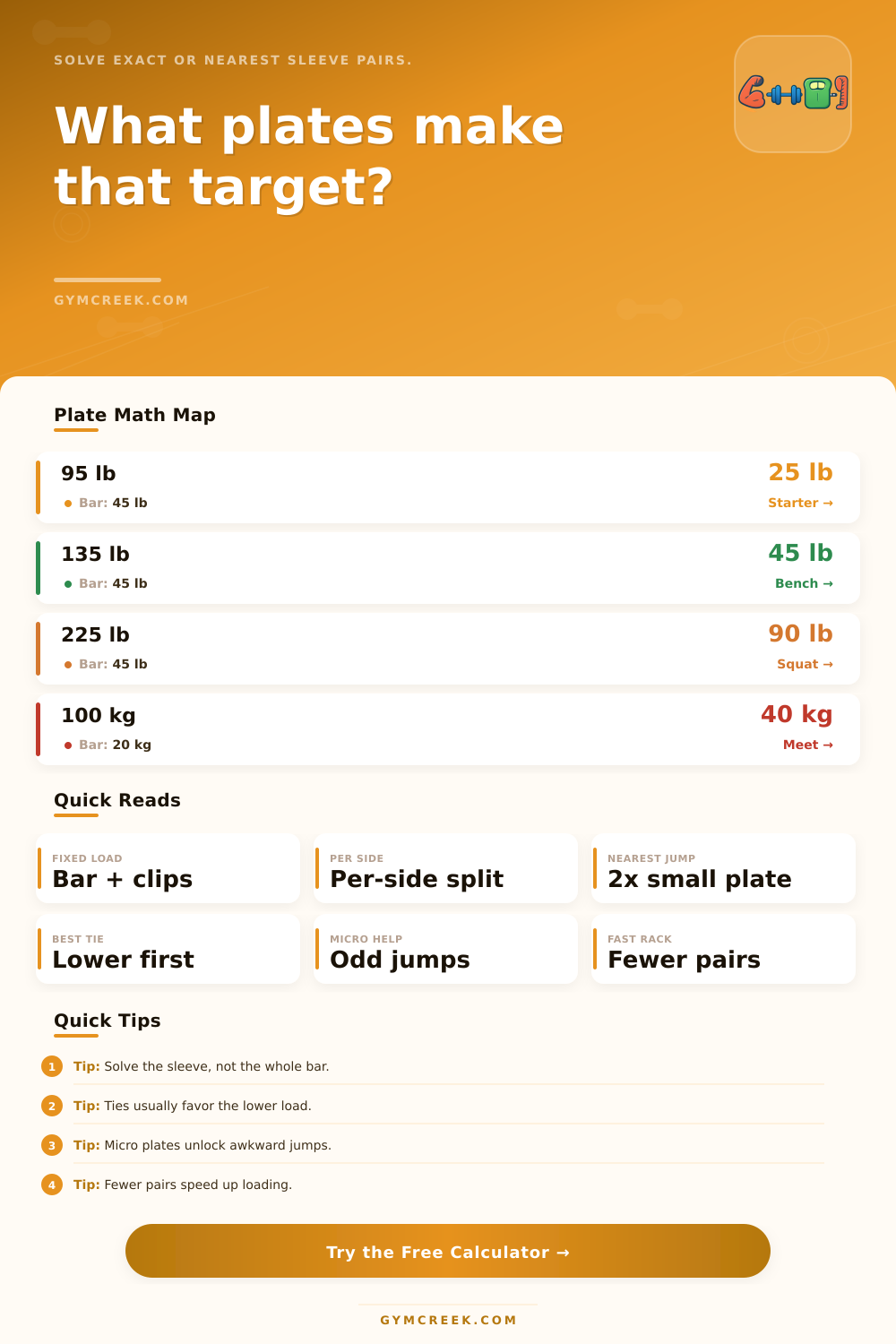
| 95 lb | 25 lb | 45 lb | First press warm-up |
| 135 lb | 45 lb | 45 lb | Classic bench checkpoint |
| 225 lb | 90 lb | 45 lb | Two plates a side |
| 315 lb | 135 lb | 45 lb | Three plates a side |
| Bar setup | Empty weight | Collars | When used |
|---|---|---|---|
| Men's Olympic | 45 lb | 0-2.5 lb each | Most US gyms |
| Women's Olympic | 35 lb | 0-2.5 lb each | Smaller hands or bars |
| Men's comp | 20 kg | 0.5 kg each | Meet prep |
| Technique bar | 15 kg | 0 kg each | Skill and rehab work |
| Plate family | Common sizes | Small jump | Strength |
|---|---|---|---|
| Standard iron | 45, 35, 25, 10, 5, 2.5 | 5 lb total | Fast everyday loading |
| Calibrated lb | 55 to 1.25 lb | 2.5 lb total | Meet-style accuracy |
| Competition kg | 25 to 0.5 kg | 1 kg total | Precise kilogram builds |
| Technique kg | 10 to 0.5 kg | 1 kg total | Light technical work |
| Rack profile | Exactness | Likely miss | Advice |
|---|---|---|---|
| Full gym rack | High | Low | Nearest mode usually lands clean. |
| Two-pair home rack | Medium | 1-10 lb | Keep small plates handy. |
| Limited hotel gym | Low | 5-20 lb | Round down if bar speed matters. |
| Meet change stack | Very high | 0-1 kg | Use collars and change plates exactly. |
💡Loading Tips
Calculating the weight for a barbell requires an understanding of the component of the weight stack and the mathematical steps that are used to divide the weight of the barbell between the sleeves of the barbell. A barbell is comprised of a bar with two sleeves, and the barbell also include collars that help to secure the weight plates to the sleeves of the barbell. The weight of the bar and the collars must be accounted for when calculating the weight that should be placed into the sleeves of the barbell.
If you dont account for the weight of the bar and the collars in the calculations for the weight of the barbell, the total weight that will be calculated will be incorrect. To calculate the weight for a barbell, first identify the total weight that is desired to be lift. Then, the lifter subtracts the weight of the barbell and the collars from the total weight that is to be lifted.
How to Calculate the Weight on Each Side of a Barbell
The remaining weight is divided by two to determine how much weight should be placed into each of the sleeves of the barbell. For instance, if a barbell weighs 45 pounds and an individual desires to lift 185 pounds, the weight of the barbell are subtracted from the total weight (185-45=140). The remaining weight (140) is divided by two to determine the weight of the plates that must be placed into each of the sleeves of the barbell (140/2=70).
Thus, 70 pounds of weight plates should be placed into each sleeve of the barbell. The weights of the plates at most gym locations is not always available in every possible weight increment. For instance, most gyms utilize standard iron plates in sizes of 45 pounds, 25 pounds, 10 pounds, 5 pounds, and 2.5 pounds.
If a gym does not have small plates, such as 2.5 pound plate or 1.25 pound plates, it may be difficult for those individuals to account for specific weight. As a result, those individuals may have to round their desired weight up or down to the nearest available weight for those plates. Rounding the weight up indicates that the individual will be lifting a weight that is more greater than their target weight.
Rounding the weight down, however, indicates that the individual will be lifting a weight that is less than their target weight. A person may choose to round the weight down to assist in maintaining propery form. However, in the case of performing a warm-up exercise, a person may choose to round the weight up to gradually increase the strength required to lift the barbell.
The availability of small plates is essential when lifting weights. Small plates, also known as micro plates, allow for precise increments in the weight that can be added to a barbell. With the availability of micro plates, small increments in weight can be made.
However, if the gym does not have micro plates, the lifter will need to use larger plates for increments in the weight of the barbell. For example, if 5-pound plates are used, adding weight will have to be in increments of 10 pounds to add a plate to each side of the barbell. The length of the sleeves on a barbell can also have an impact on the weight that can be added to the barbell.
The length of the sleeves will limit the number of plates that can be loaded on the barbell. If the sleeves on a barbell are short, then there will be no way to add many plates to the barbell. Additionally, the weight of the collars should be taken into consideration.
The collars on barbells can weigh different amount. If the collars are heavy, then this will add to the total weight of the barbell. Therefore, the weight of the collars should always be included in the math equation to determine how much the barbell will weigh once loaded.
When approaching the barbell, it is important to look at each sleeve individually. The weight for each sleeve should be calculated individually. The weight for one sleeve should be calculated first, and then the same process should be followed for the second sleeve.
By calculating the weight of each sleeve individually, errors in the total weight of the barbell can be avoided. By calculating the weight for each sleeve individually, it ensures that the barbell will be balance, which is essential to the safety of the weight lifter.