Plate Loading Per Side Calculator
Find the exact plates to load on each side of a barbell from target weight, bar weight, collars, unit system, available plates, rounding mode, lift type, and warm-up preference.
📌Plate Loading Presets
Presets load realistic gym and home-gym scenarios. Counts below are plates available per side, not total plates in the room.
⚙Calculator
Plate loading snapshot
Enter a target weight and available plates to calculate the load per side.
📊Loading Metrics Grid
📋Warm-up Table
| Set | Target | Actual Load | Plates Per Side | Reps |
|---|---|---|---|---|
| Calculate a working weight to generate warm-up loads. | ||||
📑Reference Tables
| Bar Type | Imperial | Metric | Best Use |
|---|---|---|---|
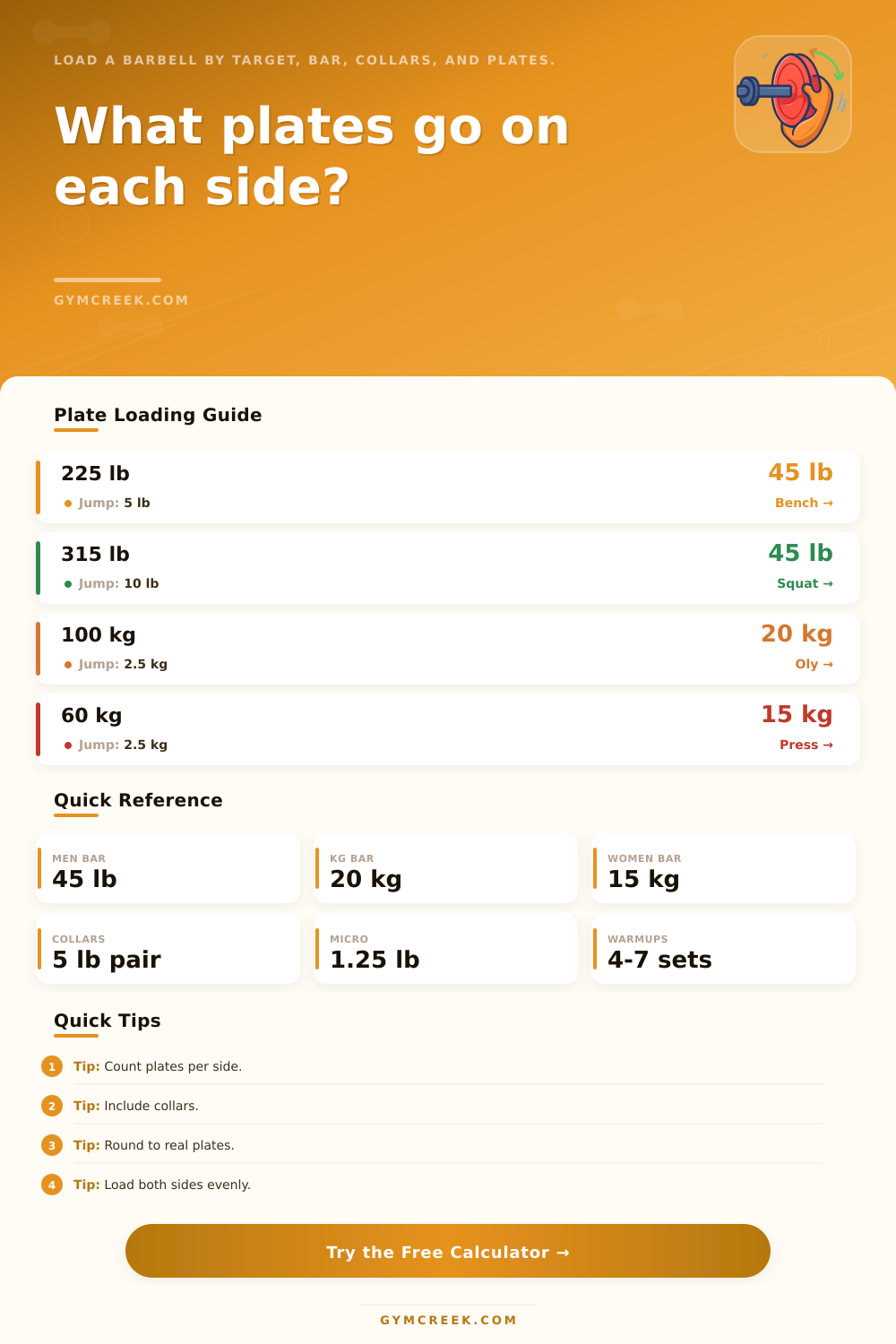
| Men's Olympic or power bar | 45 lb | 20 kg | Squat, bench, deadlift |
| Women's Olympic bar | 35 lb | 15 kg | Olympic lifts, technique |
| Trap or hex bar | 60 lb | 27 kg | Deadlift variations |
| Technique bar | 15 lb | 7.5 kg | Beginner or rehab work |
| Rounding Mode | Behavior | Useful For | Watch Item |
|---|---|---|---|
| Nearest | Closest loadable weight | Regular training | May go above target |
| Round down | Never exceeds target | Fatigue management | Can underload |
| Round up | Meets or exceeds target | Attempt planning | Can overshoot |
| Exact if possible | Exact first, nearest fallback | Meet-style loading | Needs matching plates |
| Plate Set | Typical Plates | Strength | Limitation |
|---|---|---|---|
| Full gym mix | Large and change plates | Precise jumps | May rely on 35s |
| Powerlifting set | 45s and small change | Heavy loads | Less bumper-friendly |
| Bumper set | 25 or 20 kg style plates | Olympic lifts | Fewer small jumps |
| Home gym basic | Limited pairs | Simple loading | Caps max load |
| Lift Type | Loading Cue | Warm-up Bias | Practical Check |
|---|---|---|---|
| Squat or rack lift | Collars after balance check | Steady ramp | Rack height and walkout |
| Bench press | Use matched plates tightly | More small jumps | Spotter and hooks |
| Deadlift | Largest plates inside | Fewer higher jumps | Bar height from floor |
| Olympic lift | Bumpers dominate stack | Technique ramp | Secure collars every set |
💡Tips
Adding up weight to load onto a barbell isnt as easy as 1 + 1 + 1 = X. Several factors affects the total weight of the bar: What type of plates do you own? How many do you have? How about the collars? And what about the bar? If the load is too heavy, the set is ruined before it is finished. If the load is to light, progress halts. The main difficulty lie in keeping all this information in one place instead of only a total amount.
The base weight vary from bar to bar. For example, a woman’s bar is going to be thirty-five pounds and a man’s bar will be forty-five pounds. The trap bars and axle bars tends to be much heavier still. That means if you’re shooting for a specific number or lifting close to your max that makes a big difference.
How to Use the Weight Calculator
Total load will also vary depending on what type of collar you use. Competition collars alone can tack on 5 pounds or more where spring collars may add just a single pound. Failing to take into account this weight will make your plan off by a few pounds.
Depending on which gym you train at will determine how many plates you has access to. Most gyms with a lot of space generally have everything from large weights all the way down to small change plate. If you’re training at home, then chances are you only have ten and maybe twenty-five pound plates.
Enter in your desired weight, your bar type, collar weight, plates you has access to, and let the calculator do the math. It’ll round up or down depending on your rounding rules. This give you the option to go above or below your target weight if you choose to do so. This comes into play when you want to set yourself up for an exact lift attempt or just need to manage fatigue.
How you load your plates depends off the style of lift. For balance reasons, squatting and rack pulling are generally better loaded with a bigger plate inside and smaller on the outside. Deadlifting is best when the biggest plates are on the inside as this keeps the bar at proper height. Olympic bumper plates are used for Olympic lifting due to the repeated dropping of the bar. For bench pressing, tight matching plates allow the bench to be stable throughout the set. So there’s a reason that a single targeted weight may be loaded different based on exercise. These rules help explain it.
The warm-up structure is just as important, but people often overlook it. Many athletes likes bigger jumps in weights for their ramp up. Others like multiple lower weight sets that simulate their work set. Based off your chosen warmup style, the calculator will construct one of those styles. More importently than how you choose to warmup is consistency from week to week. It’s hard to know if you missed your lift because you weren’t prepared or because the weight was inconsistent.
The bottom line: Before you load the bar, develop an easy routine. Know what weight you want to get. Note the bar and collar weights. See what plates you have on hand. Plug those numbers into the thing. It’ll tell you not only how much is actualy on the bar but whether it’s close to your desired weight or not. That takes away the bulk of the guesswork that leads to missing lifts or having one side heavier then the other.
Eventually this will become second nature, where you’re thinking about plates per side and not the total weight of the bar anymore. With the math righted by the calculator, all you should of worry about is lifting the thing.