Calories Burned Planking Calculator
Estimate low-MET plank calories, tension multiplier, time under tension, core endurance score, and weekly burn from your exact plank setup.
📌Plank Presets
Each preset loads body weight, hold length, sets, rest, plank style, external load, RPE, weekly frequency, and hold quality.
⚙Calculator
Plank calorie snapshot
Enter your plank setup to estimate session burn, time under tension, and weekly core load.
📊Metrics Grid
📑Reference Tables
| Plank variation | Base MET | Tension | Best use |
|---|---|---|---|
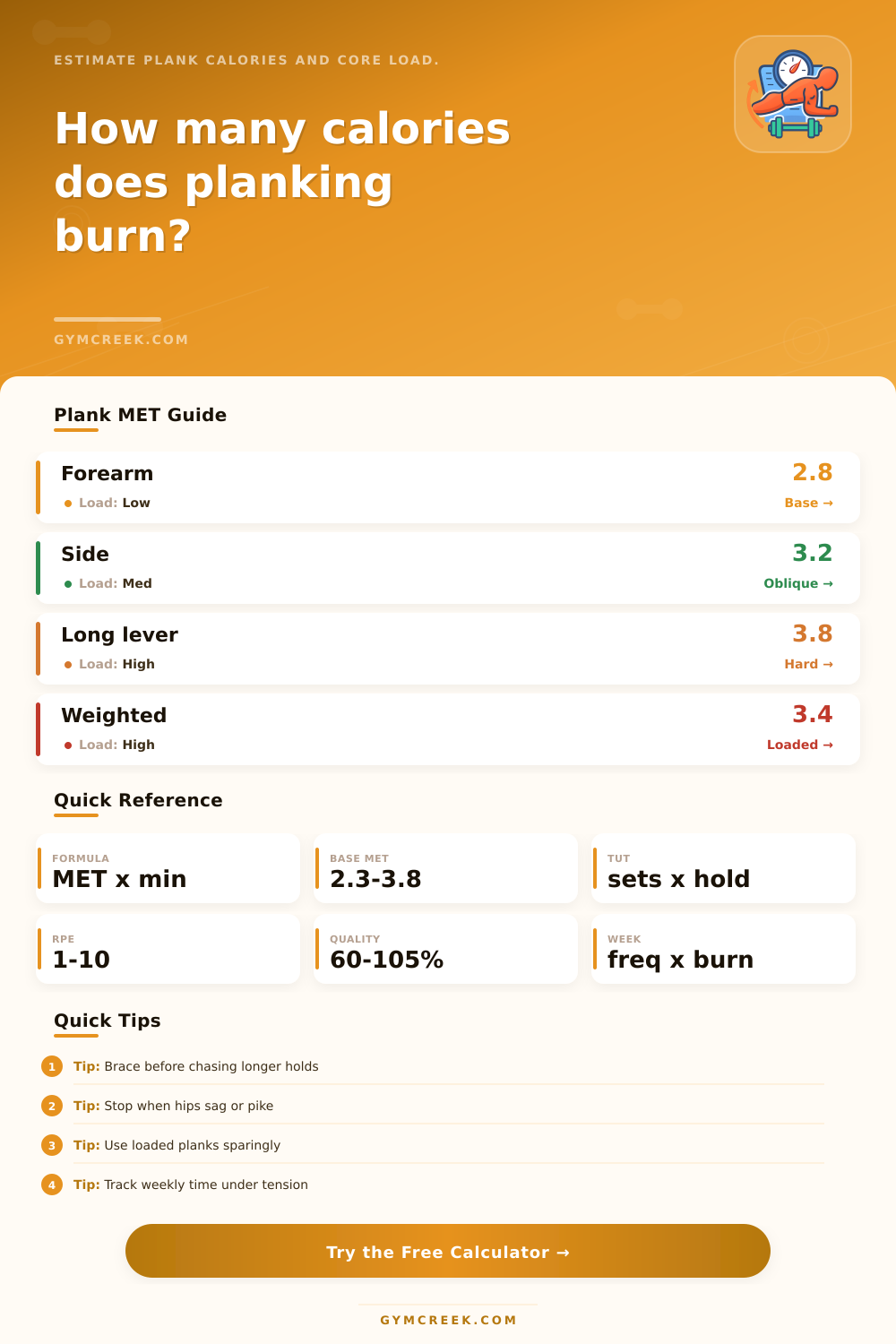
| Forearm plank | 2.8 | 1.00 | Baseline core work |
| High plank | 3.0 | 1.04 | Push-up position |
| Side plank | 3.2 | 1.10 | Obliques and anti-rotation |
| Long lever plank | 3.8 | 1.22 | Harder anterior core holds |
| Weighted plank | 3.4 | 1.16 | Loaded bracing practice |
| Hold quality | Multiplier | Score effect | Use result this way |
|---|---|---|---|
| Excellent | 1.05 | Strong boost | Trust longer holds |
| Good | 1.00 | Neutral | Good training data |
| Fair | 0.88 | Moderate trim | Keep sets shorter |
| Poor | 0.68 | Large trim | Reduce hold time |
| RPE range | Multiplier | Session feel | Planning cue |
|---|---|---|---|
| 1-4 | 0.92-0.98 | Easy | Warm-up or rehab |
| 5-6 | 1.00-1.04 | Moderate | Repeatable core work |
| 7-8 | 1.08-1.12 | Hard | Main training sets |
| 9-10 | 1.16-1.20 | Near max | Use sparingly |
| Formula | Inputs | Output | Purpose |
|---|---|---|---|
| MET calories | MET, kg, min | kcal | Energy estimate |
| Time under tension | sets x hold | minutes | Core exposure |
| Tension multiplier | style, load, RPE | factor | Hardness adjust |
| Core score | TUT, quality, density | 0-100 | Endurance context |
💡Tips
Planking is an exercise that target the core muscle of the body and is viewed as a simple movement because it takes up very little space. To perform a plank, an individual must hold a specific position while breathing and performing the plank. However, because there is little jumping or running involved in planking as a form of exercise, the energy expended during this exercise is more modest.
One of the main ways in which an individual should perform a plank is to focus upon how long they can maintain tension in their muscles without allowing their hips or ribs to move. In the calorie calculator, the energy expenditure that the calculator calculates takes into account an individual’s body weight, the length of time that they hold the plank position, and the number of rounds that they performs. Each of the factors that is included within the calculator have the potential to change the model that the calculator creates.
Planks: How Many Calories You Burn and Why Good Form Matters
For instance, an individual’s body weight is one of the factors that must be accounted for in creating that model; it is one of the factors in the standard MET equation for calculating calories burned. The duration of each round of planks and the number of rounds that an individual performs are also two factor that the model must consider. Time under tension is one of the main indicators of the effectiveness of the planks that an individual performs.
The length of time that an individual rests between sets can also have an impact upon the model; resting in between planks changes the density of those sessions. Other factors include the types of planks that is performed, the number of rounds and sets of planks that are performed, an individual’s rate of perceived exertion, and quality of the planks that is performed. Each of these factors can help to create a number for the individual relating to the calories that will be burned during that weeks sessions.
Because the outputs of the calculator are estimates only, the calculator will not provide an individual with the precise number of calories that will be burned. For instance, an individual may burn between 12 and 18 calorie performing four rounds of 45-second planks; however, they would burn more calories performing the same amount of time running. The calculator is designed to show this information so that individuals understand that planks are not an exercise that should replace other forms of conditioning.
However, it does allow individuals to understand how many minutes of bracing that their core muscle will endure in a weeks time. Individuals who perform planks for 60 seconds each and who perform these sessions three times each week will endure more than ten minutes of bracing each week. Another important factor regarding planking is the quality of the planks that is performed.
Quality directly impacts the tension that the core muscles feel. Poor form in planks, which may include allowing the hips or lower back to sag, will lead to an reduction of the score that the calculator provides. The quality selector within the calculator allows an individual to decide whether the time spent performing sets of planks that are performed with poor form are better replaced with sets of planks that are performed with better form and for longer periods of time.
Many individuals may want to attempt to perform as long of a plank as possible in a single session; however, long planks may lead to sloppy performance of those planks. Poor performance of planks can lead to the body developing incorrect movement patterns; thus, plank sessions should of focused upon shorter sets of planks that requires the body to remain in a state of full bracing. The frequency with which individuals perform planks can have an impact upon the bodys ability to recover from those planks.
Two plank sessions each performed a week may have less of an impact upon the body than five or six plank sessions each performed throughout the week. Spreading the plank sessions throughout the week has the potential to allow the body to recover from the tension placed upon its core muscles. These factors are reflected in the calculator; the total calories that are burned during each session can be multiplied by the frequency at which planks are performed to determine the total number of calories that an individual may expend each week performing planks.
Planking can be used to train the endurance of the bodys bracing muscles; it can be used to determine how long that an individual can maintain bracing. The math within the calculator can be used to determine the modest number of calories that will be burned during planking; this factor can help to prevent individuals from attempting to use planks as a means of losing body fat. The quality of planks can be focused upon, as can the total length of time that an individual spends bracing their body each week.
Additionally, an individual can choose the types of planks that are performed according to the strength that an individual possesses within their body. Each of these factors will provide an individual with an understanding of how effective the planks are becoming; if an individual finds that their numbers increase with time and their form remains intact, the planks are working.