Plank Hold Percentile Calculator
Compare a plank hold against age, sex, bodyweight, style, load, and form-adjusted reference bands.
📌Presets
Presets load real plank testing situations across ages, body sizes, training backgrounds, and plank variations.
⚙Calculator
Plank percentile snapshot
Enter a plank hold and calculate your adjusted score.
📊Metrics Grid
📑Reference Tables
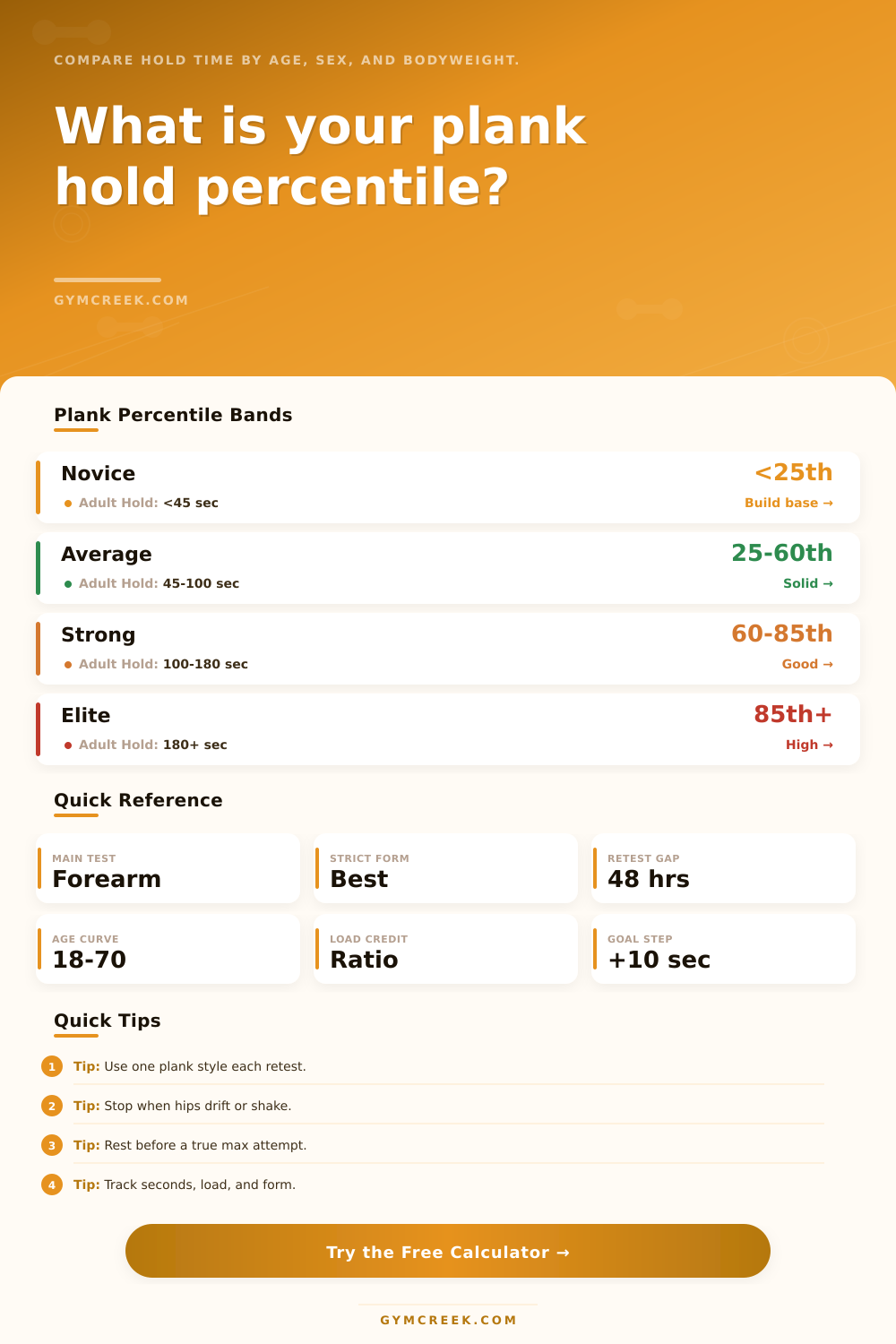
| Band | Percentile | Meaning | Next Step |
|---|---|---|---|
| Novice | Under 25th | Below peer median | Add short holds |
| Average | 25th-60th | Solid base | Build consistency |
| Strong | 60th-85th | Good endurance | Refine bracing |
| Elite | 85th+ | High endurance | Add variation |
| Age | Male Median | Female Median | Spread |
|---|---|---|---|
| 18-29 | 105 sec | 85 sec | Wide |
| 30-39 | 95 sec | 78 sec | Moderate |
| 40-49 | 84 sec | 69 sec | Moderate |
| 50-59 | 70 sec | 58 sec | Wide |
| 60+ | 55 sec | 46 sec | Wide |
| Style | Multiplier | Use Case | Form Note |
|---|---|---|---|
| Forearm | 1.00x | Standard test | Elbows under shoulders |
| High | 0.82x | Push-up position | Lock ribs down |
| Side | 1.32x | Lateral core | Score per side |
| RKC | 1.25x | High tension | Squeeze hard |
| Weighted | 1.08x | Loaded test | Load safely |
| Factor | Formula Role | Range | Why It Matters |
|---|---|---|---|
| Age | Median curve | 13-90 | Compares peers |
| Sex | Base median | M/F | Sets reference |
| Bodyweight | Burden factor | 40-500 lb | Adjusts leverage |
| Added load | Load ratio | 0-300 lb | Credits loading |
| Form | Quality factor | 0.58-1.00x | Protects validity |
💡Tips
A plank is an exercise to passively punish yourself with… Or so you probably think. Why? Because you sit there until your abs quiver. Not that it’s a bad thing, but it doesn’t measure how long you can maintain a position when gravity pulls on your spine. Core endurance does. And only when you benchmark yourself against appropriate standards do you gets anything useful.
Age, bodyweight and plank style aren’t considered on most fitness charts. They changes what constitutes a good hold. Once you plug in your conditions, the calculator above do the math for you. No need to remember that forearm holds is easier or harder than high planks. It levels out various variations and avoids comparing apples-to-oranges. A side plank engages different lateral stabilizers. That’s tougher, so it applies a multipler that reflects its greater relative difficulty.
Why You Need a Plank Score Calculator
If someone performs a relaxed forearm plank, while another struggle with a strict RKC variation, raw seconds is misleading. We’re after real progress and need a common denominator to measure it. Age is one variable that throws off results. Your body isn’t static, so you’ll compare yourself against the younger version of you. It doesn’t matter that the younger you can hold longer; nostalgia doesn’t follow physiological curves.
As you get into your thirties and forties, your muscle fibers changes, and the natural tendency is to decrease your average hold times. The app takes this into account, adjusting its reference middle value to your age group. Maybe you’re 45 and you hold for eighty seconds. That might make you way higher then average for people your age! It will feel like nothing compared to when you were in college. But it’s correct for who you are now. You’re building up from an honest starting place by accepting where you really are.
In static holds, bodyweight actualy works against you. You have to keep your hips level while using enough strength from your core to handle your body weight. Adjusted scores is often higher for heavier people as they take advantage of this leveraged handicap. To account for this physics, I’ve added a burden factor into the calculator. It doesn’t punish a well-conditioned, strong lifter who must move more weight around. The test will evaluates strength in relation to amount of weight it’s carrying. This prevents fit people from feeling frustrated when their raw times look worse.
Self-reported form. Self-reporting is only valid if it’s good form. If someone loses good form but doesn’t stop timing, or they let their hips sag but keep going… The tool accounts for slight variations in form, such as a bit of shaking at the end. That is considered a brief break down in primary muscle engagement. Maintaining strong glute engagement and a flat back matter most, so it carries the most weight. Twice as long doing a sloppy hold isn’t the same thing. It’s also about consistency in execution as well as consistency in timing.
Do you want to see if your standards dropped? Or did your core strengthen? Discipline yourself to retest, Fatigue impacts your numbers far sooner than you think. Your max-effort plank following a leg day will reflect your quads more then your transverse abdominis. You’ll see this in the calculator where you can record what condition you were testing in. Even if you do it under fatigued conditions, it allows some comparable credits so you can track things and get an idea of progress. But the best data comes from rested days with fresh attempts. When your nervous system is fully available.
This is when you separate the wheat from the chaff, when you differentiate between actual adaptation vs. It is just temporary fatigue management. It’s never about getting to some target metric (e.g., 2 minutes, 100 seconds). That’s an arbitrary number that doesn’t take into account your training history or physiology. It’s all about building strength through gradual increases in weight or time under tension with strict form control.
Percentile bands represents how you compare with others. Personal trend lines indicate whether you’re trending upward/downward. Establish the base, refine the brace, and use the data to determine the next rep. Don’t rush yourself into something your body won’t accommodate. This is an active test of structural integrity, yet if we track our core strength using it, then it becomes a measurable ability.
It’s not guesswork anymore; you know exactly where your progress lies because you can see it in increments. The plank might still be nothing more than a body position on the ground, but knowing its significance alters your perspective based off all of your movements in the gym.