Pin Squat Load Calculator
Estimate pin squat maxes, rounded working loads, overload percentage, plate loading, and session tonnage from your rack height and squat setup.
📌Presets
Each preset loads a complete pin squat scenario and recalculates with the current unit labels.
⚙Calculator
Pin squat snapshot
Enter your squat max and pin setup to calculate a working load.
📊Fitness Metrics Comparison
📑Reference Tables
| Pin Position | Typical ROM Change | Expected Load Effect | Best Use |
|---|---|---|---|
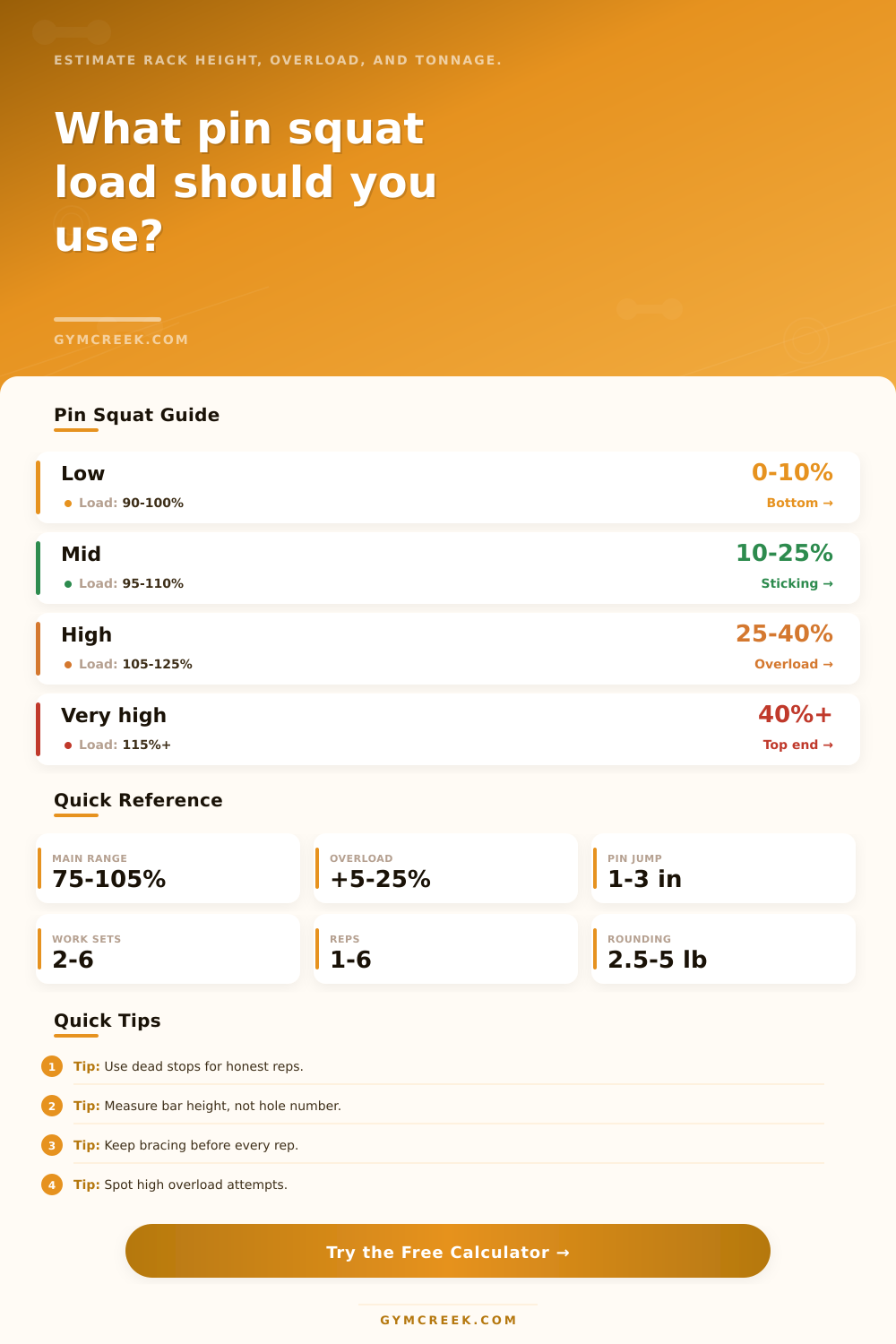
| At full-depth bottom | 0-8% range reduction | Usually 85-100% of full squat | Dead-start strength and bracing |
| Just above parallel | 8-18% range reduction | Usually 95-110% of full squat | Bottom-to-mid transition practice |
| Mid-range pin | 18-32% range reduction | Usually 105-122% of full squat | Sticking point and overload triples |
| High pin | 32-45% range reduction | Usually 115-135% of full squat | Top-end confidence and heavy walkout carryover |
| Training Purpose | Common Intensity | Reps | Loading Note |
|---|---|---|---|
| Technique practice | 60-75% pin max | 3-6 | Keep contact quiet and bar path repeatable |
| Bottom strength | 70-88% pin max | 2-5 | Start tight before each dead-stop rep |
| Sticking point work | 75-90% pin max | 2-5 | Choose a pin height near the missed position |
| Volume builder | 65-82% pin max | 4-8 | Keep sets submaximal and consistent |
| Heavy overload | 85-100% pin max | 1-3 | Use spotters and avoid soft knee lockouts |
| Peaking singles | 90-105% pin max | 1-2 | Low total reps and exact rack setup |
| Variable | Adjustment Used | Reason | Watch Point |
|---|---|---|---|
| Safety bar | -4% load modifier | Forward pull raises upper-back demand | Keep ribs down before the start |
| Front squat | -12% load modifier | Front rack limits partial squat loading | Keep elbows high through the drive |
| Wide stance | +1.5% load modifier | Often shortens vertical travel | Keep knees tracking over toes |
| Dead stop | -3% load modifier | Removes stretch reflex from the pins | Brace hard before the drive |
| Full reset | -5% load modifier | Hardest start with no stored tension | Rebuild air every repetition |
| Formula Step | Calculator Formula | Output | How to Use |
|---|---|---|---|
| Pin offset | Pin height - full-depth bar height | Partial range change | Shows how much higher the start is |
| ROM reduction | Offset / estimated bar travel | Percent range removed | Scales pin max upward |
| Pin max | Squat 1RM x setup modifiers | Estimated partial max | Sets the training ceiling |
| Working load | Pin max x intensity - top resistance | Straight bar load | Round to available plates |
💡Tips
For most people, the squat rack is just a place to stack some heavy weight. After pulling yourself up off the ground, they stands up tall and repeat that process till their legs give out. This will build general strength.
However, it won’t help you address a weakness during the drive phase or overload the quads while protecting the lower back. Pin squats exist to bridge that gap between full-range movement and isolated mechanical advantage. Because you can begin pinning at any portion of the rep, you’re able to work on the bottom position, mid-range sticking point, or top-end lockout with concentrated effort.
How Pin Squats Help You Get Stronger
Your legs don’t need to travel as far and there’s much more mechanical advantage involved, so partial reps aren’t as easy as they seem. Squatting as heavy as possible with a maximal range of motion is one thing; but if you estimate your weight by starting with your maximal squat, then you’ll either end up overloading this movement. Or potentially hurting yourself.
The calculator above take the guesswork out of it for you after entering your body measures and pin height. You won’t have to guess how much additional loading you can handles with your shorter range of motion.
The basic theory behind a partial squat is simple: you can produce more force with less distance. Removing the bottom portion of the squat gets rid of the limiting deep hip flexion part of your strength curve (which is why most people’s strength curve ends early). You’re able to stack some serious weight onto bar. But you need to be careful about piling it on haphazardly. That’s where this tool comes into play.
It takes into account your lifter height and the specific height of the bar off the ground at the bottom of your full squat relative to pin height. Why? Because even though your pins may be set at the same height above the floor, a 6’-tall lifter and a 5’-tall lifter will see very different changes in advantage.
The calculator measure how much actual range of motion has been reduced. Then, they take your estimated one-rep max at that certain pin position and multiply it by that percentage. You might think you are only able to go 20 pounds on a particular pin position, but in reality you would be fine going 40 pounds because you wouldn’t need to drive all the way through the deepest part of hole. This takes that into account and scales upward to match.
How do you want to contact those pins? The stretch reflex involves a light touch or just hovering above the pins and bouncing up from bottom. This makes the reps seem easier, which is a touch-and-go rep. It can also create an elastic recoil to get you back up off the pins, which is a bounce-off-the-pins rep. Neither develops the kind of starting strength a dead stop on the pins does.
Now you must create all your force from a perfectly static position. That’s more honest, and harder, when building power. If you choose a dead-stop or full-reset style, the calculator will reduces the load. This is because you’re starting with no momentum. You require a heavier push at the start than you would if you were merely rebounding off the pins.
It’s one of those little mechanical details that make a difference in how your nervous system uses muscle fibers. And if you’re using a band or chain, put in that top-end resistance too. The calculator subtracts that from your straight bar weight. It tells you exactly how much plate to load on each side so you don’t have to stand underneath the bar.
There’s a practical reason too: You don’t normally lift in exact decimal amounts. Twenty-five-pound plates or five-pound plates are all you get at the gym. When using this calculator, it’ll round your theoretical load to the next most practical increment (i.e., how much weight you could actualy use at your gym). This means the amount shown is the one you can use.
It can be used to account for fatigue too, say, when you’re running pin squats after doing a lot of volume, or when you’ve been away from lifting and want to ease back into partials. You can get a handy guideline just by glancing at reference tables that come with the tool. They give an idea of the typical intensity zone for various goals like heavy overload training vs. It could be used for working on technique, for example.
It maintains your progression so you can measure whether you’re ready to attempt a new full squat max, rather than guess at whether or not you’re there yet. Precision is the name of the game for pin squats. By removing the leverage and momentum benefits of a complete squat, they reveal your weakness, or strength, down to the exact point.
Isolation training can help you develop confidence in top-end overload or crush that sticking point around parallel. Half the struggle is knowing how much weight to put on the bar. When you’ve figured out how much weight will be both effective and safe, step underneath the bar, brace your core, and drive upward.
From there, let the pins do the work; they are responsible for starting each rep exactly how you want. This consistency is what transforms a partial movement from an easier lift to a powerful training tool.