Pilates Reformer Calorie Calculator
Estimate reformer Pilates calories from body stats, class length, apparatus style, spring load, active carriage time, transitions, effort, and optional heart-rate context.
📌Presets
Presets load realistic reformer Pilates sessions and auto-calculate so you can compare class formats, spring settings, and active-time assumptions.
⚙Reformer Inputs
Reformer Pilates session snapshot
Enter class details to estimate reformer Pilates calories and intensity.
📊Reformer Metrics
📑Reference Tables
| Class type | Base MET | Typical time | Best fit |
|---|---|---|---|
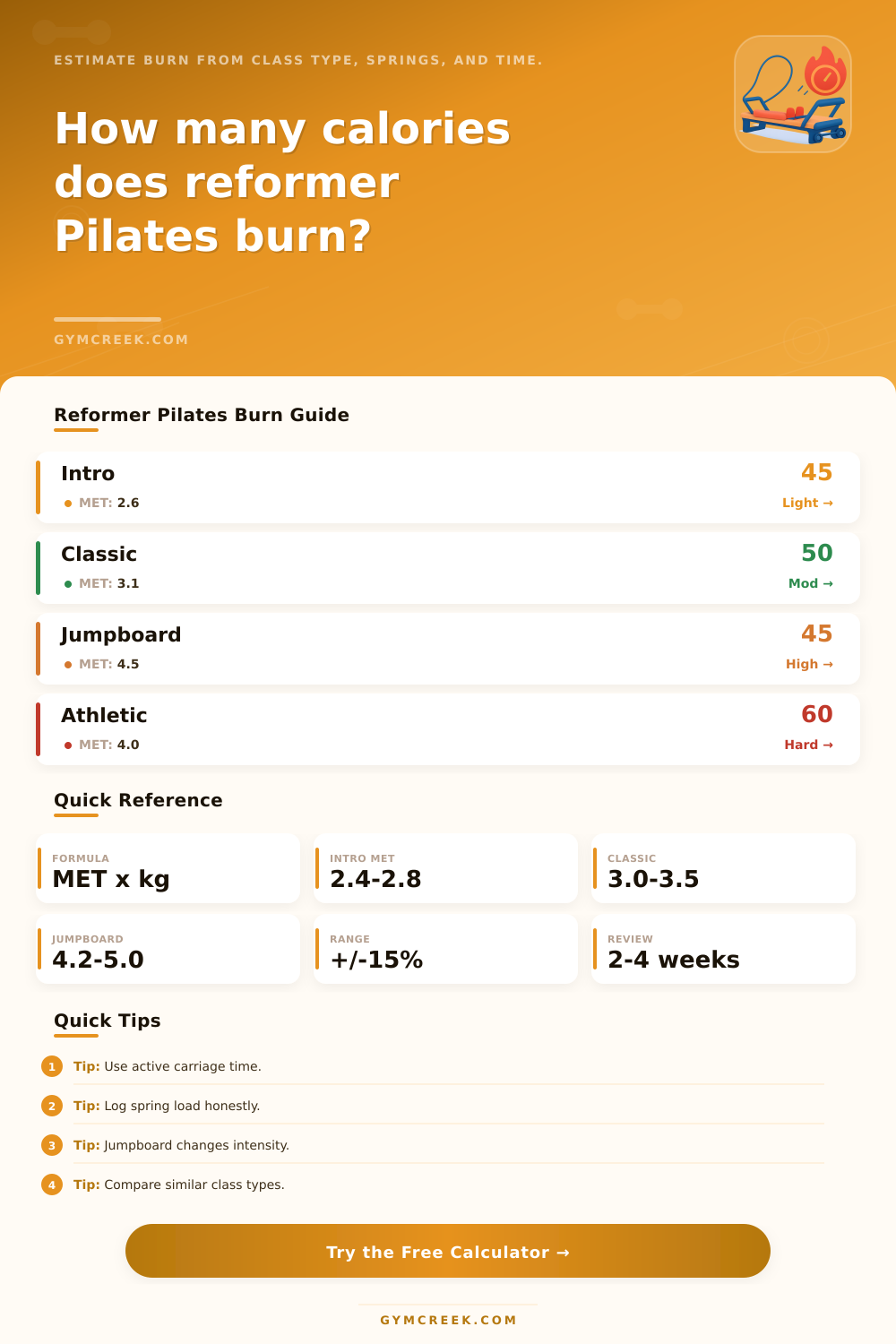
| Intro or fundamentals | 2.6 | 40-50 min | Technique pace |
| Classic reformer flow | 3.2 | 45-55 min | General fitness |
| Intermediate continuous flow | 3.7 | 45-60 min | Steady training |
| Jumpboard cardio | 4.6 | 35-50 min | Higher burn |
| Modifier | Lower | Middle | Higher |
|---|---|---|---|
| Spring load | Light | Moderate | Heavy |
| Effort RPE | 3-5 | 6-7 | 8-10 |
| Active carriage | 50-65% | 70-85% | 90%+ |
| Cueing pace | Coached | Balanced | Continuous |
| Scenario | Weight | Class | Burn range |
|---|---|---|---|
| Intro private | 130 lb | 45 min | 105-145 |
| Classic class | 150 lb | 50 min | 145-200 |
| Athletic flow | 170 lb | 55 min | 230-310 |
| Jumpboard | 160 lb | 45 min | 230-320 |
| Formula | Variables | Use | Output |
|---|---|---|---|
| MET calorie equation | MET, kg, time | Exercise burn | kcal |
| Mifflin-St Jeor | Sex, age, size | BMR context | kcal/day |
| Activity multiplier | BMR, level | Daily context | TDEE |
| HR reserve | HR, age | Effort check | percent |
💡Tips
Many individuals feel that fitness tracker are incapable of accurately measuring the number of calories that is burned during a session on a Pilates reformer. While the individual may feel as if they have burned significant amount of energy after performing a reformer class, the fitness trackers may indicate a low number of calories burned due to the method in which they calculate calories burned. Most fitness trackers calculates calories burned based off an individual’s heart rate and the number of steps that they take.
However, classes on a Pilates reformer class do not rely upon these two measurement of physical activity; rather, they rely upon the tension of the muscle. As a result, the fitness trackers are unable to accurately calculate the energy that an individual burns during a Pilates reformer class. The amount of energy that an individual burns while performing a Pilates reformer class are correlated with the strength of the spring that exert the resistance against the individual.
Why fitness trackers show low calories for Pilates reformer
On a treadmill, the effort that an individual performs is linear. However, on a Pilates reformer, the individual must push against the springs to perform the exercise. Additionally, the amount of energy that an individual burns correlates with the amount of time that they are active moving the Pilates reformer.
Individuals who are performing in a class that is in continuous flow will burn more calories then those who are performing in a class that focuses upon the fundamental of performing Pilates exercises on the reformer. An individual’s body composition and statistics will alter the amount of energy that they burn. Indicators of an individual’s weight and height will impact the amount of energy that they burn in relation to the rest of their body statistics.
Additionally, an individual’s age and sex will influence their resting metabolic rate, which can help to determine in what way that their Pilates reformer class may impact their daily energy expenditure. The intensity of the class can be calculated through the METs value of the exercises that are performed. METs calculates the amount of energy expenditure of a task.
For instance, light stretching will have a low METs value, while high-intensity exercises will have a more higher METs value. For instance, performing jumpboard exercises on the reformer will increase the metabolic demand upon the individual, turning what would be a session focused upon building strength into a session that burns calories. An individual must also take into consideration the amount of time that it takes for an individual to transition from exercise to exercise within the Pilates class.
Pilates classes are not performed in a manner in which an individual is continuously performing exercises with maximum exertion; instead, the individual must transition between different spring loads and the footbar. An assumption that an sixty-minute Pilates class continues for sixty minutes of exertion will result in underestimation of the amount of calories that an individual burns. Accounting for the time spent transitioning between exercises will result in more accurate calorie count.
An individual’s fitness goal will impact the importance of the calories that are burned during a Pilates reformer class. For instance, an individual who wish to increase their strength may not care all that much about the calories that are burned. However, an individual who desires an increase in cardio conditioning will desire to increase the amount of active minutes that they can perform during their Pilates class.
Heart rate is one factor in indicating if the calories that are burned are accurate. For instance, if an individual burns a high number of calories but their heart rate remains within their resting range, they may have overestimated the calories that were burned. Additionally, if an individual burns a low number of calories but their heart rate is high, they may be experiencing fatigue from performing deep core engagement exercises.
Deep core engagement is strong exercise for the muscles of the body, but it does not necessarily increase the amount of oxygen that the body consumes. An individual who utilizes a Pilates reformer to develop their strength will increase their lean muscle mass and improve their posture. As lean muscle mass is metabolically active, increasing that muscle mass increase the resting metabolic rate of an individual over time.
Thus, by considering the amount of time that they are actively performing on the reformer, the strength of the springs, and their body statistics, an individual can accurately calculate the amount of energy that they used during their Pilates reformer class.