Pendlay Row Calculator
Estimate strict floor-start rowing strength, dial in work weights, and score how your torso angle, bar speed, grip, and dead-stop control carry over to pulls and presses.
📌Presets
Each preset changes load, floor start quality, torso angle, speed, reps, RPE, grip width, and carryover focus before calculating.
⚙Calculator
Pendlay row snapshot
Enter your set, setup, and speed details to estimate strict rowing strength.
📊Metrics Grid
📑Reference Tables
| Strict 1RM Ratio | Category | Useful Range | Interpretation |
|---|---|---|---|
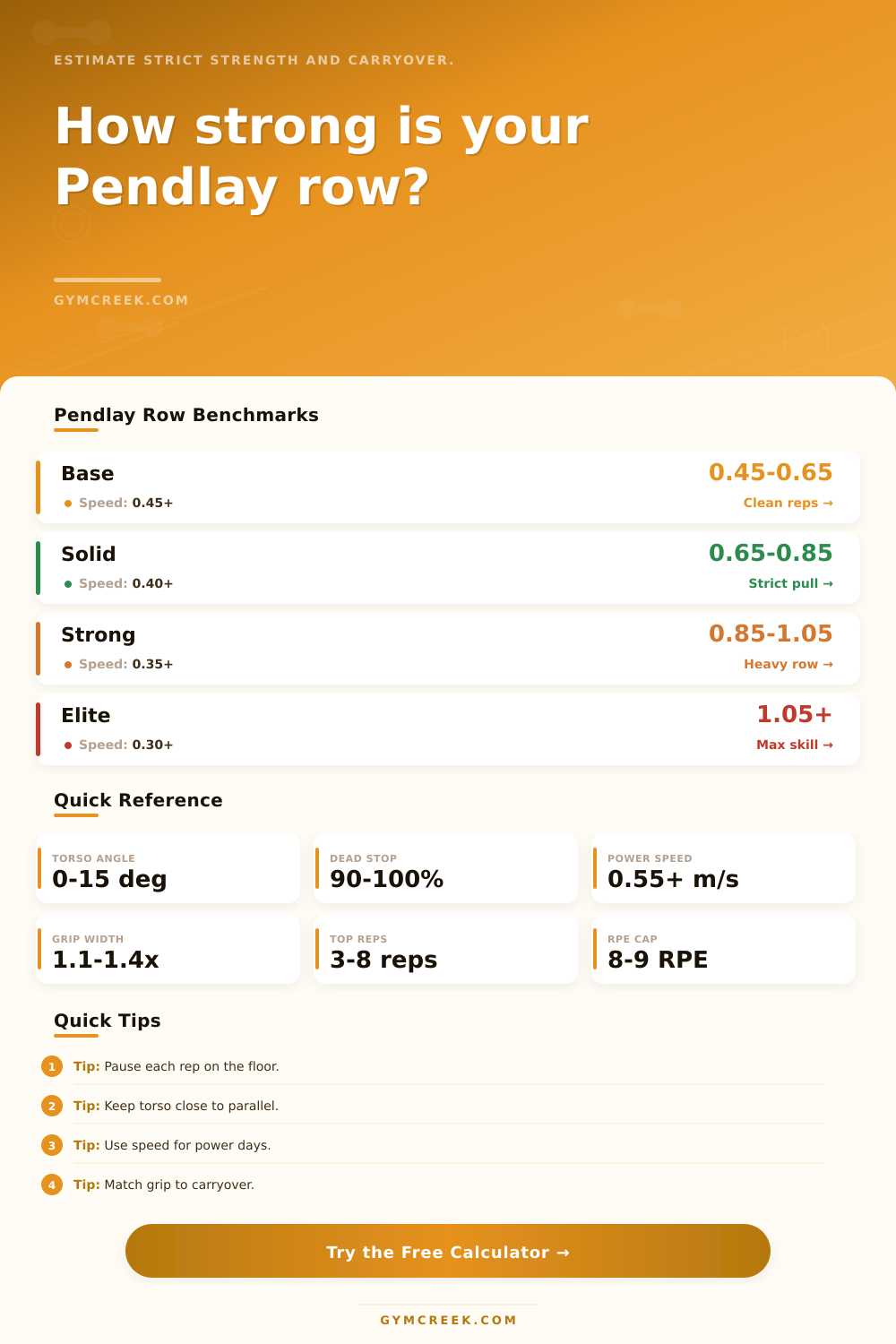
| 0.45 to 0.65x BW | Base | 6 to 10 reps | Build consistent floor starts before chasing heavier rows. |
| 0.65 to 0.85x BW | Solid | 5 to 8 reps | Good general back strength for most recreational lifters. |
| 0.85 to 1.05x BW | Strong | 3 to 6 reps | Useful for deadlift positioning and pressing stability. |
| 1.05x BW and up | Advanced | 2 to 5 reps | Technique quality matters because small cheats change the lift. |
| Setup Factor | Ideal Pendlay Target | Common Drift | Calculator Effect |
|---|---|---|---|
| Floor start | Full dead stop | Touch-and-go bounce | Lowers strictness score and adjusted 1RM. |
| Torso angle | 0 to 15 degrees | Upright row pull | Penalizes loads that rely on body English. |
| Bar speed | 0.35 to 0.75 m/s | Grinding or yanking | Separates power work from max-strength work. |
| Grip width | 1.10 to 1.40x shoulders | Too narrow or too wide | Shifts carryover toward lats or upper back. |
| Goal | Work Weight | Rep Target | Best Carryover |
|---|---|---|---|
| Strict strength | 80 to 85% strict 1RM | 3 to 6 | Heavy rows without losing the floor reset. |
| Explosive power | 55 to 70% strict 1RM | 3 to 5 | Fast starts that reinforce pull speed. |
| Back volume | 65 to 75% strict 1RM | 6 to 10 | Upper-back size with repeatable position. |
| Bench support | 65 to 78% strict 1RM | 6 to 12 | Scapular control, lats, and upper-back shelf. |
| Formula Piece | What It Uses | Why It Matters | Output |
|---|---|---|---|
| Adjusted Epley | Load, reps, RPE | Adds estimated reserve reps to the set. | Raw estimated 1RM. |
| Strictness factor | Dead stop, floor, torso | Separates a true Pendlay row from looser rows. | Strict 1RM estimate. |
| Speed modifier | Top-set m/s | Flags whether load suits power or strength work. | Power range and readiness note. |
| Carryover score | Grip, ratios, goal | Maps row qualities to deadlift and bench support. | 0 to 100 score. |
💡Tips
What you’ll realize is this: Your form falls apart at some point mid-pull. At first, bar starts low with your chest up; by rep four, you’re standing tall and using momentum to get the bar off your body; hence the drift. That’s not good; it’s mostly spinal stress and it feel like work.
To counteract this drift, the Pendlay row force you to go through a full dead stop on the floor for each and every rep. This turns what would be a pulling exercise into power movement requiring full-body coordination. Mistake: Most lifters view it as simply another back builder, it’s not; the mechanics are totally diffrent than a bent-over row. The whole point is its strictness.
How to Do Pendlay Rows Correctly
This page is a way to help cut through that technical noise and find out what kind of strength you’re displaying. Do you think you had a good set? Or did you just push something until failure? Use this page to enter your reps, your load, and how hard it felt to see where you sit in reality. We’ve done the math for you. You simply enters your metrics into the calculator above. And we eliminate all the guesswork when it comes to conversions and coefficients.
Variables such as bar speed and torso angle goes into figuring out if you’re training power or if you’re just moving some weight around. Because heavy rows performed poorly will do little for your deadlift, let alone your posterior chain. The table on the page breaks it down, grouping lifters according to their bodyweight to strength ratio.
Control these main variables: Your torso angle should ideally be like a glute-ham raise, with your back nearly horizontal. This puts the load off your lower back and fully engages the hamstrings. When you stand too high, the exercise becomes more similar to an upright row, dramatically altering the muscle use pattern. Upright angles decrease the specificity of this exercise for pulling strength, which is why the calculator punishes them.
Can you build a big back with a higher torso? Sure. But you’re not training the same brain connections. And that’s where most people get it wrong. They’ll chase those pounds without paying attention to their posture. Then when their back starts hurting after a while, they don’t know what happened.
Another key parameter that distinguishes strength from power is the speed of the bar. An actual Pendlay row should be explosive. If the bar isn’t moving slowly then either you’re doing too much weight or not trying to move the bar as fast as possible. Based off the speed you report, the tool provides a recommendation on whether current load is appropriate for a strength block vs a power block.
With power, you desire light weights and a fast bar movement. With strength, you take heavier loads and slow bar movements but still require the dead stop. You can’t bounce the bar off your hips to get it started. That’s cheating the physics of the start. That’s why strictness input into the calculator includes this and adjusts down your estimated one-rep max if you confess to touching and going instead of stopping.
You’ll notice the same basic movement with different grip widths; it just feels different. For example, a narrow grip feels more like a vertical pull, focusing more on the lats. A wide grip emphasizes the rear delts and upper back, which can help with bench press stability. Use your best judgement according to your programming needs.
For instance, if you have a weak “shelf” in your bench press routine, a wider-gripped row might fill the void. On the other hand, if your deadlift lockout is weak, perhaps some lat tension via a regular or even narrower grip will do the trick.
For most lifters, the ultimate test is carryover. Because both a good deadlift and a Pendlay row demand a stable torso and explosive hip extension, they should strongly correlate. Based on your ratios and setup quality, the calculator spits out a carryover score. This tells how well your rowing form translates to other lifts.
If you have a high score, you’re doing something right in your rows that’s translating well to your other lifts. If you have a low score, it tells you that you should of cleaned up your form before trying to add any additional weight. You can’t out train poor form.
If the bar doesn’t settle on the ground, lower your strictness level and realize that number will be an estimation of a looser version of this exercise. Better to know you’re training loose than thinking you’re training strict but really aren’t.
Use light weight to master the dead stop. Don’t get caught up in how much is on the bar; learn to reset each rep before doing so. Focus on technique first, then strength will follow. Until you make getting on the floor a starting point instead of a finishing line, that’s when you’ll see the real improvement.