Peak Week Water Manipulation Calculator
Estimate water intake, sodium density, sweat loss, body-mass shift, and red-flag risk before a physique peak or weigh-in.
🚨Safety First
📌Presets
Presets load realistic peak-week scenarios for checking risk. They are not recommendations to copy.
⚙Calculator
Peak-week hydration snapshot
Enter water, sodium, sweat, and carb details to estimate risk.
📊Fitness Metrics Comparison
📑Reference Tables
| Hydration Signal | Lower Risk | Caution Zone | Stop And Review |
|---|---|---|---|
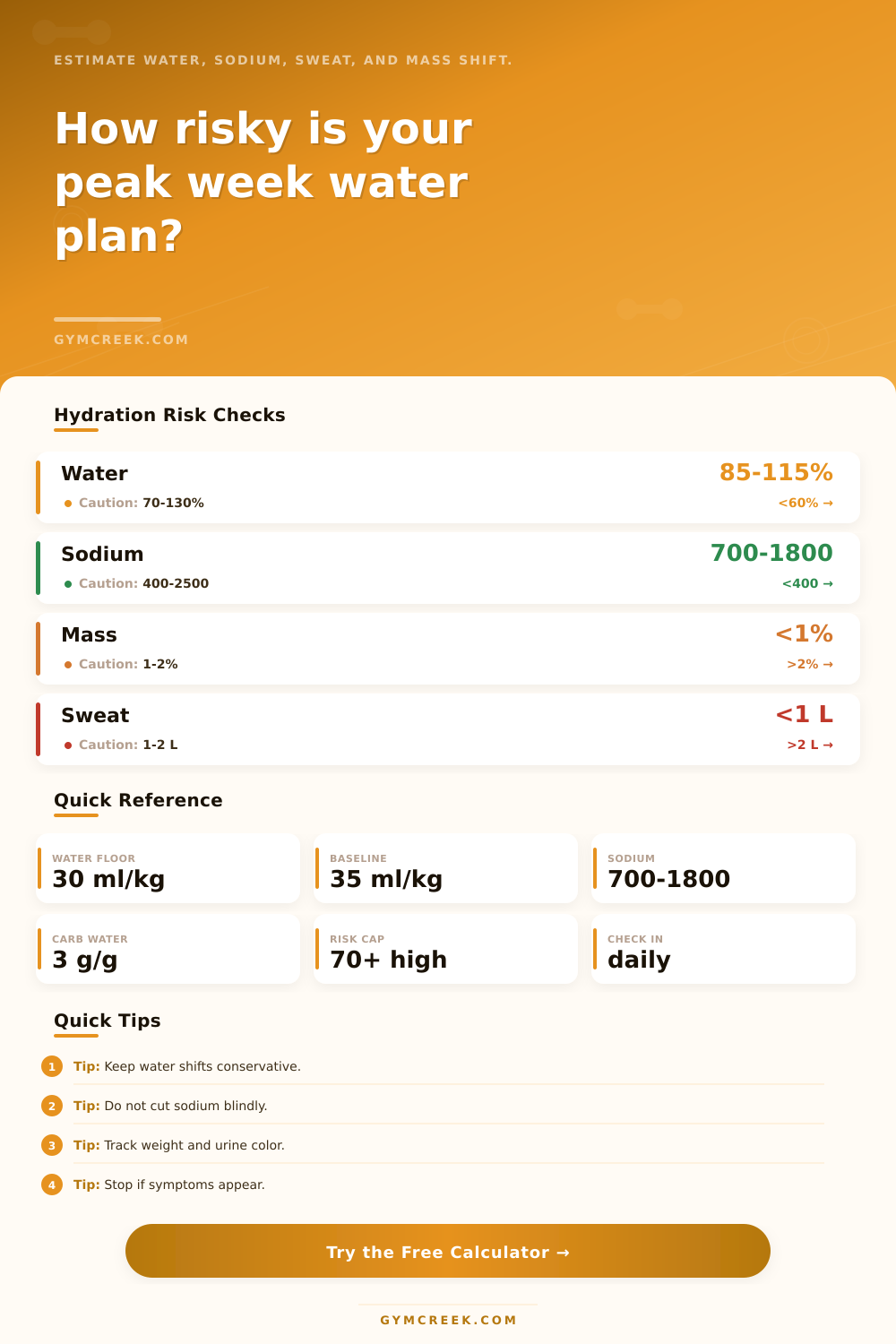
| Water vs usual | 85-115% | 70-130% | Below 60% or above 180% |
| Projected fluid deficit | Under 1% body weight | 1-2% body weight | Over 2% body weight |
| Sweat loss session | Under 1 L | 1-2 L | Over 2 L without replacement |
| Same-day check | Stable plan | Small change only | New aggressive change |
| Sodium Density | Approximate Meaning | Typical Risk | Calculator Flag |
|---|---|---|---|
| Under 400 mg/L | High free-water load | Low sodium risk | High caution |
| 400-700 mg/L | Light sodium support | Watch symptoms | Caution |
| 700-1800 mg/L | Balanced intake zone | Lower risk | Preferred |
| 1800-2500 mg/L | Dense sodium day | Bloating or thirst | Caution |
| Over 2500 mg/L | Very salty relative to water | High thirst load | High caution |
| Peak Scenario | Data To Track | Safer Interpretation | Do Not Do |
|---|---|---|---|
| Carb load | Carbs, weight, waist | Expect water gain with glycogen | Slash water to chase dryness |
| Final pump day | Sweat, urine color, weight | Replace session losses gradually | Use dehydration symptoms as proof |
| Scale weigh-in | Body mass trend | Use qualified supervision | Attempt severe last-minute cuts |
| Travel day | Fluids, sodium, flight time | Keep routine predictable | Change every variable at once |
| Formula | Inputs | Output | Use |
|---|---|---|---|
| Water floor | 30 ml/kg plus sweat | Minimum fluid estimate | Safety floor |
| Sodium density | Sodium divided by water | mg per L | Electrolyte context |
| Sweat loss | Duration times sweat rate | Lost liters | Replacement estimate |
| Glycogen water | Carb change times 3 | Water shift | Mass context |
| Mifflin-St Jeor | Sex, age, size | BMR calories | Recovery context |
💡Peak Week Tips
On stage day, when you wake up in morning of that fateful day, there’s a certain type of dread that sets in. After all, you’ve trained for months; you’ve eaten clean and worked hard. Yet here you are, staring into this tub of water and wondering what you’re going to do with it.
At this stage in any physique competition, the difference between looking sick and looking shredded is very small. This explains why most competitors either follow old wives’ tales or let fear take over, leading them to copy other competitors whose bodies is nothing like theirs.
How to Prepare for Your Show Safely
Enter your own personal metrics into the calculator and find out whether your plan will be safe … or guess.
There’s also something I don’t see many people talking about, a very basic physiology concept: Water control. If you take in excess water and then abruptly stop, your body will flush out fluid to keep things in check. It creates an instant lack that expose underlying muscularity behind the water under the skin. But again, that depends heavily on person-to-person differences. Sodium habits, kidney function and sweat rate all influence how two individuals of equal body fat and weight might handles this technique different than before. There’s no use forcing one protocol down anyone’s throat.
The other half of that equation are sodium, and that’s where most plans go awry. Water and salt is chemically bound in your cells, you can’t think of them as two separate variables. If you slash your sodium too hard but maintain high water levels, then you’re on the road to hyponatremia: cramps, confusion, even hospitalization. And that’s why density is more important than absolute intake: you want to see if your sodium per liter of water fall in the caution zone or the balanced zone (see reference table). This isn’t about consuming as little salt as possible. It’s about ensuring your electrolyte support matches your level of fluid volume so that cells neither shrink nor swell dangerousy.
Sweat loss is one of the most overlooked factors in competitions among new competitors, not to mention they’re underestimating what the sauna suit really offers. The sweat won’t burn away any muscle tissue or fat. All that happens is you’ll drop some water weight. This won’t leave you looking vascular and ripped. Instead, it leaves you dehydrated and flat if you drop five pounds of sweat two hours prior to show.
The app considers your individual sweat rate and length of session and lets you know exactly how much mass you’re shedding compared to how much is just evaporating. That makes all the difference when it comes to posing confident.
And then there’s carbs: specifically glycogen storage. Each gram of glycogen your body stores has ~three grams of water inside that muscle cell. That’s great for making you look full, not-so-great for eliminating bloat. If you’re packing on the carbs but haven’t adjusted water, you’ll be puffy. Cut carbs too far out and you’ll be left looking empty.
These factors combine; the volume of sweat, the sodium density, the amount of water per unit; into one simple safety score: Low = playing it safe. High = gambling with your health for a slight improvement in photos. But this one’s the worst: Too much variation in a single day. Did cutting water cause the cramp? The headache? Traveling? Training hard? Altering your carb intake? You’ll never know unless you’ve done a proper dry run, a dress rehearsal weeks prior to competition.
This allows you to discover your sweat rate. It helps you observe how your skin behaves under mild dehydration conditions. Finally, it lets you determine what your body will tolerate and where it won’t.
You should of tested this first. So at the end of the day, it’s not a magic trick; it’s risk management, chasing the aesthetic but staying within acceptable bounds. You’re aiming to be looking good on stage without needing to visit the emergency room after the event.
Stick with conservative water shifts. Check your pee color. Quit if you start feeling confused or dizzy. Don’t take any chances. The risk isn’t worth the trophy. You’d rather remember what you saw than how you felt.