Peak Torque Calculator
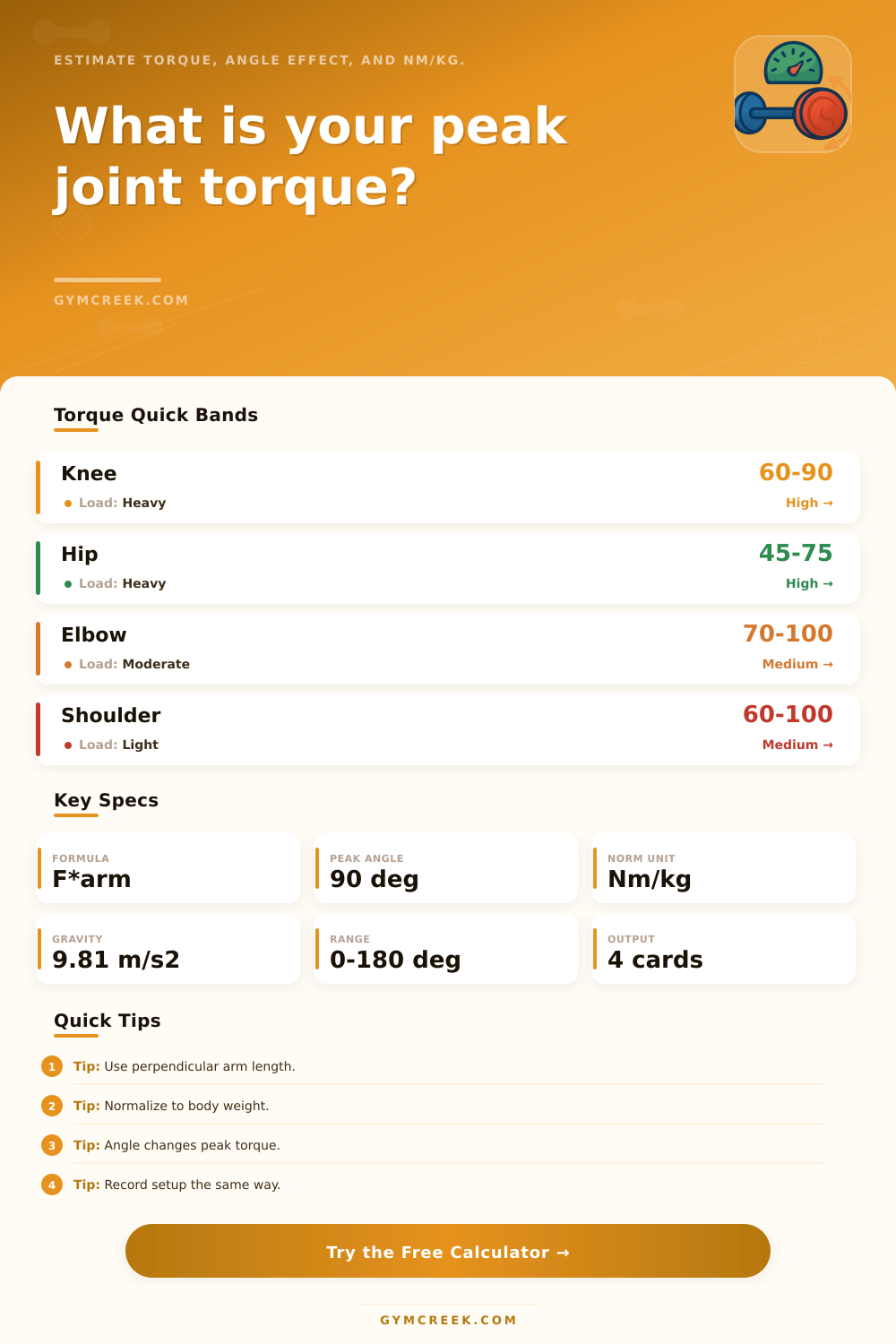
Estimate peak joint torque from force and moment arm, then compare the result by joint angle and bodyweight-normalized strength.
📌Presets
Each preset loads a realistic joint, load, angle, lever, and bodyweight setup for a quick comparison.
⚙Calculator
Peak torque snapshot
Enter load, moment arm, and joint angle to calculate torque.
📊Torque Metrics
📑Reference Tables
| Angle | Sine factor | Torque effect | Use note |
|---|---|---|---|
| 30° | 0.50 | Low | Short arm |
| 60° | 0.87 | High | Rising torque |
| 90° | 1.00 | Peak | Max arm |
| 120° | 0.87 | High | Falling torque |
| Joint | Common peak angle | Typical arm | Measurement note |
|---|---|---|---|
| Knee | 60-90° | Shank length | Pad or ankle load |
| Hip | 45-75° | Hip to load | Bar or trunk force |
| Elbow | 70-100° | Forearm | Hand or cable line |
| Shoulder | 60-100° | Arm length | Dumbbell or cable |
| Normalized torque | Signal | Training context | Compare with |
|---|---|---|---|
| 0.5-1.0 Nm/kg | Light | Rehab or skill | Same limb |
| 1.0-2.0 Nm/kg | Moderate | General strength | Body weight |
| 2.0-3.0 Nm/kg | High | Heavy training | Same setup |
| 3.0+ Nm/kg | Very high | Peak effort | Coach review |
| Formula | Variables | When to use | Output |
|---|---|---|---|
| Torque | F * arm | Peak load | Nm |
| Angle arm | arm * sin(a) | Joint angle | meters |
| Normalized | Nm / kg | Body size | Nm/kg |
| Rep peak | load * reps | Rep set | estimate |
💡Tips
Lifting more weight? Stronger? Yup. Mostly. Most of the time. Except when it’s not. You might lift five more pounds on bar every week. You might adjust angle by changing where the cable attaches or alter your stance width to take pressure off your knee joint. In those cases, weight has gone up, but stress on that knee joint hasn’t increased.
This is a measure of rotational force at a joint. It shows what your muscles are actualy doing, rather than making you assume they works the way you imagine just because there is a number on weight plate. You put in your lever arm and load and the tool above does the rest. You don’t need to do any trigonometry yourself.
What Is Torque?
Suddenly, you can see how small changes in mechanics can change demands on your body. It’s basic physics in human form. Torque = force x distance. When holding a dumbbell with your arm bent at right angles to your body, distance from your elbow joint to center of mass of the weight (the moment arm) is large. Therefore, torque is large. Drop your hand slightly so angle closes to thirty degrees, and that same weight feel easier because perpendicular distance from the joint axis shrinks dramatically. That perpendicular distance from your elbow joint has decreased a lot.
That’s what sine factor does in table on the page, decreases as we move further away from that maximum torque at the right-angles point. So explanation for why some reps “feel” harder despite no change in load is geometry opposing your leverage.
This is where most people fall off wagon with estimates: they include full length of their limbs when calculating input moment arm. Torque only consider the perpendicular distance between the joint axis and line of force. If your pad is a little far forward on your foot or your cable pulls at some angle, that will change your lever arm. You can also account for losses due to efficiency. These are things like friction in machines or wasted energy in cable angle as it approaches the muscle. Cam shapes and handle paths can change actual force applied at the joint, so thinking of the machine’s load as perfect would of been a mistake.
And beyond that, there’s detail of normalizing torque to body weight. While the raw numbers provides absolute data points, they hide the deeper insight found in normalization. Sure, a big dude may crank out higher absolute newton meters than someone smaller, but does that necessarily mean his legs is relatively stronger? His output divided by his mass provide a ratio against which we can make more fair comparisons… Among athletes of differing sizes and at various points in their training block(s). That’s why such normalized values is frequently used in rehabilitation protocols and strength standards. They remove the benefit of sheer size from equation, concentrating instead on functional capacity relative to what you have to move around everyday.
The weight isn’t all that’s important; joint angle is also critical. For example, knee extension typically peaks at approximately 60-90 degrees of bending (with maximum torque), whereas the hip hinge see its greatest demands near 45 degrees. If you attempt to assess strength during an unfavorable angle, then you’re not getting a complete picture. It may appear your hamstrings is weak due to testing at an angle in which they have insufficient leverage.
If you want to monitor your progress over time, then you must avoid changing your set up. Maintain the same warm-up routine, cable height, and pad placement each session so that any variation in results represent true adaptation instead of measurement error.
In addition, eccentric and concentric phases alters the effective torque profile. Lifting something explosively creates more mechanical stress for connective tissue than lowering a weight does, yet requires less neural drive. You can tag these kind of contractions in the tool to keep context obvious. Dynamic reps will be different than isometric holds because they don’t have momentum to help with movement. Knowing what kind of effort yielded that number will help you determine if you should adjust your volume or loading for the upcoming workout.
In the end, measuring peak torque gives us a way to make abstract thoughts about strength real. We no longer have to guess if lifting that additional pound made a difference; we can see how much rotational stress was applied. That’s a subtle mental adjustment, but it alters training. We’re no longer mindlessly heaving more metal onto the bar because we “respect” the lever of our own bones. Rather, we get a sense for what that force does to this moddern machine we call the body.