Peak Power Output Calculator
Estimate peak watts, relative power, average concentric power, and test quality from jump, lift, throw, sprint, or erg data.
📌Presets
Each preset fills the test setup, movement factor, displacement, timing, and optional measured peak watt value.
⚙Power Test Inputs
Peak power snapshot
Enter test data to estimate peak output and relative power.
📊Power Metrics Grid
📑Reference Tables
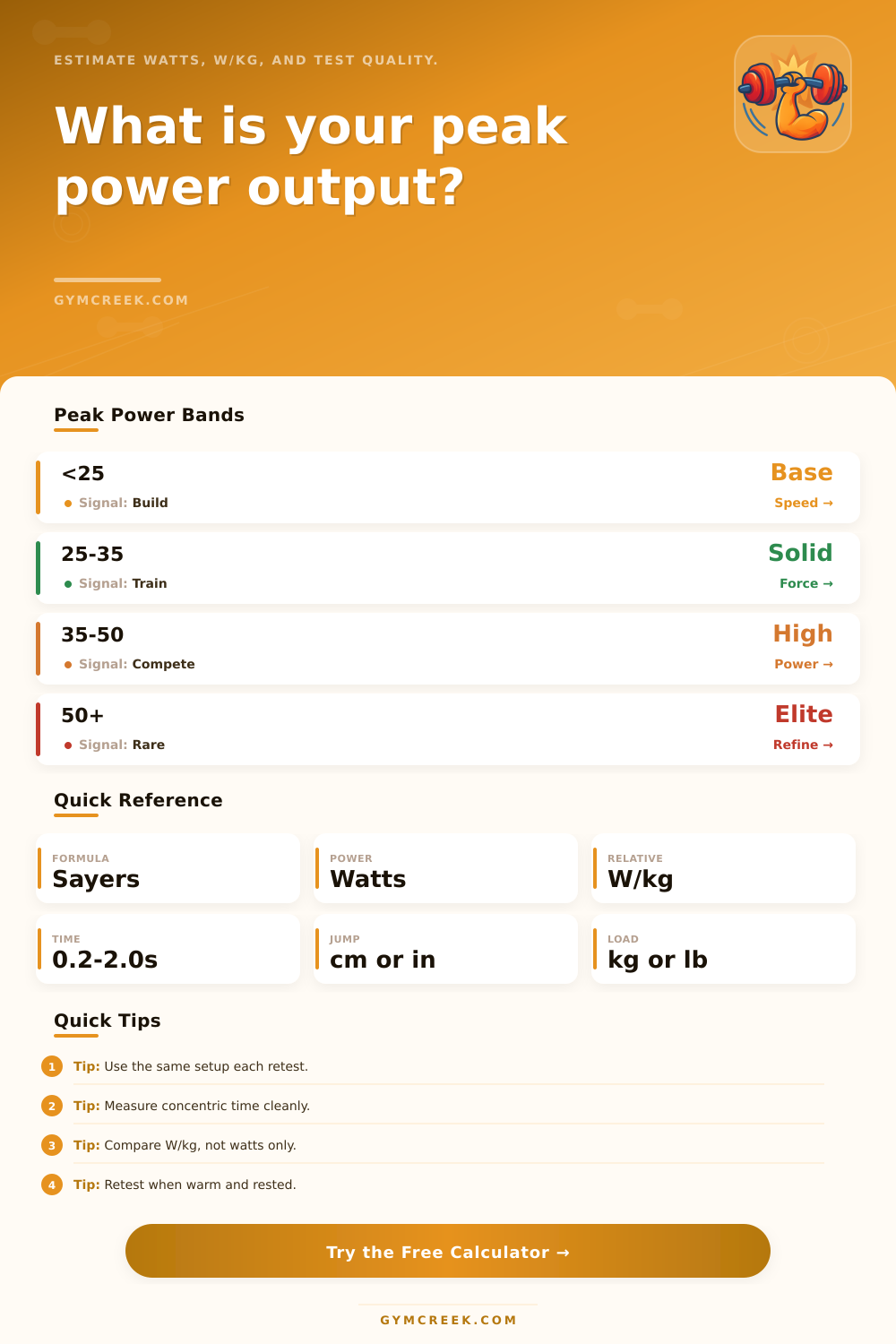
| W/kg | Band | Signal | Focus |
|---|---|---|---|
| <25 | Base | Build rate | Speed |
| 25-35 | Solid | Trainable | Force |
| 35-50 | High | Sport ready | Power |
| 50+ | Elite | Rare output | Refine |
| Test | Factor | Best Input | Use |
|---|---|---|---|
| Jump | 1.35 | Height | Field |
| Loaded jump | 1.45 | Time | Gym |
| Pull | 1.25 | Bar path | Weight |
| Erg sprint | 1.15 | Watts | Cycle |
| Check | Good | Warning | Fix |
|---|---|---|---|
| Time | 0.2-2.0s | Too slow | Retest |
| Height | 10-80cm | Odd path | Measure |
| Load | 0-80% BW | Too heavy | Lighten |
| Reps | 2-5 best | Fatigue | Rest |
| Formula | Variables | Output | When |
|---|---|---|---|
| Sayers | Mass, jump | Peak W | CMJ |
| Harman | Mass, jump | Peak W | CMJ |
| F x v | Load, speed | Avg W | Lifts |
| Sensor | Measured W | Peak W | Device |
💡Tips
Peak power describe the amount of work that an individual can perform in a very short span of time. Peak power is created when force and velocity combine to create the maximum amount of work. For example, an individual can exhibit peak power if they is moving a heavy weight at a high speed or if they exhibit peak power during an explosive jump.
Peak power isnt the same than absolute strength. Absolute strength is the amount of force that an individual can exert to move a heavy weight. Peak power, on the other hand, is the amount of force that an individual can move at a high rate of speed.
What Is Peak Power and How to Measure It
Peak power can be measured using a few different method. However, most individuals dont have access to professional force plates or linear transducer. An approximation of peak power can be made by measuring the body mass of the individual, the weight of any external load, and the distance that the load was moved.
Using the formula that combine those three variables, an estimate of an individuals peak power can be calculated. The calculator that is available combine those variables to make calculate peak power for an individual much simpler. This calculator transforms raw data from the gym into a meaningful metric that reflect the individuals peak power in relation to their body size.
The calculator determines peak power in watts per kilogram (watts/kg). This is referred to as relative power rather than absolute power. Absolute power can be misleading because the heavier an individual is, the more absolute watts they will be able to produce compared to an individual who weigh less.
For example, an individual who weigh 250 pounds will have more absolute power than an individual who weighs 150 pounds. Relative power, however, indicate whether the individual is becoming stronger or gaining more mass over time. This is the most important measurement of peak power for an individual because it is the best indicator of how the individual is progressing over a long period of time.
Peak power can be measured in a variety of different movements. Each movement will require different factor to be accounted for to obtain an accurate measurement. For instance, the physics of a vertical jump are not the same as those of a loaded jump squat or a rowing stroke.
The body will apply different coefficient to each of these movements because the physics of jumping with ones bodyweight is not the same as the physics of pull a heavy load. Not all movements are created equal, and an individual should perform the test that best reflect their goals using this calculator. In addition to the other factor mentioned, the time that an individual perform the movement is also an important factor.
For example, the concentric time is the amount of time that an individual take to move from the start of the movement to the peak height of that movement. If the time that is measured for this variable is incorrect, the wattage that is calculated will also be incorrect. A test that is considered of high quality will have both a clean movement and a realistic time for that movement to be performed.
Too slow a movement will provide an inaccurate measurement of an individuals peak power. The quality check that is included with the calculator will help to identify any outlier. The reference bands will allow individuals to understand the meaning of their relative power score.
If an individual score within the base or solid areas of the reference bands, they have a solid foundation to build upon. An individual who score within the elite category for relative power possesses high level of neurological efficiency. These scores can help an individual to change their training.
For instance, if an individual has high levels of absolute strength but low relative power, they will not have to change the weights that they lift. However, they can change the way that they lift their body weight to increase the relative power that they exhibit. Finally, to ensure the accuracy of the data, an individual should remain consistent in the measurement that are taken when measuring peak power.
For example, if an individual changes the type of shoe that they wear or the way in which they stand when performing the measurements, the results will be invalid. By using the same setup for every test, an individual can ensure that any change in relative power are due to changes in neurological efficiency. By remaining consistent in the variables for each test, if relative power increase, it is a result of the nervous system firing in a more efficient manner.