Paused Rep Load Calculator
Estimate the right paused-rep load from your normal strength work, pause duration, position, tempo, and target set difficulty.
📌Presets
Each preset loads a realistic paused-rep scenario and calculates a conservative bar weight for the selected unit system.
⚙Calculator
Paused rep snapshot
Enter your normal set and pause details to estimate the load.
📊Pause Stress Grid
📑Reference Tables
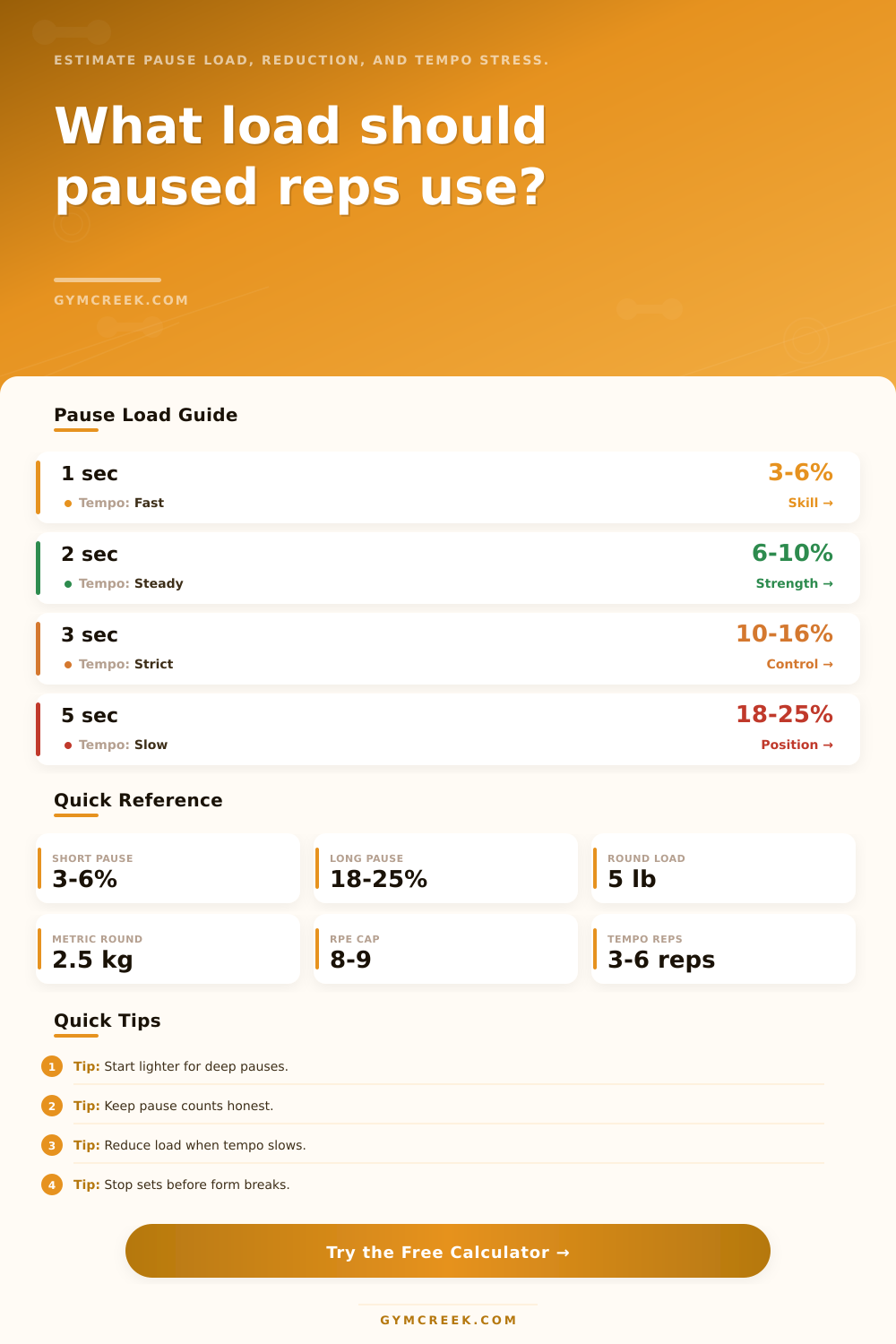
| Pause Length | Typical Reduction | Best Use | Load Note |
|---|---|---|---|
| 1 second | 3-6% | Competition practice | Keep bar speed crisp |
| 2 seconds | 6-10% | Strength control | Good default for most lifts |
| 3 seconds | 10-16% | Position strength | Use stricter bracing |
| 4-5 seconds | 16-25% | Technique rebuild | Cut load before reps grind |
| Lift | Hardest Pause | Factor | Why It Matters |
|---|---|---|---|
| Bench press | Chest pause | Medium | Removes rebound from the press |
| Squat | Deep bottom pause | High | Requires tension out of the hole |
| Deadlift | Below knee pause | High | Extends time in poor leverage |
| Overhead press | Chest pause | Medium | Limits leg drive and stretch reflex |
| Tempo | TUT Per Rep | Load Effect | Use Case |
|---|---|---|---|
| 2-1-X | 4 sec | Small | Power with control |
| 3-2-X | 6 sec | Moderate | Strength positions |
| 4-3-1 | 8 sec | Large | Hypertrophy control |
| 5-5-1 | 11 sec | Very large | Light technique work |
| Goal | RPE Range | Reps | Load Approach |
|---|---|---|---|
| Skill | 6-7 | 3-6 | Leave clear speed reserve |
| Strength | 7-8.5 | 2-5 | Use steady bracing |
| Hypertrophy | 7-9 | 5-10 | Manage total time under tension |
| Peaking | 8-9 | 1-3 | Keep pauses competition strict |
💡Tips
Have you ever noticed that in many of these heavy lifts, you are relying more on the momentum/rebound off your chest than raw strength? That’s because momentum and elastic energy disguise how hard something is. With paused reps, there’s no longer any of that. If you can’t get that 225 up off the ground without the bounce, you sure as heck won’t be able to do so when starting from a dead stop.
The math are important. Because if you guess incorrectly, you’ll stall out or fail rep. To do all of this, I built a calculator (above) that does heavy lifting for you, converting your usual strength numbers into a safe place to start when paused. It look at what you normally use for load and reps. It then reduces those numbers to match the length of your pause based on a reduction factor. It also takes into account how experienced you are with holding such tension.
How to Use the Pause Rep Calculator
That’s not choosing a lower weight, it’s tuning down the intensity to a level where you can actualy get better instead of grinding away doing something wrong. For example, if you put in a pause of two seconds, the calculator knows that’s standard strength-building work. Put in a pause of five seconds and it will know that you’re working on correcting a tech flaw or building position stability, which mean a far deeper cut in weight is required. And these differ dramatically from each other, but most lifters lump them together as if they were interchangeable.
There’s also the factor of experience. A beginner using pauses won’t be able to brace as well; a professional might lift more weight because they have learned to hold internal pressure without moving their body. This is where the tool adjusts based off your own assessment of your skill level, increasing or decreasing its recommendation of load. For a beginner it will keep you from ego-lifting into an injury; for someone who has been around the block a few times it will challenge them sufficiently to continue progressing. No algorithm will ever feel your core being that tight on rep number four, so you better be honest with yourself as to what camp you fall under.
Eliminate the stretch reflex, and it’s all about time under tension. An explosive drive coupled with a quick eccentric descent looks similar to a slow, controlled grind, but your body recruits a vastly different set of muscles and metabolic cost is completely different. These tables within the tool help explain that tradeoff. You’ll notice prolonged pause demands far lower load; sometimes dropping the weight by twenty percent or even more then that, depending on the depth of your squat position. It isn’t punishment, it’s physiology. Your muscle must stabilize joints that momentum typically supports. Ignore this physics lesson and your form will break down quickly.
When adding a pause, most folks makes the mistake of maintaining their rep count. This isn’t always the best move. A paused rep is far more fatiguing (physically and mentally) than a standard set. Each rep take maximum effort from a dead stop. Fatigue will accumulate quicker. To keep the quality up, the calculator recommends changing the volume to account for this (often suggesting fewer reps per set).
If you can get three perfect paused reps but five sloppy reps with violent shaking of the bar or premature hip rise, go with three reps. Quality dictates adaptation. Go conservative. Choose a little lighter than what you think you should of started with on the first set and work up slowly as you dial in your form. You’re not aiming to hit a brand-new one-rep max; you’re trying to nail down the under-load position. When you can get the weight moving over the sticking point without hesitation/bounce, you deserve to add some plates.
That way, your body gets used to dealing with the difficult portion of the movement by itself. This develops true strength that carries over into everyday lifts. Because you’ve learned how to make the hard part feel effortless, the next time you do the bench or squat, it’ll seem like you got all the help in the world.
Be patient throughout this process. This takes a long time because you’re going against years of using elastic energy to get yourself out of holes, but it’s worth it in the end. Not only does your stability improve, your lifts clean up and your strength becomes more functional. Don’t get hung-up on the numbers on the screen, they’re just a guideline. When you know your body can handle more, it’ll tell you. Listen to that feedback loop. Build the tension, pause, and let the strength come along naturaly. Real progress comes one controlled rep at a time.