Pause Squat Load Calculator
Estimate paused squat max, rounded working weight, full-squat percentage, and session tonnage using pause length, squat style, depth, tempo, and readiness.
📌Presets
Each preset loads a complete paused-squat scenario and recalculates with the selected unit labels.
⚙Calculator
Pause squat snapshot
Enter your squat benchmark and pause setup to estimate training loads.
📊Fitness Metrics Comparison
📑Reference Tables
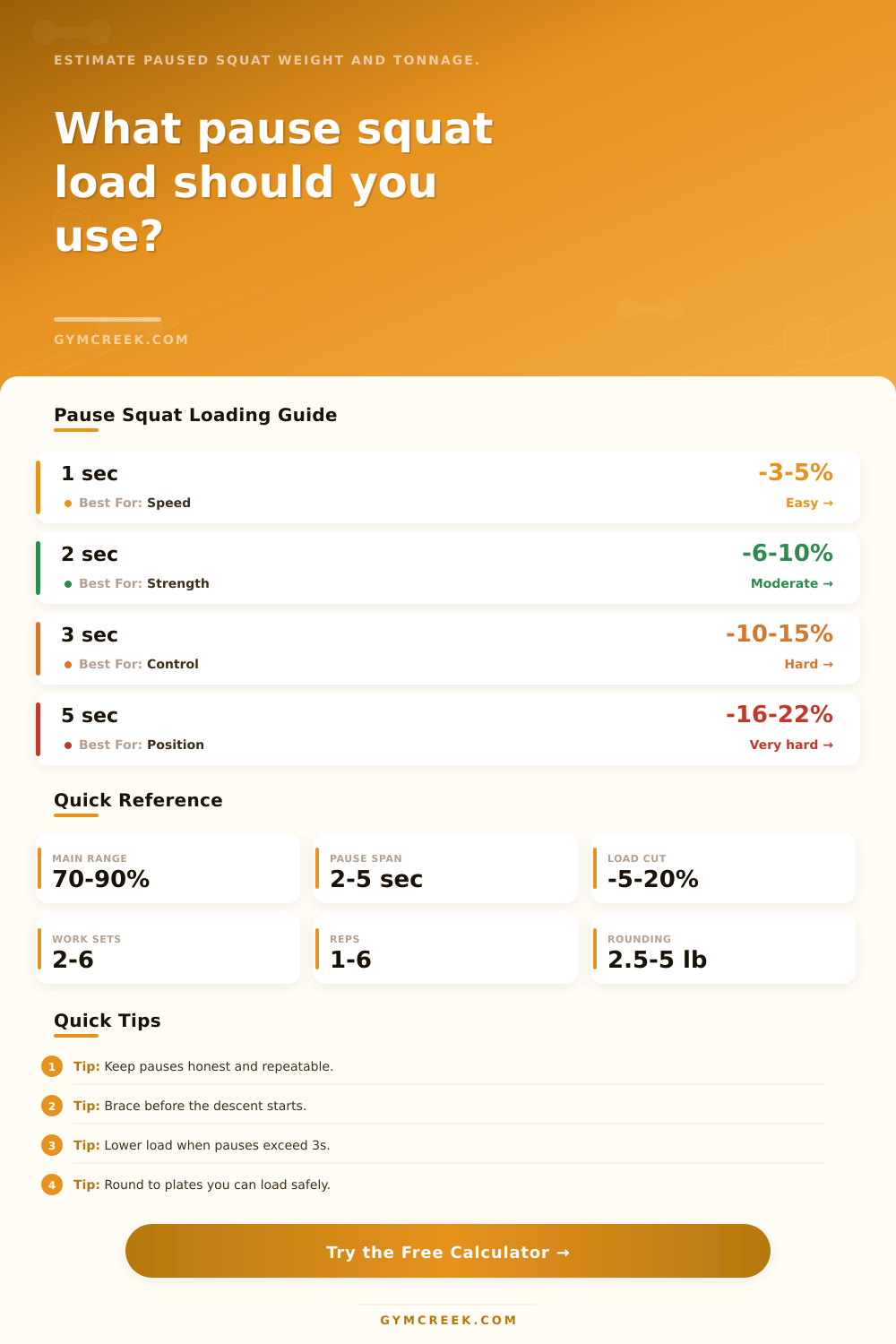
| Pause Duration | Typical Load Drop | Best Use | Coaching Focus |
|---|---|---|---|
| 1 second | About 3-5% below full squat | Speed and meet-depth confidence | Stay tight without relaxing |
| 2 seconds | About 6-10% below full squat | General strength work | Own the bottom position |
| 3 seconds | About 10-15% below full squat | Control and positional strength | Keep pressure through mid-foot |
| 4-5 seconds | About 16-22% below full squat | Strict technical practice | Avoid breathing or bracing leaks |
| Training Goal | Common Intensity | Reps | Loading Note |
|---|---|---|---|
| Technique practice | 60-75% of pause max | 3-6 | Prioritize identical depth and pause timing |
| Strength volume | 70-85% of pause max | 2-5 | Use enough load to feel the bottom |
| Heavy singles | 85-95% of pause max | 1-2 | Keep total attempts low and crisp |
| Long-pause work | 55-75% of pause max | 1-4 | Reduce weight as pause time climbs |
| Variable | Adjustment Used | Reason | Watch Point |
|---|---|---|---|
| Front squat | Extra 10% reduction | More upright torso and upper-back demand | Do not lose rack position |
| Safety bar squat | Extra 6% reduction | Forward pull makes pauses harder | Brace against the handles |
| Deep depth | Extra 4% reduction | Longer range and less rebound | Keep knees and hips balanced |
| Excellent position | 2% readiness boost | Stacked posture improves force transfer | Use only when reps look stable |
| Formula Step | Calculator Formula | Output | How to Use |
|---|---|---|---|
| Benchmark max | Input x basis modifier | Adjusted full squat | Normalizes training maxes and recent singles |
| Pause penalty | Pause seconds x 4.5%, capped | Load reduction | Scales load down for longer pauses |
| Pause max | Adjusted max x total modifier | Paused squat max | Sets the ceiling for work sets |
| Work load | Pause max x target intensity | Rounded bar load | Plan plates and session tonnage |
💡Tips
In each pause squat you have this unique experience where the load becomes more difficult then three seconds ago. That’s due to physics removing your stretch reflex which is usualy assisting with getting back up off bottom of lift. The lift become a test of control and structural integrity instead of power.
Lifters will guess at how many pounds to strip from their bar. Guessing cause failure before descent starts. You can’t gauge what makes a one second stop versus a three second hold. Training effectiveness doesn’t happen with guessing.
How to Use the Pause Squat Calculator
When you plug in the duration of each pause and your total squat benchmark, the calculator do all the math for you. You no longer have to guess at coefficients that depend on biomechanics.
First thing to note is you have to input your actual one-rep max. That’s because your level of strength at the start will decide how far you can go with the penalty. If you plug in a recent heavy single (versus your absolute peak), then the output adjust down accordingly. That takes into account greater fatigue or lessened recovery time. In other words, it make the numbers grounded in reality versus potential.
The most important factor here is length of time paused. If you can pause for just a second, you’ll give up about 3-5% of your max. You won’t lose too much strength, so you can get away with pausing and keeping weight pretty heavy while remaining tight.
If you pause for three seconds, then you’re looking at roughly a 10-15% decrease. That’s a significant decrease in weight on the bar. Longer pauses are an exponential increase in difficulty. Your muscles is going to have to hold it there statically and not rely on momentum to help them do their job.
But your squat style changes everything here. An upright torso and increased upper-back engagement define front squats. Low-bar back squats is easier to hold on a pause compared with front squats. Due to this added stress, shoulders fatigue before quads, so it automatically reduces the weight for front variations. A similar cut goes to safety bar squats, as pulling down on the forward handle create torque that opposes stability. If you ignore these subtleties, expect compromised form and failed reps.
Another thing folks seem to miss are the stops’ depths. Stopping at competition depth or deep high-control ranges will be more difficult than stopping at parallel depth. Deep high control ranges limit your use based off the bottom. The calculator add a greater reduction for deeper stops so the working weight is doable yet difficult enough. You want to feel the burn, not break your lower back. It keeps the workout tough without hurting you.
The reference tables on the page lay this out clearly, showing typical load drops for various goals. Sixty to seventy-five percent of your max pause is where technique practice should of be. Eighty-five percent is push for strength building. Never use same weight for a long hold as you would a quick touch.
Adjusting readiness is just as key. The tool will nudge numbers higher on fresh days, pulling them back on fatigued days. This prevents us from pushing through nervous system exhaustion by using weights that require peak energy levels.
The last practical step is plate rounding. There are no such things as fractional percentages when loading plates. The calculator round your theoretical number to the nearest usable increment based off what plates you have available. That’s what fills in the blanks between the theoretical world of percentage calculations and real-world execution. It will tell you precisely which plate to load so you won’t have to guess at compatibility and waste your time.
Many lifters also neglect session tonnage, which refers to how much volume you’ll complete in a given workout. Long pauses and high intensity causes massive amounts of fatigue. Monitor your tonnage so you can control your training load throughout the week. For example, you may discover that six sets of regular back squats are less fatiguing than four sets of pause squat with a lower load. That awareness prevents overtraining.
Removing emotion from the loading process When it’s time to reduce a lift, don’t hang onto the ego of proving yourself tough. Let physics dictate what gets on the bar. There is no ego in the pause. The lift will only respond to an honest hold and proper load.
Build your respect for the penalty. Build strength that transfers back into dynamic lifts. Learn to control the bottom position. Soon enough, normal squats becomes effortless because you trained for it with precision, not pride.