Paul Law Rowing Calculator
Predict rowing machine splits, finish time, watts, and fatigue-adjusted pacing from one benchmark row using the classic distance-doubling rule.
📌Presets
⚙Calculator
Rowing pace prediction
Enter a benchmark row and calculate a target split.
📊Fitness Metrics Grid
📑Reference Tables
| Distance Change | Split Shift | Meaning | Example Use |
|---|---|---|---|
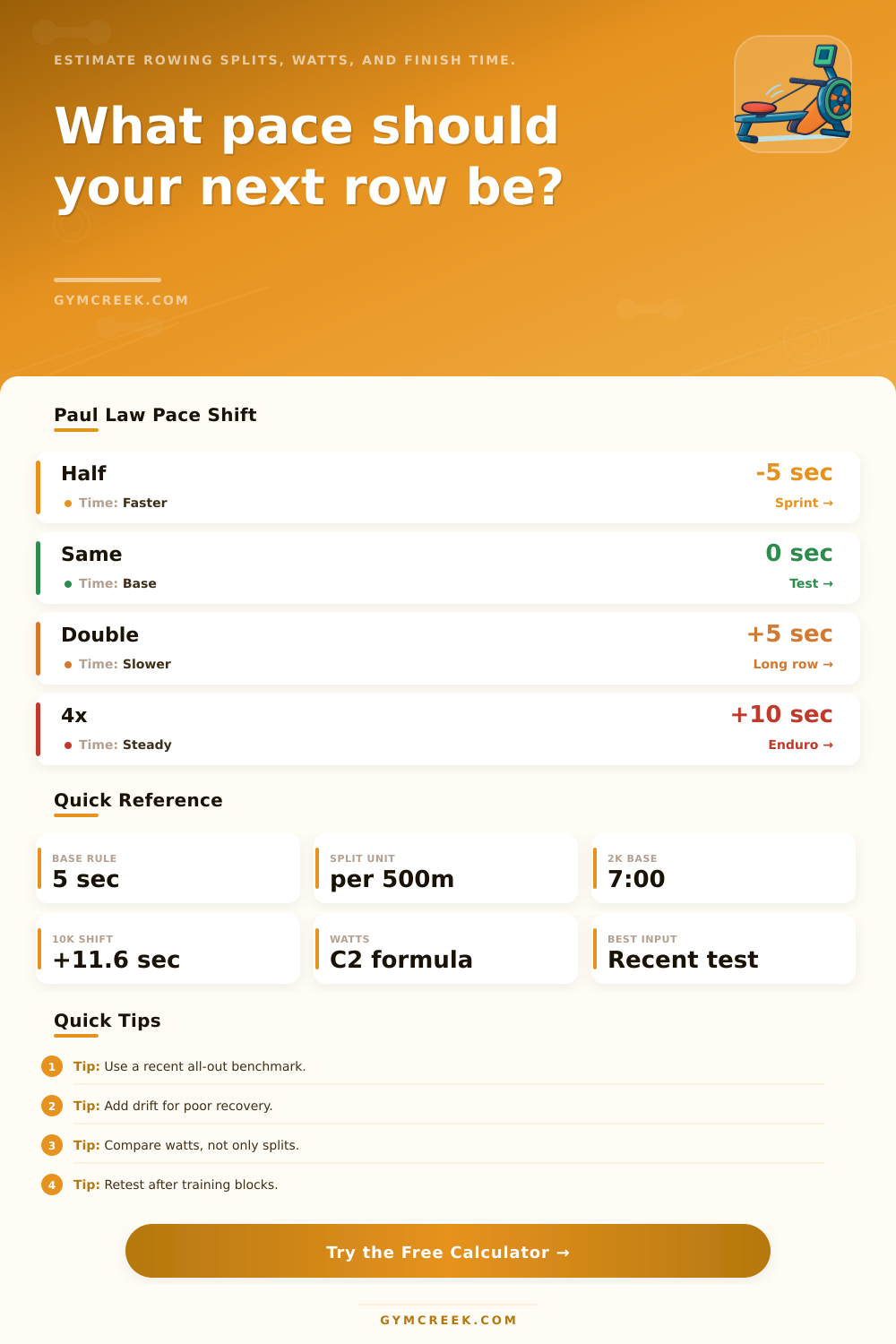
| Half distance | -5 sec | Faster split | 2k to 1k |
| Same distance | 0 sec | Benchmark pace | Retest |
| Double distance | +5 sec | Slower split | 2k to 4k |
| Four times | +10 sec | Endurance pace | 2k to 8k |
| Split Band | Row Feel | Watts Range | Typical Session |
|---|---|---|---|
| Under 1:35 | Very powerful | 350+ | Short racing |
| 1:35-1:50 | Hard | 225-350 | 2k to 5k |
| 1:50-2:10 | Steady hard | 135-225 | 5k to 10k |
| Over 2:10 | Aerobic | Under 135 | Long rows |
| Input | Role | Formula Impact | Good Practice |
|---|---|---|---|
| Benchmark time | Base split | Primary input | Use recent test |
| Target distance | Ratio | Log base 2 | Match erg type |
| Fatigue | Adjustment | Adds seconds | Be honest |
| Stroke rate | Efficiency | Meters/stroke | Hold steady |
| Formula | Variables | Output | When To Use |
|---|---|---|---|
| Paul Law | Split, ratio | Target split | Distance change |
| Finish time | Split, meters | Total time | Race planning |
| Concept2 watts | Split pace | Power | Power compare |
| Watts per kg | Watts, mass | Relative power | Body-size check |
💡Tips
The Paul Law rowing calculator is used to determine the target rowing pace for a specific distance. The distance that a person row will change from one day to the next. Based off the distance that is targeted, the target pace will change with that distance.
The Paul Law rowing calculator uses a specific rule to calculate the target pace that is appropriate for each distance. The rule suggests to a person that they should add or subtract five second from their split time for every 500 meter in their race if they are doubling or halving the distance that they will row. After using this five-second rule to calculate the target split for a given distance a person may feel particularly fatigue.
How to Use the Paul Law Rowing Calculator
In this case, a person can adjust the split using the Paul Law calculator according to how tired they feel so that they are more likely to experience success during there rowing session. Thus, the Paul Law calculator allow for a person to determine a specific target split for rowing using these calculations. The five-second rule is used for calculating the target rowing split for each particular distance because the cost of rowing aerobically is not linearly increase according to the distance that is rowed.
Thus, when a person doubles the distance that they are to row, the body must pay an extra price to accomplish this distance. This extra price indicates that a person will have a slower time for each split. The five-second rule is a way of remembering this particular relationship between distance and rowing splits for training with rowing machines.
Thus, while not a law of physics, the five-second rule is a way of managing training splits for rower. The inputs for the Paul Law rowing calculator are used to indicate the specific meaning of the final number that is provided to each person. For instance, the distance and the time for a specific rowing benchmark will allow a person to establish the fitness of their body.
A person should use a rowing benchmark split and time that are relatively recent and accurately for there abilities to best manage the Paul Law calculator. Using inaccurate inputs for body fitness will indicate to the Paul Law rowing calculator that a distance split that is too fast for the body. Additionally, a person can enter body weight into the calculator because splits in watts and power are affected by the body weight of a rower.
Thus, by entering body weight, the calculator can show splits in both absolute watts and watts per kilo so that a person can understand if their physical strength is increase or if they are simply becoming lighter in weight. Other inputs for the Paul Law rowing calculator include a fatigue level, stroke rate and drag factor. A person can set the fatigue level to reflect the level of fatigue that a particular body may feel during training.
For example, if a person feels particularly fatigue due to training heavy the previous week, poor sleep, or muscle soreness the fatigue level may be set to reflect this level. This allows for the body to adjust to the splits at the start of rowing so that it does not become discouraged when it discovers that the splits are too fast for the body. Additionally, stroke rate and drag factor allow a person to understand if the splits indicated by the Paul Law calculator are able to be achieved with the bodys current stroke rate or if they can be achieved on a particular rowing machine.
The Paul Law rowing calculator indicates several different split or times for a person to understand the different aspects of the calculation. For instance, the split that is indicated is the split that is to be achieved by the rower, while the projected finish time allow a person to understand the length of the rowing session. Additionally, the watts that the calculator indicates can be used to compare rowing abilities to other rowers, as well as the pace shift indicates the difference between the splits for the benchmark distance and the splits for the distance that is to be rowed by the Paul Law rower.
A person can use the Paul Law rowing calculator to determine the splits that are to best be achieved during a race in several different ways. For instance, rowers can use splits as a starting guess to incorporate into their race. Additionally, after twenty minutes of rowing a person can determine if the target split that is incorporated into the Paul Law rowing calculator is too fast or too slow for that body so that adjustments may be made to the splits.
The same principles that is utilized by the Paul Law rowing calculator can be used to calculate splits for a shorter distance when using a longer distance as a starting point. When calculating splits for shorter distances from a longer distance benchmark, however, the splits that are indicated will likely be an optimistic number for the distance that is to be rowed by a body. Thus, while the five-second rule can be applied to those calculations, the bodys level of freshness becomes more important to a rower.
For instance, a body that is in the process of tapering will need to row at a faster split than one that is recovering from heavy rowing the previous week. Thus, the fatigue selector allow for adjustments to be made to the calculator to manage these levels of freshness. A person can increase there effectiveness in rowing machines by keeping a list of their most recent benchmark distances.
For instance, using both a 2k and a 5k split and times can provide a person with a better understanding of their fitness than if they used only one benchmark distance. Any gap between the splits for these distances may indicate any change in the fitness level or rest periods of the body. Thus, these splits can be used to compare the results of the Paul Law rowing calculator to any training log for the body.
The reference tables included in the Paul Law rowing calculator can help to make visible the logic that is incorporated into each of the calculations performed by the calculator. For instance, the tables show how various ratios of distance will shift splits of rowers. Additionally, the tables represent the split bands of rowers along with the watts that is produced by each body when rowing.
These tables help to show the reason that each adjustment to the Paul Law calculator can change the split of a rower. Thus, these tables help to allow for a person to more easily understand the reasons that splits in watts are easier to compare than splits of rowers. Finally, these tables eliminate the need for a rower and body to argue with themselves regarding the splits that should be rowed so that the math of the Paul Law rowing calculator is a number that a body can use to manage there training.