Partial Rep Load Calculator
Estimate partial-ROM overload, full-ROM equivalent load, and progression targets using exercise curve, range length, segment strength, reps, and effort.
📌Presets
Presets load realistic partial-rep scenarios and recalculate the overload and full-ROM equivalent immediately.
⚙Calculator
Partial overload snapshot
Enter your full-ROM set and partial range to estimate load targets.
📊Overload Metrics Grid
📑Reference Tables
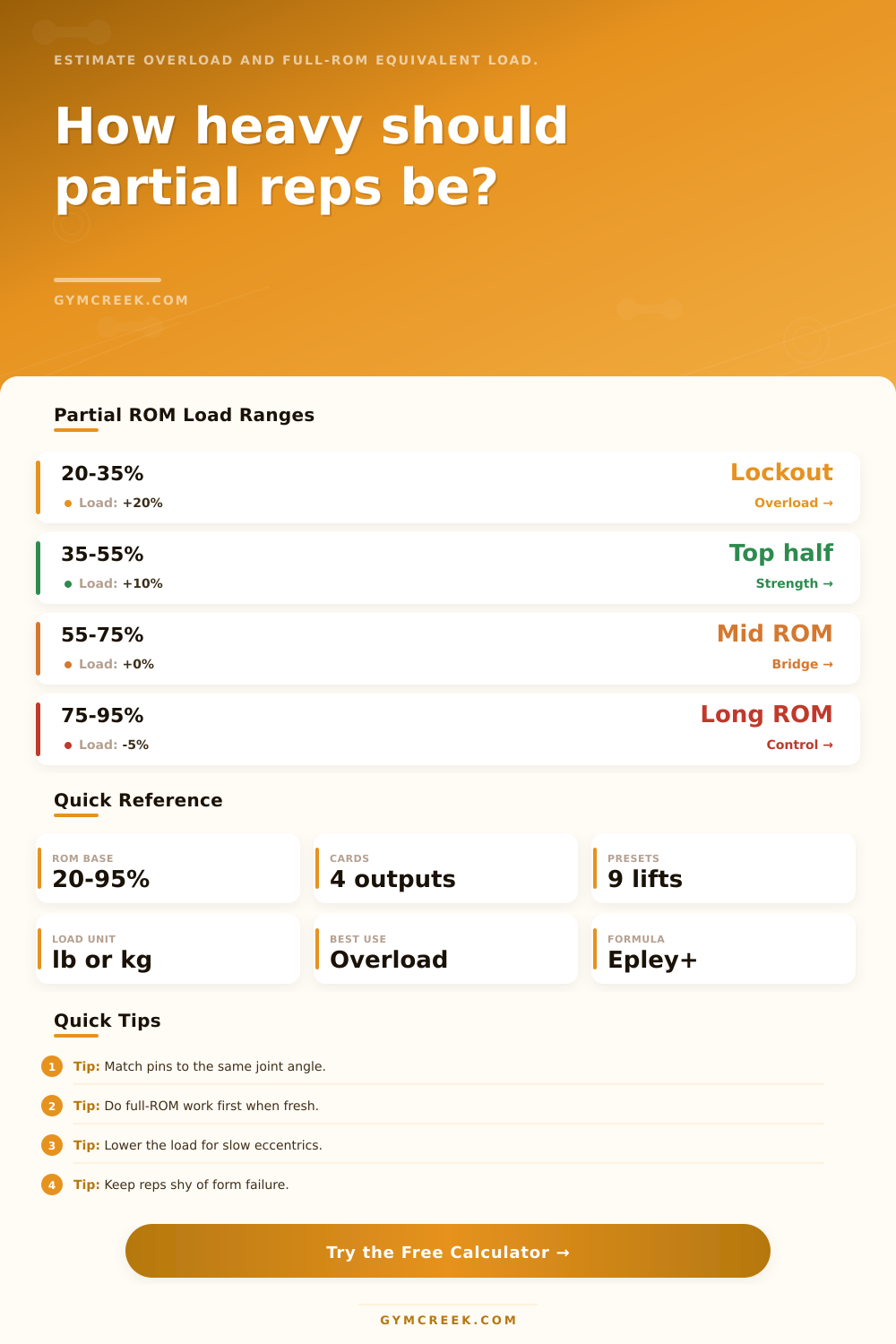
| ROM | Typical Load | Best Use | Watch Point |
|---|---|---|---|
| 20-35% | 110-130% | Lockout overload | Bracing |
| 35-55% | 100-118% | Top-half strength | Same pins |
| 55-75% | 90-108% | Bridge work | Control |
| 75-95% | 80-100% | Long partials | Fatigue |
| Segment | Multiplier | Useful For | Load Bias |
|---|---|---|---|
| Bottom | 0.92x | Start strength | Lower |
| Mid range | 1.04x | Sticking point | Neutral |
| Top half | 1.18x | Overload | Higher |
| Lockout | 1.28x | Confidence | Highest |
| Stretch | 0.88x | Tension | Lower |
| Intent | Adjustment | Rep Style | Target Feel |
|---|---|---|---|
| Strength | 1.03x | 1-6 reps | Heavy |
| Hypertrophy | 0.96x | 6-15 reps | Controlled |
| Sticking | 0.99x | 2-8 reps | Precise |
| Deload | 0.86x | 5-12 reps | Easy |
| Formula | Variables | Output | Why It Matters |
|---|---|---|---|
| Epley | Load, reps | Full 1RM | Baseline |
| ROM curve | ROM, segment | Ceiling | Partial bias |
| Equivalent | Load, reps | Full load | Stress check |
| Index | Partial, 1RM | Overload % | Risk scale |
💡Tips
“Too often the bench press get stuck on the chest. Your shoulders aren’t failing. Your triceps aren’t either. You’ve changed the mechanics against yourself. Partial rep training can help with that sticking point, provided you know why the shorter range of motion affects the lift.
Lifters tend to guess when adding weight. This causes too much joint stress and to little stimulus. Enter your starting weight, the section you want to focus on, and the calculator does the math for you. Save yourself from guessing if more weight will strengthen you…or hurt your shoulders.”
How to Use Partial Reps to Get Stronger
The whole idea revolves around leverage. Taking out the bottom of a press or squat remove the portion of the lift in which gravity acts most strongly against you. So your muscles face less mechanical disadvantage. You’re able to carry more weight at any given level of effort different than full ranges. It may feel like heavy weight, but it shouldn’t always be harder on muscle fiber and the central nervous system then moderate full reps.
The tool will tell you how much that partial load would translate into in terms of full range. If it equals what you did for maxes this week, you’re upping the intensity. If it equals the same as last week’s volume, then you’re just moving some weight for ego. That helps you identify which approach won’t burn you out.
Know when the bar begins and ends. Force production curves differs between joints. For example, squat strength is frequently deepest at the bottom position while bench press strength peak around lockout. A ten percent shift in range of motion can change the required load by a substantial margin, given how much weight varies with even small changes in movement.
The reference table details which segment require which multipliers. Sometimes moving into the middle portion of a lift will hardly alter the load while lockout work may increase by 20%. Boring yourself or breaking form occurs if you treat both set the same.
Establish your spot and stay there. Pin it, block it, or mentally cue yourself to hit the same position each week. This way, next week’s set compares to this week’s. Range consistency matters as much as load consistency.
And then use them like this: there’s a cadence here. If you’re doing strength training, which usually requires high tension and low reps, it’s mostly about tempo rather than the raw number on the bar. When you slam weight through a short arc, you lose the time under tension necessary for both neural adaptation and muscle growth. Want to manage the stress? Slow down the eccentric phase. Forcing yourself to grind out each rep to failure isn’t always best. In fact, stopping two reps shy of failure often results in better gains over a given six week block, as you can recover quicker and get back at it sooner.
You should of wanted more time under tension. Intent and reps in reserve help the calculator find this sweet spot. Does it tell you if you’re pushing a new peak or going into deload?
Here is how to use it: And again, partials are a tool, not a way of life. It’s a leak sealer for the strength chain, but doesn’t build the entire house. Still squat deep and press full to keep your joints healthy and your muscles balanced. Overload the weak point(s) with shortened ranges. Then bring that new neural efficiency home to your primary lifts.
Yes, weight will feel lighter. Because you just trained your nervous system to lift it. Hold onto that confidence when you revert to full reps… That’s where the real gains occur. Actually, training moddern styles helps too.