Paddleboarding Calorie Calculator
Estimate stand up paddleboarding calories from duration, body weight, SUP style, water type, wind and current, stroke cadence, board load, and balance demand.
📌Presets
Each preset loads a realistic SUP session and recalculates with paddle-specific modifiers.
⚙Calculator
Paddleboarding calorie snapshot
Enter session details to estimate SUP calories from MET formulas.
📊SUP Metrics
🧮Formula Cards
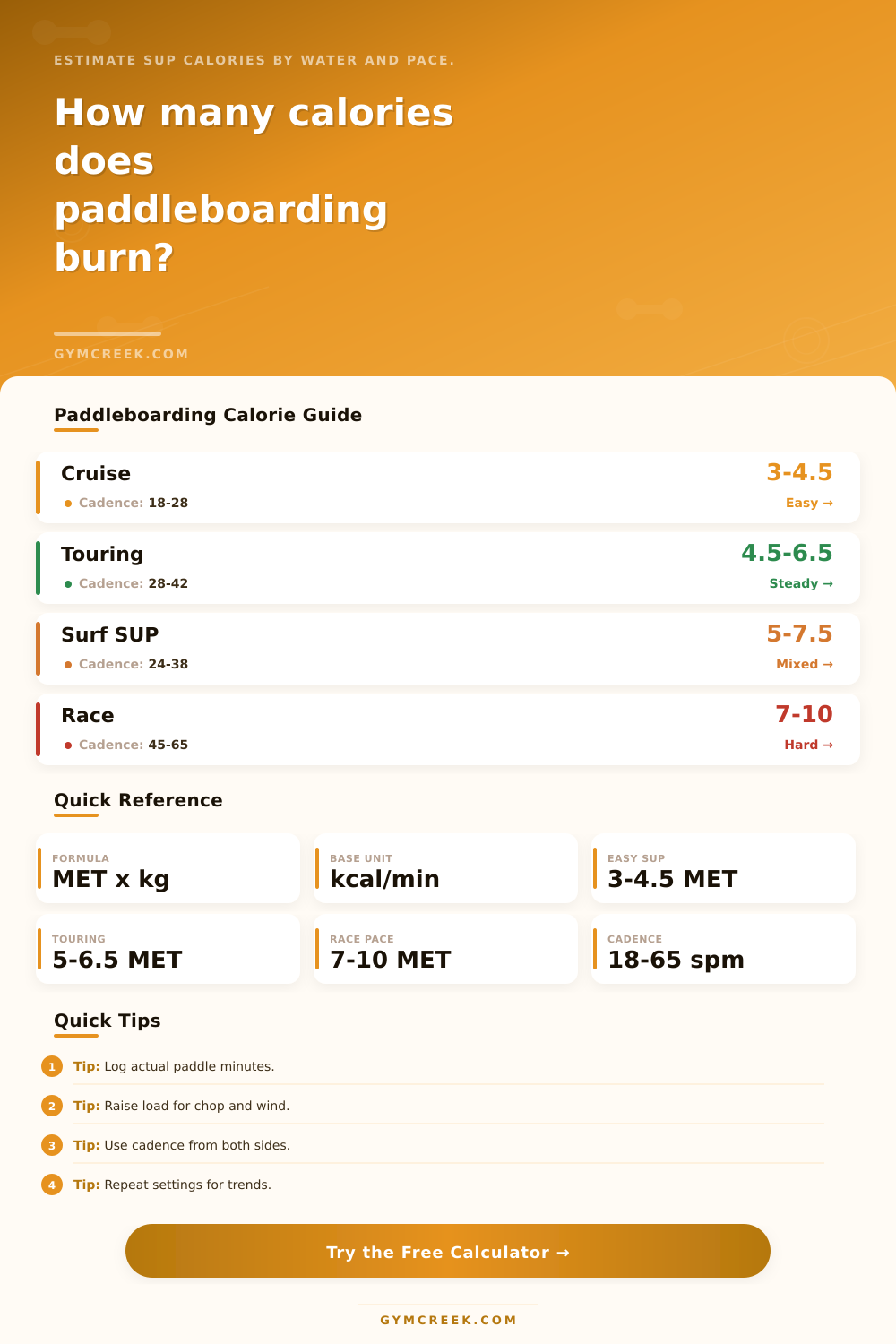
Calories per minute = adjusted MET x 3.5 x body weight in kg / 200. The calculator applies that to active paddling time.
Base SUP MET is tuned by water texture, wind or current, cadence, balance demand, board load, and paddling efficiency.
Non-paddling board time is counted separately with low activity MET so floating time does not overstate the session burn.
Mifflin-St Jeor estimates BMR from size, age, and gender, then the activity multiplier turns it into TDEE for comparison.
📑Reference Tables
| SUP Style | Base MET | Cadence Range | Typical Session |
|---|---|---|---|
| Fishing or exploring | 2.8 | 8-18 spm | Slow movement |
| Recreational cruise | 3.8 | 18-28 spm | Easy flatwater |
| Fitness paddling | 5.4 | 28-42 spm | Steady cardio |
| Distance touring | 6.1 | 32-48 spm | Endurance pace |
| Race or intervals | 8.4 | 45-65 spm | Hard training |
| SUP yoga | 2.9 | 8-16 spm | Balance class |
| Surf SUP | 6.3 | 24-38 spm | Paddles and waves |
| Loaded expedition | 6.7 | 28-44 spm | Gear on board |
| Water Type | Modifier | What It Captures | Use When |
|---|---|---|---|
| Calm lake or marina | 0.94x | Smooth glide | Protected water |
| Flatwater texture | 1.00x | Normal small ripples | Most casual SUP |
| Choppy bay | 1.11x | Bracing and wake | Short waves |
| Ocean swell | 1.16x | Rolling balance work | Open coast |
| Moving river | 1.13x | Current control | River sessions |
| Surf zone | 1.22x | Starts and remounts | Wave takeoffs |
| Wind or Current | Modifier | Calories Effect | Example |
|---|---|---|---|
| Tailwind or help | 0.91x | Lower | Downwind glide |
| Neutral breeze | 1.00x | Baseline | Light air |
| Crosswind correction | 1.08x | Higher | One-sided steering |
| Headwind upstream | 1.17x | Much higher | Return leg work |
| Gusty shifting flow | 1.24x | Highest | Stop-start control |
| Formula | Variables | Output | When Used |
|---|---|---|---|
| SUP MET kcal | MET, kg, min | Calories | Main estimate |
| Cadence factor | Strokes/min | Load | Stroke output |
| Rest kcal | 1.6 MET, kg | Drift burn | Inactive time |
| Mifflin BMR | kg, cm, age | Baseline | Daily context |
💡Tips
“Is it working out? Maybe I am burning more or less than I think.” The thing about paddle boarding is that it’s complicated. From afar, it appears easy: you’re standing on a board in calm water. Then you paddle around for an hour and feel good. But how much did you burn? The answer is unknown (and that’s okay).
Paddle boarding isn’t as simple as it seems. There are so many factors at play; your arms propel you forward while your core engage constantly to ensure you remain standing upright. A light cruise can be seen as a hard workout, and vice versa. With this new calculator, the math gets run for you, but knowing what these factors mean help you trust the number.
How To Count Calories When Paddle Boarding
The main factor here is body weight. A heavier person use more energy then a lighter person to cover the same distance traveling at the same speed. It’s basic physics. But it doesn’t stop there. The water itself play a part. On flat water, you can let that board slide without much resistance.
When water gets choppy, however, your core has to work harder to stabilize yourself against each small wave. You’re fighting for balance and trying to go forward at the same time. Even if your stroke rate remain consistent, that double demand will increase your calorie burn.
The other factor is wind direction. Paddling up-current or into a headwind make what should of be a moderate workout into a strength session. You’re pushing against the world! Your tool will adjust for your reported conditions and raise the metabolic equivalent accordingly. Drift with a tailwind and the burn will lower. Fight those gusts and it’ll climb. Few appreciate how much energy correcting steerage require. Side winds require more effort on one side to maintain straight lines. That is not straight-line paddling. You tire out quicker paddling unevenly then you do going in a straight line.
There’s also cadence. Greater intensity tend toward a higher stroke rate. Strong kickback with quick catches are what is needed when sprinting on a board. Low cadence suggests an easy cruise or efficient long-distance touring. To fine tune the estimate, the calculator requests that you enter the average number of strokes per minute. High numbers indicate racing. This means a high metabolic demand from anaerobic effort. Low numbers and high balance demand mean something different, maybe yoga-paddling.
There was a load of boards. You stand on them all day. They feel different under foot. Light hardboards react quickly. Expedition boards loaded down with drybags and gear feel heavy. It takes more oomph to turn it and get it going. That inertia has to be fought by your muscles. It’s why you can see two people burning different amounts of calories; they’re both paddling at the same pace in the same water but one glides around on a light racer while the other hauls a heavy load.
You’re presented with a total number of calories burned during that session, broken down into what was spent during active paddling, and drifting around. When you’re sitting and waiting on a buddy to catch up, you’ll be burning calories. But it won’t be at the same pace as when you were powering ahead. So the tool distinguishes those two activities, providing you with a more accurate look at how many calories you’ve expended.
They uses normal metabolic calculations, tweaked specificaly for stand-up paddleboard exercise. Consider the last time out on the water. How much did you have to battle wind? What kind of water conditions were you facing, choppy water? Did you bring a ton of extra gear? Plug it all in. You’ll be surprised at the numbers.
You may learn your lake cruise isn’t as easy as you thought with wind correction. That swell made for a harder workout then you expected on the ocean. Knowing those variables makes guessing a thing of the past. Now you can plan out your workouts, follow your progress and even recognize the hard work behind each stroke.
The water doesn’t care what you believe you’re putting out there. It just reacts to the force you apply. When you measure that force correctly, you’ll respect the effort you put in.